April 3, 2023

Healthcare marketing operates in one of the most data-rich and high-stakes environments in advertising. Amid such complexity, it can be tempting to default to familiar digital benchmarks: impressions served, clicks recorded, pages visited. But for marketers charged with moving real clinical outcomes, those numbers only tell part of the story.
Standard digital metrics are useful for gauging whether an ad is being seen and engaged with, but they don’t tell you whether you reached the right HCPs or patients, whether your message influenced a prescribing decision, or whether your campaign actually drove new prescription starts. Without that visibility, optimization becomes guesswork.
The healthcare brands seeing the strongest ROI aren’t homing in on the right metrics to track. This guide covers the full spectrum of healthcare marketing metrics: from the foundational digital KPIs every campaign should monitor, to the clinical outcome metrics that connect ad exposure to real-world results. Together, they give you the complete picture needed to optimize with confidence and prove the value of every media dollar spent.
Foundational Healthcare Marketing Metrics Every Campaign Should Track
Before you can measure what makes healthcare advertising unique, you need a firm grasp on the baseline. The following digital KPIs apply across industries, but they take on added nuance in healthcare, where audience precision and regulatory complexity shape how each metric should be interpreted. Understanding these foundational healthcare marketing metrics is the starting point for any campaign built to perform.
1. Impressions and Reach
Impressions measure the total number of times an ad is displayed. Reach refers to the number of unique individuals who saw it. Together, they answer the most basic question a campaign must address: how many people were exposed to your message?
In healthcare marketing, reach carries additional weight. Rather than being just about volume, it’s about whether you’re reaching the right audiences: verified HCPs, patients with relevant diagnoses, or caregivers involved in treatment decisions. High impression counts with low verified reach signal wasted spend, making it essential to evaluate reach quality alongside raw numbers.
Reach also anchors cost efficiency calculations. Metrics like cost-per-thousand impressions (CPM) and cost-per-verified patient (CPVP) all derive from your reach baseline, which is why getting this right from the outset matters.
2. Click-Through Rate and Engagement
Click-through rate (CTR) measures the percentage of people who saw an ad and clicked on it. It’s one of the most widely used digital marketing metrics and a useful early signal of creative relevance and message resonance.
In healthcare advertising, CTR provides a directional read on whether your messaging is compelling enough to prompt action. A consistently low CTR may indicate a need to test new creative, refine targeting, or reconsider the call to action. A high CTR, while encouraging, doesn’t necessarily translate to clinical impact, so it should always be read in context, alongside downstream metrics that reflect real behavior.
Beyond CTR, broader engagement metrics, like video completion rates, time spent on landing pages, and return visits, help build a more complete picture of how audiences are interacting with your brand across the funnel.
3. Cost Per Thousand Impressions (CPM) and Cost Efficiency
CPM measures how much you’re spending for every 1,000 ad impressions. It’s a standard benchmark for comparing media costs across channels and inventory types and a common lens for evaluating the efficiency of programmatic campaigns.
In healthcare, CPM alone can be misleading. A low CPM may look efficient on paper but deliver minimal verified reach among relevant HCPs or patients. That’s why CPM is most valuable when paired with audience-specific cost metrics, like cost per HCP or cost per verified patient, that account for the quality, not just the quantity, of impressions served.
Tracking cost efficiency alongside audience quality ensures budget is consistently allocated toward the inventory and tactics that generate the greatest return.
4. Conversion Rate
Conversion rate tracks the percentage of users who take a desired action after engaging with an ad, whether that’s submitting a form, signing up for more information, visiting a website, or downloading a resource.
In healthcare digital marketing, conversions are often soft actions rather than direct transactions. A patient clicking through to a condition education page or an HCP downloading a clinical brief both represent meaningful signals of intent. Still, digital conversions are a proxy for behavior, not a direct measure of clinical impact.
Conversion rate is most useful as a funnel efficiency metric, a way to identify which touchpoints are best at prompting engagement and moving audiences toward a treatment decision. It should inform optimization, but it shouldn’t be treated as the final word on campaign effectiveness.
5. Patient Lifetime Value (PLV/LTV)
Patient lifetime value (PLV or LTV) estimates the total revenue (or, in pharma marketing, the total number of prescriptions or adherence events) associated with a patient over the duration of their relationship with a brand or therapy.
LTV is especially relevant in chronic condition categories, where patients may remain on a medication for months or years. It encourages marketers to think beyond a single conversion and weigh the long-term value of acquiring and retaining the right patients. Campaigns designed with LTV in mind tend to prioritize audiences who are both clinically appropriate and likely to stay on therapy, a combination that produces more durable ROI.
Understanding LTV also shapes how healthcare brands should think about budget allocation: investing more to reach a high-value patient segment often delivers far better returns than optimizing purely for low-cost volume.
The Metrics That Connect Campaigns to Clinical Outcomes
Foundational digital metrics are a necessary starting point, but for healthcare brands advertising prescription drugs or specialty treatments, they’re not enough on their own. The metrics in this section go further, bridging the gap between ad exposure and real-world clinical behavior.
Unlike CTR or CPM, which measure activity within an ad platform, these healthcare marketing metrics draw on data from the healthcare system itself: prescribing patterns, HCP visit activity, and verified patient populations. They are more complex to measure, but they’re also far more meaningful. While foundational KPIs tell you how your ads are performing, clinical outcome metrics tell you whether your campaigns are actually working.
For any healthcare brand serious about optimizing toward ROI, not just engagement, these are the metrics that can’t be ignored.
1. Unique Reach
Unique reach represents the number of verified HCPs or patients exposed to the brand message during the campaign flight. In simple terms, this is the total number of verified HCPs and/or patients who were shown an ad, regardless of its format or where it was seen. Unique reach is one of the most important healthcare marketing metrics because it represents how many individuals saw the ad broken out across different campaign tactics. It also plays a crucial role in helping advertisers understand the cost-per-unique HCP as well as the cost-per-verified patient (CPVP).
In particular, unique reach speaks to the strength of DeepIntent’s identity solution. Powered by pharma’s most trusted data source, DeepIntent’s Health Advertising Platform can reach 95% of the prescribing HCP universe. DeepIntent clients have immediate access to this data within the platform. Machine learning algorithms then auto-optimize campaigns to maximize reach at the lowest possible cost throughout the duration of the flight.
These optimizations helped one leading migraine drug achieve 10% higher verified patient reach vs. the guaranteed amount while reducing CPVP by 50%.
2. Audience Quality
Audience quality (AQ) is one of the healthcare marketing metrics we reference most often. In an industry as complex as healthcare, the target market for a certain drug or treatment can be pretty specific. Defined as the number of unique relevant patients exposed to the brand message, AQ is a KPI used to ensure you are reaching the right people based on a historical medical code defined by the client.
With patented technology, Outcomes makes ours the only demand side platform (DSP) to link real-world clinical data with impression data to automatically optimize live campaigns toward AQ.
Because Outcomes uses machine learning and predictive algorithms, key campaign parameters like audience, format, inventory, and creative can be automatically adjusted in flight based on privacy-safe information about relevant patients.
For one drug, an antiviral medication used to treat symptoms of an infectious disease, Outcomes optimizations improved AQ for all campaign audiences, including third-party segments. As a result, the campaign delivered up to 865% greater AQ prevalence vs. that of the U.S. population.
3. Exposed HCP Visits
Exposed HCP visits are defined as when HCPs and patients meet in a clinical setting. You can use an HCP target list to link HCPs and patients, while also building custom Patient Modeled Audiences based on the patients who see your highest-value HCPs. Maximizing awareness leading up to clinically relevant patient visits helps ensure your brand is top of mind for HCPs as they make treatment decisions.
Coordinated HCP and patient media also prime patients with more knowledge of conditions and treatment options. When both parties have the same information, they’re able to have better, more open conversations during exposed HCP visits. These conversations lead to more trust and, ultimately, better patient outcomes.
Integrated campaigns are proven to improve script lift. One leading pharmaceutical brand and its media agency found that coordinating HCP and patient media drove 35% higher total prescriptions (TRx) filled compared to non-integrated media.
4. Script Lift
Perhaps the most direct measure of healthcare marketing ROI is script volume. With script data refreshed daily, campaigns can be optimized in flight to improve:
- NPS (new patient starts), which represents new prescription starts
- TRx, which includes refills and renewals
The patented technology that links real-world clinical data with impression data optimizes live campaigns toward script lift as well. These individual metrics can help tell a story about a campaign’s efficacy in driving scripts.
DeepIntent’s script performance algorithm helped one leading migraine medication increase script lift by 27%. The brand also saw 1,780 new prescription starts, a concrete illustration of how outcome-based optimization translates to real-world results.
How DeepIntent Helps Measure and Track What Matters Most
Having the right healthcare marketing metrics framework is only half the equation. The other half is having the technology to measure and act on them in real time, at scale, and in full compliance with healthcare privacy requirements.
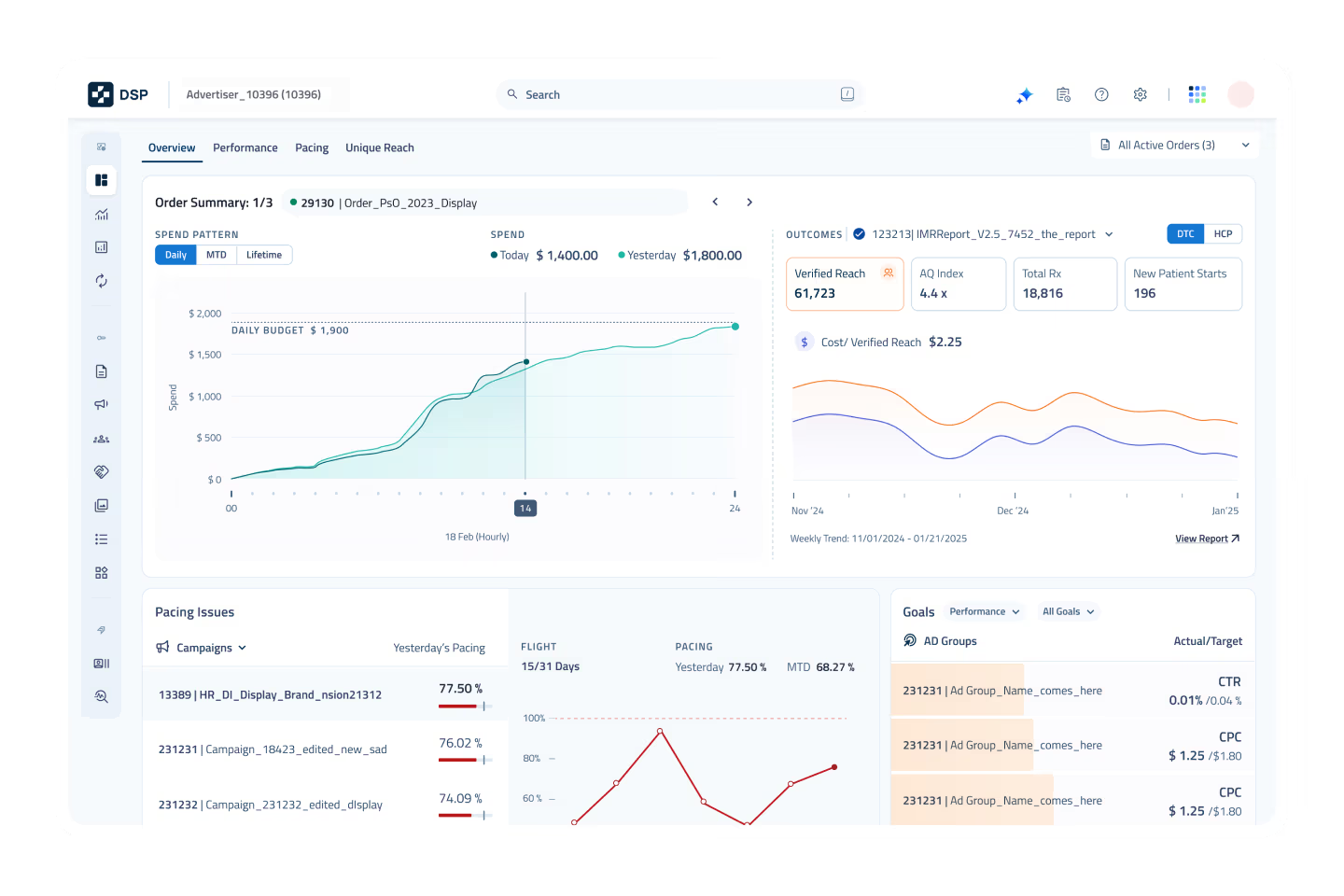
DeepIntent’s advanced platform is built specifically for this challenge. DeepIntent Outcomes™, embedded directly into the Health Advertising Platform, connects clinical data to impression data daily, giving marketers continuous visibility into verified reach, audience quality, exposed HCP visits, and script lift throughout the campaign flight. Rather than waiting until a campaign ends to understand what worked, healthcare brands can optimize in real time, adjusting targeting, creative, inventory, and budget allocation as results emerge.
This kind of outcomes-driven optimization isn’t possible with standard digital analytics tools. It requires purpose-built data infrastructure, trusted clinical data partnerships, and a platform designed from the ground up for the complexity of healthcare advertising, all of which DeepIntent provides.
The result: campaigns that reach the right people, measure what happens next, and continuously improve toward the outcomes that matter most. Healthcare marketers can finally move beyond clicks and impressions to demonstrate clear, defensible ROI, from impression served to prescription filled.
Ready to see what outcomes-driven healthcare advertising looks like in practice? Request a demo or explore DeepIntent Outcomes™ to learn more.
.png)