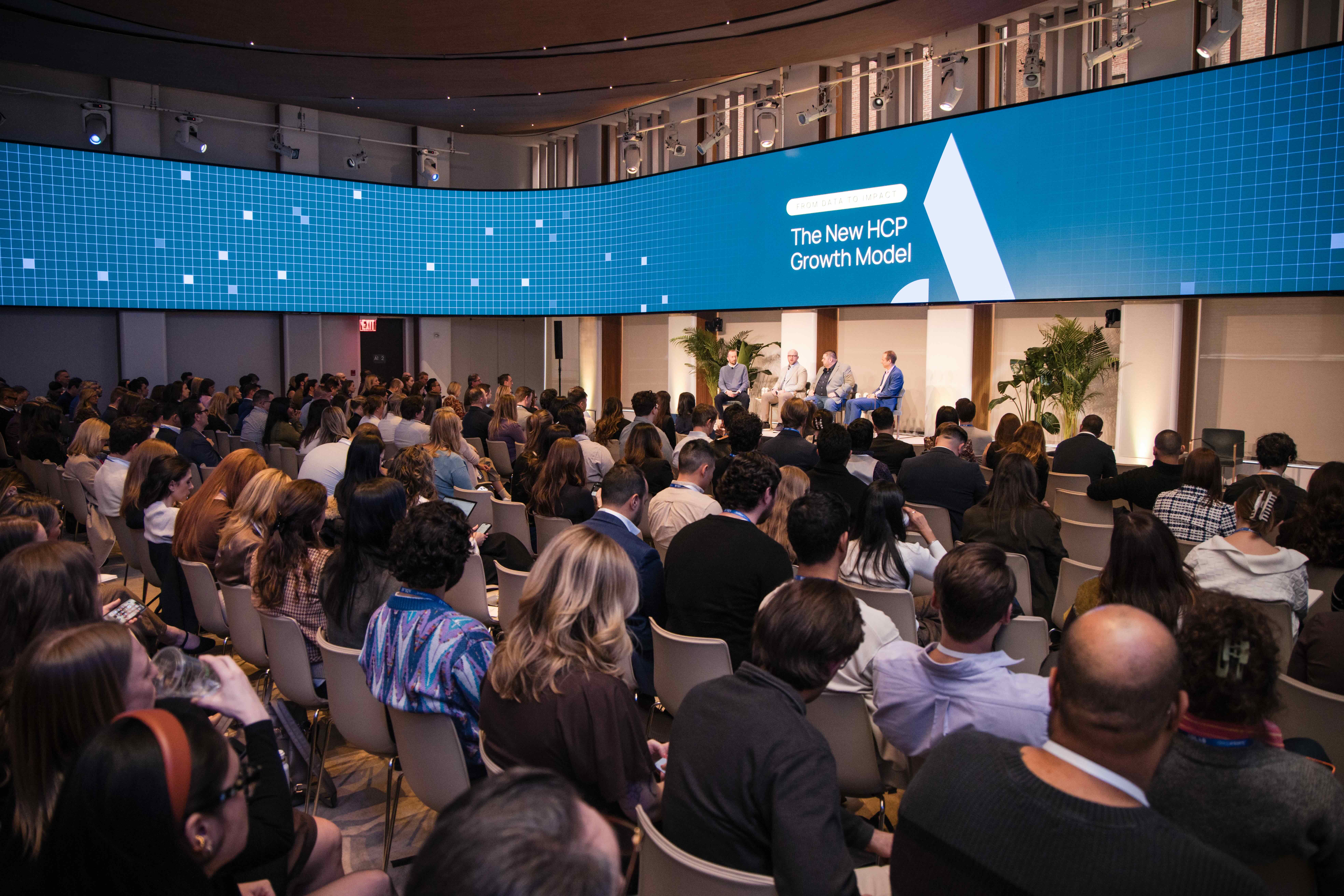
Last month, at AdLab 2026, some of healthcare marketing's sharpest minds gathered to tackle one of the industry's most pressing challenges: turning fragmented HCP data into meaningful, measurable engagement. The panel, moderated by DeepIntent SVP of Product Management Aaron Fulmer, brought together Tyler Doppelhauer, Head of Digital Data and Tokenization at IQVIA Digital; Michael Caruso, Pharmaceutical Senior Director of Commercial Media Strategy and Planning; and Eric Trepanier, Chief HCP Officer at Publicis Health Media. What followed was a candid, wide-ranging conversation about where HCP marketing stands today and where it needs to go.
Defining the Fragmentation Problem
The panel opened by asking a deceptively simple question: what does "fragmented HCP data" actually mean? The answers revealed just how multi-dimensional the challenge is.
For Doppelhauer, the issue isn't a shortage of information but connectivity within information. "It is really making that information talk to each other," he said. "Making sure that we know that our HCP is connected to our DTC, making sure we know that our behavior is informed by actual real results."
Caruso added a human dimension, pointing to the organizational silos that compound the technical ones. "There's a lot of operational silos that cause the HCP data to be fragmented," he noted, stressing the importance of cross-trained teams that share findings and act on them quickly. Trepanier agreed, saying, "The word silos comes to mind, and silos apply in a lot of different ways, whether it's the organizations, the budgets, the teams, the execution."
The Case Against Static Target Lists
One of the panel's liveliest exchanges centered on static NPI lists, a longtime staple of HCP marketing that all three panelists agreed is well past its prime.
Trepanier described working with a client whose target list was built from data over two years old: "They expect their sales teams and digital teams to have amazing results using data that we all know is stale." Caruso offered a memorable reframe: "I look at a static target list as a snapshot of the past that's extremely useful — but what we really want is more of a video of the present."
Doppelhauer made the stakes concrete, pointing out that a two-year-old list would completely miss the explosive growth of nurse practitioners and physician’s assistants in primary care. "If you're using something from two years ago," he said, "you're using something that's missing probably the biggest part of growth in primary care."
What Unified Data Actually Unlocks
Once the conversation turned to the upside of connecting data sources, the energy in the room shifted. The panelists shared inspiring examples of what becomes possible when channels, signals, and teams are brought into alignment.
Caruso spoke to the power of using each channel's best metrics to strengthen the others, for example, letting programmatic performance data inform creative decisions on social. "That cross-channel analysis and promotion is key to success with unified data streams," he said. Trepanier framed the ultimate goal in terms of relevance over volume: "The holy grail is to get to a point where we better understand that journey, giving them a message that's more likely to resonate with them. It may end up, ironically enough, being at a lower frequency—but with higher impact—because it’s more effective messaging at the right time with the right people."
Doppelhauer highlighted the value of early behavioral signals, like an HCP looking up a journal article on an unfamiliar condition, as a way to act on intent long before a prescription is ever written.
Collaboration as a Competitive Advantage
A recurring theme throughout the session was that better data means little without better collaboration between brands, agencies, and media partners.
Caruso made a pointed distinction: "We don't have vendors; we have partners." He advocated for a shared operational playbook established from the very beginning of a campaign, one that defines objectives, channel roles, success metrics, and optimization rules so teams can move without waiting for a monthly reporting call.
Doppelhauer distilled the underlying principle to a single word: "What we're all inadvertently describing is trust. We all do our best work when we trust the people that we're working with." Trepanier added that before any of that trust can be put to work, everyone needs to be building on the same foundation: "Having a robust data foundation is critical to making any of this work. And then from there, you can have a crawl, walk, run to get to that holy grail of one-on-one HCP execution."
What's Next: Predictive Audiences, AI, and Real-Time Execution
The panel closed on an optimistic note, with each panelist pointing to forces that are reshaping what's possible in HCP engagement.
Doppelhauer highlighted predictive audiences as a frontier worth watching — using the breadth of available data to identify and reach HCPs before traditional signals like prescribing patterns would ever surface them. He also pointed to the growing importance of NPs and PAs as a distinct and underserved audience.
Noting that AI is democratizing sophisticated data analysis, Caruso said, "Now we have the proper tools with AI... multiple people operating on the brand's behalf can start to converse with the data and actually get a sense of what the right journey is." Trepanier connected it all back to the Amazon-style personalization model, arguing that HCP marketers, with NPI-level data at their disposal, are uniquely positioned to get there. "We have the ability to do that today," he said, "in ways that we couldn't yesterday."
The through-line of the entire conversation was a call to stop treating data as a reporting tool and start treating it as a strategic engine. As Caruso put it in his closing thought: "Don't confuse connection for action." Having unified data is a critical first step, but the real work lies in building the processes, trust, and operational agility to act on it at speed. Our industry is ready to make this leap.
Discover more AdLab 2026 takeaways.