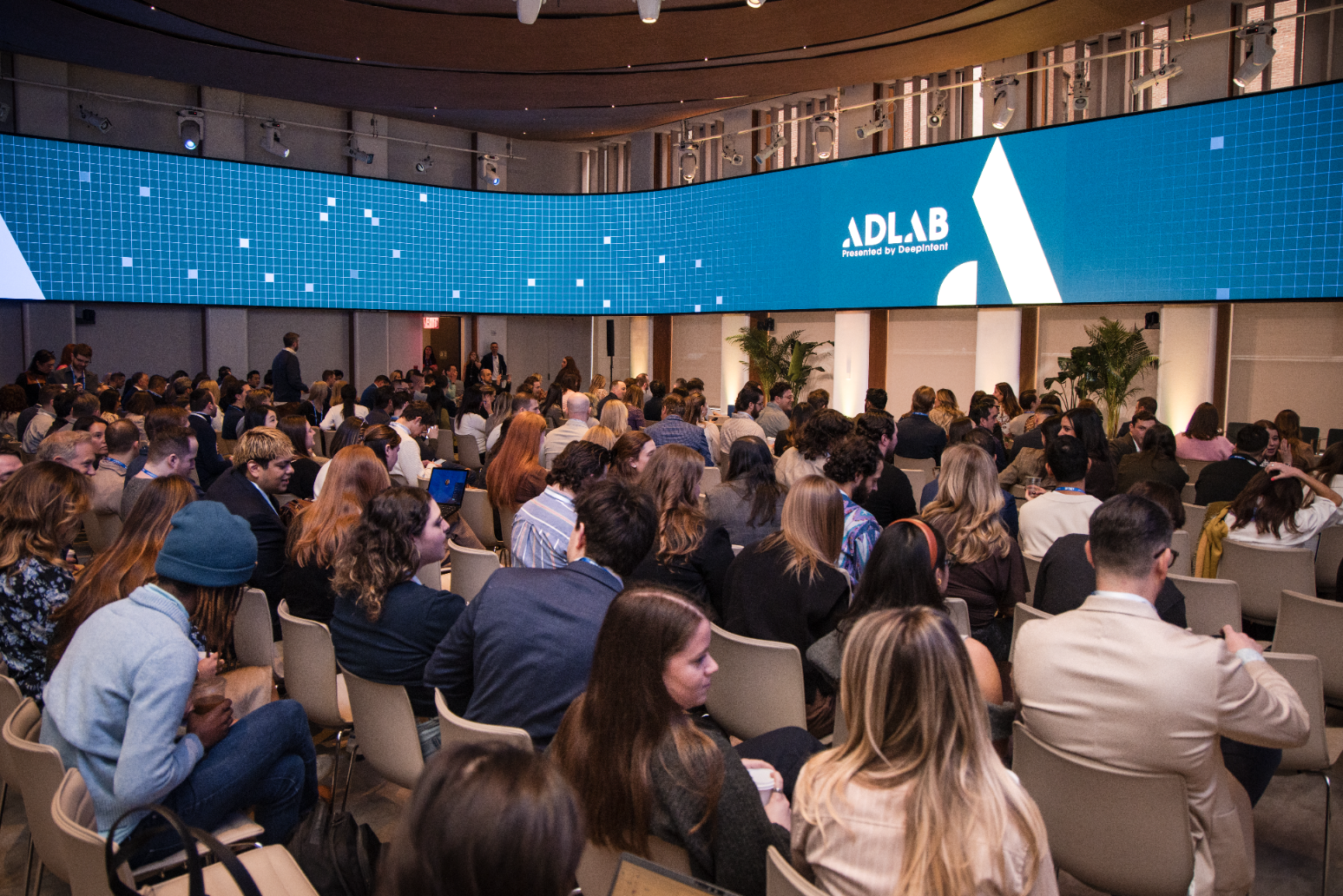
Last week, AdLab 2026 showcased an industry that’s rapidly leveling up. Across every panel of leaders, there was a clear sense of momentum: new ways to use data, sharper approaches to engagement, and a growing ability to meet patients and providers in more meaningful moments. Here are the key themes that stood out.
1. Healthcare marketing’s biggest gap is orchestration
The healthcare marketing ecosystem is richer than ever, with signals coming from every direction across HCP and DTC behavior. But too often, those signals remain disconnected, or they’re activated without an integrated strategy. The result is a missed opportunity to show up meaningfully in the moments that actually influence patient and brand outcomes.
That challenge is compounded by the sheer volume of information now available. As Dave Leitner, Eversana InTouch EVP and Head of Media, put it, “There is a tremendous amount of data at our fingertips, probably too much in some ways, where it causes analysis paralysis… sorting through that and prioritizing those touchpoints along the journey is really where we’re trying to get to.” In other words, when it comes to data, the competitive advantage is the ability to filter it, align around it, and act on it with precision. Without that discipline, more data simply creates more noise.
And that noise doesn’t just slow down marketers. It also impacts patients. In a world where individuals are more informed and more empowered than ever, there is an expectation for relevant, mindful healthcare ads. “We don’t want to inundate them too much… We want to give them enough information to feel like they have choices or control, but also ensuring that it's at those right moments that actually matter,” said Melissa Gordon-Ring, Global President of IPG Mediabrands Health.
Orchestration, then, is what ensures that every touchpoint—whether digital, in-person, or triggered by real-world behavior—works together toward the best results.
2. HCP marketing is shifting from snapshots to real-time decisioning
When it comes to HCP engagement, brands have long relied on fixed target lists built from historical data. But in a constantly changing landscape, those static approaches quickly lose relevance. IQVIA Digital Strategy Director Tyler Doppelhauer put it plainly: “If you use something from the past, you’re using the past.” The implication is hard to ignore: strategies rooted in outdated signals can’t effectively drive present or future performance.
What’s emerging instead is an approach where targeting is a living system rather than a fixed input. Healthcare media strategy and planning leader Mike Caruso captured this shift compellingly, saying, “I look at a static target list as like a snapshot of the past… what we really want is more of a video of the present.” Marketers need to see how behaviors are evolving in real time. Who is actively researching, diagnosing, or engaging with content right now? This opens the door to identifying new opportunities that would never surface in a rigid, pre-defined audience.
3. Point-of-care (POC) is evolving from a siloed channel to an integrated ecosystem
For years, POC largely operated on its own terms: planned separately, bought directly, and measured in isolation. But AdLab showed that this model is starting to give way to something more connected.
As Kate Calabrese, SVP Client Solutions, Emerging Digital Media at PatientPoint put it, “It’s breaking the mindset that point of care is this siloed, standalone channel and starting to think about how it integrates across the broader media ecosystem.” That shift is both strategic and practical. Marketers are now thinking about how POC complements other channels and how it can be informed by the same audience and data signals that power the rest of the campaign.
Programmatic activation is a big part of what’s making that shift possible. It introduces a level of flexibility that hasn’t historically been associated with POC. Campaigns can be adjusted in-flight, audiences can be expanded beyond traditional target lists, and performance can be evaluated more quickly. Publicis Health Media SVP, Programmatic Jordan Galbraith explained, “We’re not trying to replace what point of care teams are doing—we’re making it more dynamic… you can test, target new audiences, go live quickly, and optimize in ways you couldn’t before.”
4. CTV and streaming are democratizing access to premium content
For years, if you wanted in on live sports as an advertiser, you needed the kind of budget that could support broad, linear buys with little room for precision. But programmatic pipes and richer data signals have opened the door for more brands to participate.
Kristy Quagliariello, VP, Programmatic at Klick Health, outlined a smart way to begin. “You don't have to start with the Super Bowl,” she said. “You can start with March Madness. You can start with MLB. Start testing and learning and develop a framework of what's working for your clients… Be hungry and be willing to take a chance on live events.” For brands with narrower audiences or more complex messaging requirements, that flexibility is key.
While the cost of entry has changed, the appeal of these environments hasn’t diminished. Live sports and major events still command attention in a way few other formats can, and that attention carries meaning. As Cliff Covey, SVP and Group Director, Digital Activation at CMI Media Group noted, “There’s a level of credibility and trust that comes with sports… you’re associated with people’s favorite teams.” Showing up in those contexts signals relevance and legitimacy.
Taken together, these dynamics point to a more inclusive version of premium video. Brands can meet patients and providers in the moments that matter, without needing to buy their way in at the highest level from day one.
5. Context is now as important as audience
For years, healthcare marketing has been built on audience precision: identifying the right healthcare consumer or provider and delivering a tailored message. That foundation remains essential. What’s changing is the recognition that context plays an equally important role.
“Any environment where your audience is engaging becomes its own behavioral data signal,” said CMI Media Group EVP, Digital Activation Andrew Miller. “So learn from it.” What someone chooses to watch, and how they engage with it, offers meaningful clues about mindset, intent, and receptivity. Marketers who start treating media environments as signals rather than just inventory open the door to more relevant messaging.
That signal becomes even more powerful when paired with health data. Eric Speck, VP, Programmatic Partnerships at Paramount, described the new state of affairs clearly: “Instead of just slapping on an audience in a silo… now you can select an audience intentionally that has proven outcomes indexed with a publisher.” The result is advertising that feels more intentional and less disruptive.
6. Health equity is both a moral and commercial imperative
Health equity is often framed as a values-driven initiative, but this panel made it clear that it’s just as much a business issue as it is a human one. The same forces that prevent people from accessing care are the ones limiting reach and effectiveness across healthcare marketing. When large portions of the population are missing from the system, they are also missing from our strategies and, ultimately, our impact.
These barriers show up in the realities of everyday life. As Holly Dunn, Havas Media Network Managing Partner, Performance, explained, “It’s how much time you have to take out of your day, your access to care, your insurance. There are so many different things that healthcare equity impacts.” When marketers build plans around the audiences who are easiest to reach, they risk reinforcing those barriers rather than addressing them.
At the same time, the scale of the business opportunity is hard to ignore. “120 million Americans have limited access to care," said Alice Harmon, Lundbeck Director of Omnichannel Analytics and Strategy. "So from a reach perspective, that’s also just good business." Expanding access directly drives growth.
7. Agentic AI’s success depends on trust, governance, and human oversight
Agentic AI may represent the next evolution of marketing intelligence—moving from generating insights to optimizing decisions—but its success in healthcare will hinge on something far less technical: trust.
That’s why panelists emphasized that agentic AI should be viewed as an amplifier of human expertise, not a substitute for it. As Alan Ochoa, Director of Product - Marketing & Advertising Technology at GlaxoSmithKline put it, “It’s important not to take the human out of the loop… these agents are meant to help our teams, not necessarily replace them.” Rather than removing marketers from the process, agentic AI enables them to move faster and operate more strategically.
At its core, the value of agentic AI lies in its ability to make sense of complexity. As Dr. Nadia Khatri, enterprise media and pharma marketing leader, framed it, “Agentic AI is going to find information from different places and then synthesize that for you… it’s meant to help you understand your work and the data more efficiently.” By connecting disparate data sources and distilling them into actionable insights, these systems can help teams move from reactive decision-making to more proactive, predictive strategies.
Taken together, these themes point to an industry at an inflection point. With more data, channels, and technology than ever before, the opportunity is to bring them together in smarter, more intentional ways. The marketers who succeed will be the ones who can orchestrate complexity, act in real time, and build trust across every touchpoint.
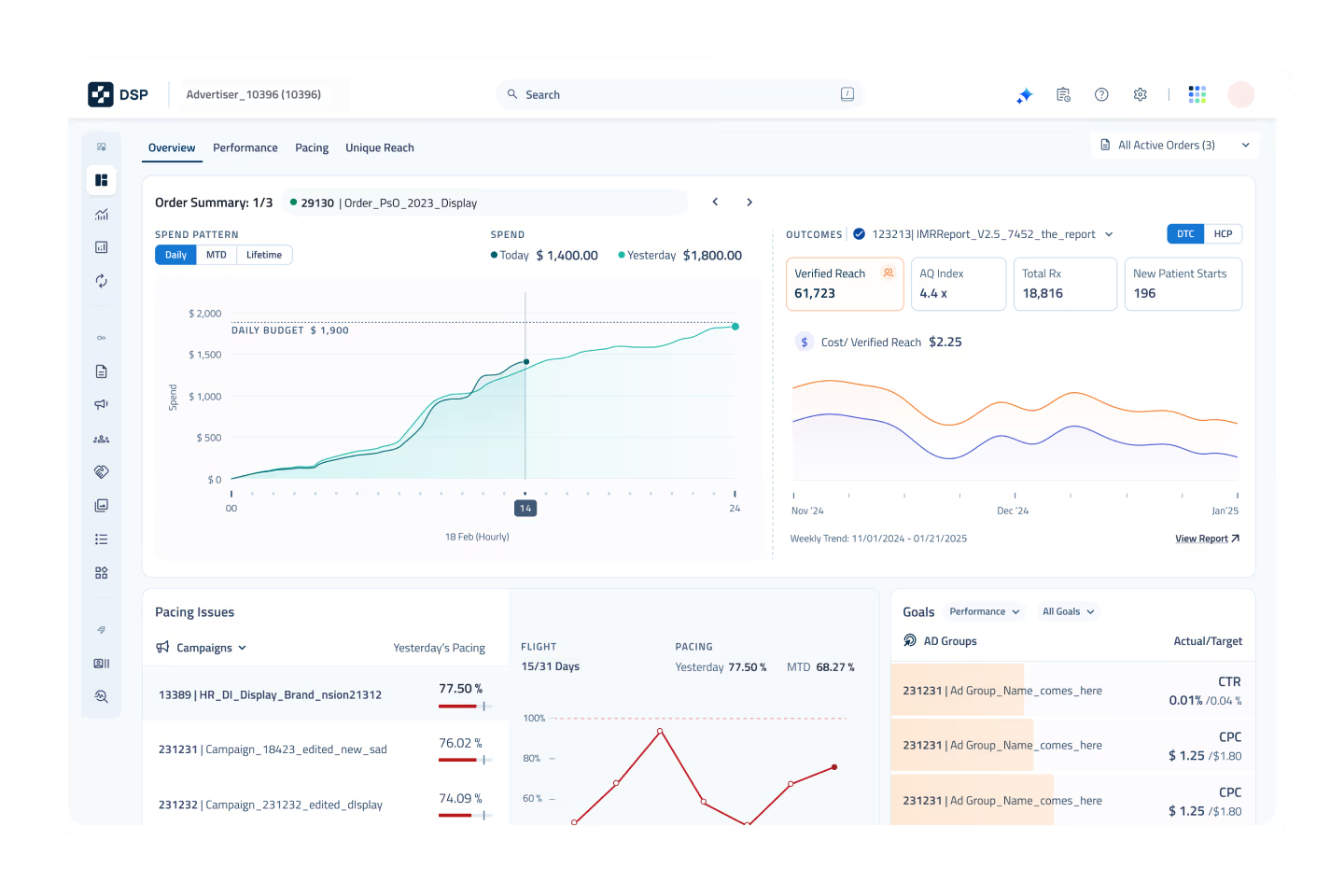
At AdLab 2026, we unveiled DeepIntent Helix™, the healthcare marketing cloud opening doors to faster innovation. Learn more about Helix here.