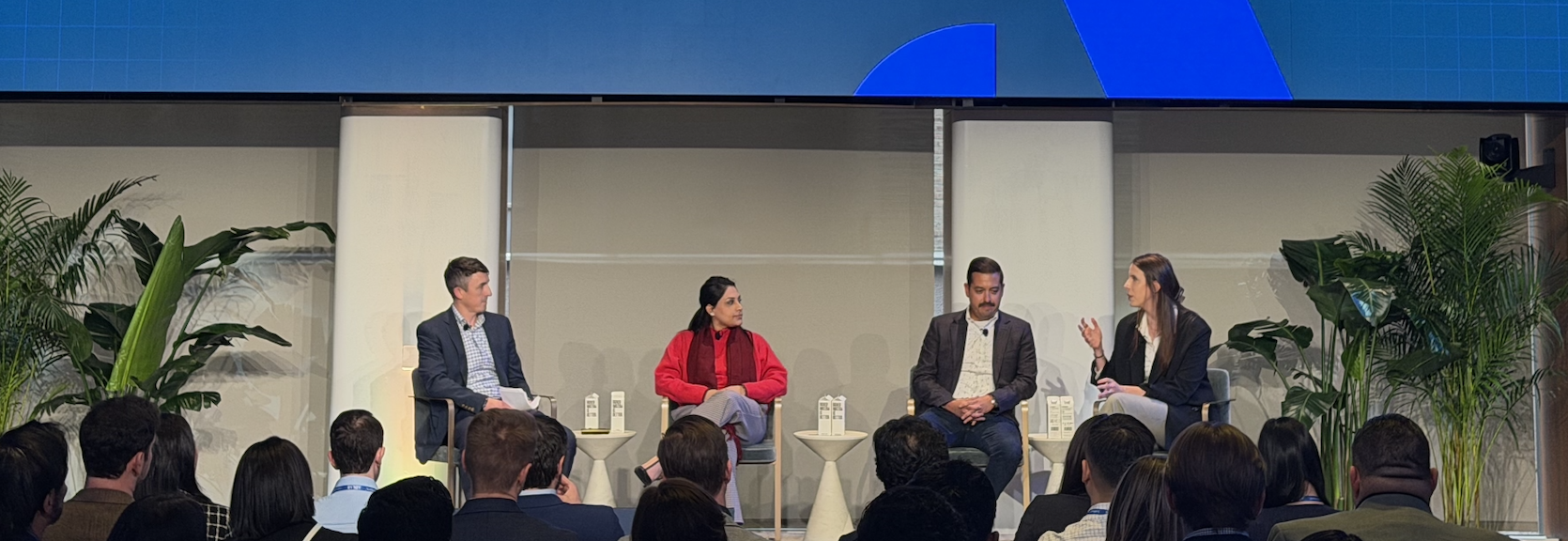
At AdLab 2026, the final panel of the day tackled one of the most consequential shifts in healthcare marketing: the rise of agentic AI. Moderated by DeepIntent General Counsel Rob Engel, the conversation featured three leaders with front-row seats to this transformation: Dr. Nadia Khatri, an emerging technology advocate in life sciences and health; Alan Ochoa, Director of Marketing and Advertising Technologies at GSK; and Meredith Carber, Omnichannel Media Lead for the vaccines portfolio at Sanofi Pharmaceuticals. What followed was a candid, wide-ranging discussion on how agentic AI is reshaping strategy, governance, data, and the patient experience.
Demystifying Agentic AI
Unlike generative AI, which produces something new from a prompt, agentic AI finds information across sources, synthesizes it, and can even take action on your behalf. For many marketers, that description still triggers anxiety, but Dr. Nadia Khatri pushed back on that instinct.
"If we really understand what AI is for, it's not that scary,” she said. “It's a tool that humans use. It's not replacing what humans do. And it's meant to help you understand your work and the data more efficiently."
She also spoke from personal experience about how she uses AI day to day: "I have used AI to vet my thinking. It’s not necessarily AI telling me what to do, but to give me, on some level, objective feedback on whether I'm thinking about all of my options. I can do it in like five minutes."
GSK’s Alan Ochoa reinforced the point, noting that keeping humans central to the process is non-negotiable: "It's important not to take the human out of the loop. A lot of the agents that we're bringing online are meant to help our teams, not necessarily replace them."
We Don't Have a Data Problem
If there was a single theme that united the panel, it was this: the industry has more data than it knows what to do with. The challenge is no longer collecting it but making sense of it.
"I don't think we have a data problem anymore. I think we have a decision problem," said Sanofi’s Meredith Carber. "It's how do we leverage AI to take that data, put it into clear action so that we can go from reactive optimizations to predictive optimizations."
Ochoa echoed that framing from the infrastructure side: "That era of 'what data do I have' is over. We're all drowning in data. It's going to be more about how do I more safely and effectively use this data in a complex ecosystem and maintain that trust."
His prescription: before any agent is activated, the foundational work has to be done. "When you take into account things like consent, identity resolution…those are all things you have to align as foundational pieces before you start turning these agents on. Because if not, it's just going to lead to confusion faster."
Playing Where the LLMs Play
Carber brought one of the panel's most tactical and forward-looking perspectives, centered on how the rise of large language models is fundamentally changing how marketers should think about content, search, and measurement.
She argued that the traditional website-as-destination model is giving way to something new: "Looking at websites not as the final destination, but as the infrastructure — how do we use that as the infrastructure that's powering all of these online tools and AI engines that our patients and HCPs are turning to for information?"
Fixing the 15-Minute Exam Room Problem
Carber put a human face on what's at stake. The goal of all this technology, she argued, is a better-informed patient walking into a better-quality conversation with their doctor.
"These doctors have 15 minutes with their patients. These patients are coming in so empowered because they've talked to ChatGPT about all their symptoms and it's the wrong information. The 15 minutes that they're spending with their physician is just the physician getting them out of that rabbit hole. And that's a huge miss."
That problem is solvable but only if healthcare marketers can deliver the right information, in the right format, at the right moment in the patient journey. That’s precisely what agentic AI, at its best, makes possible.
The North Star: N of One
When the panel turned to the future, each panelist described a version of the same vision: an end to one-size-fits-all messaging and the beginning of truly individualized engagement.
"N of one is the ideal,” said Khatri. “Always. Everybody's journey is unique. Eventually, ideally, we really speak to that person and provide them with the information that they're looking for. That's our job. That's the goal."
Looking Ahead
Khatri noted that the industry has moved well past the question of whether to adopt agentic AI: "We're kind of beyond the piloting phase right now. We're all very comfortable with what AI means and what it could do. We're now trying to prove it out." The next phase, she said, is about pruning what isn't working, doubling down on what is, and doing it all with the right foundations in place.
As closing advice, Ochoa offered, "Build really strong foundations that allow you to scale and move quicker in the future. And then, how do you drive adoption inside the company? We've all seen tools that have been built and spent a lot of time and money on, but they don't actually get adopted because they're not meeting people's needs."
Robert Engel captured a throughline of the entire conversation in his closing remarks: "A lot of people see the governance and complexity of healthcare as being a headwind. It can really be a tailwind if you know how to navigate that area." To that end, the goal is AI that is strategically clear, operationally realistic, trustworthy, and genuinely useful.
For healthcare marketers, that’s the work in front of us right now.