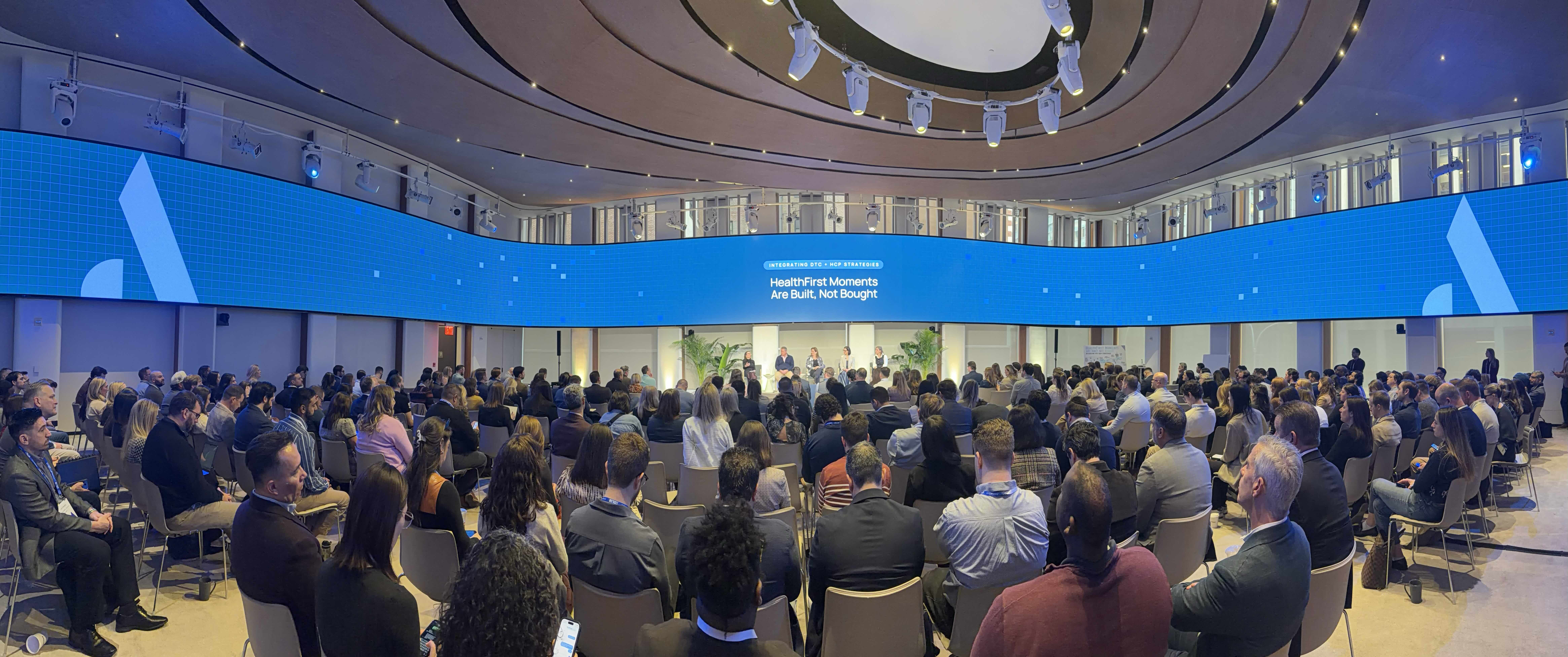
At the opening panel of AdLab 2026, “HealthFirst Moments Are Built, Not Bought: Integrating HCP and DTC Strategies,” leaders from across the healthcare marketing ecosystem came together to tackle a challenge everyone in the room recognized: despite unprecedented access to data, tools, and channels, the industry struggles to bring it all together.
Sarah Caldwell, General Manager, Crossix; Melissa Gordon-Ring, Global President, Omnicom Media Health; Dave Leitner, EVP, Head of Media, Eversana InTouch; and Kristen Tappan, EVP, Client Leader, CMI Media Group, joined moderator Natalie Mancuso, SVP, Data Partnerships at DeepIntent. They began by acknowledging that despite commitments to omnichannel, precision, and personalization, fragmentation persists, especially between HCP and DTC efforts.
The conversation that followed made one thing clear: the current phase of innovation in healthcare marketing is about thoughtfully orchestrating the vast array of signals available to us to maximize outcomes.
More Isn’t Always Better
Healthcare marketers today are operating in a data-rich environment that would have been unimaginable a decade ago. But with that abundance comes the new challenge of deciding which data actually matters.
Kristen Tappan reinforced this idea, urging marketers to focus less on quantity and more on meaning. “It’s not the breadth of data necessarily so much as the depth,” she said. “Understanding what is that one core objective… has been really powerful.”
The issue is prioritization. Teams are inundated with signals from claims, media exposure, behavioral data, and more. Without a clear framework to filter and act on that information, even the most sophisticated datasets can stall decision-making. The challenge is compounded by the fact that much of this data lives in separate HCP and DTC ecosystems, often owned by different teams with different objectives.
David Leitner captured this tension directly, saying, “There is a tremendous amount of data at our fingertips—probably too much in some ways, where it causes analysis paralysis… sorting through that and prioritizing those touchpoints along the journey is really where we’re trying to get to.”
Winning the Right Moments
If data overload is one side of the problem, over-communication is the other. Melissa Gordon-Ring emphasized that more touchpoints don’t automatically translate to better engagement—especially in healthcare, where consumer journeys are complex. “We want to give them enough information to feel like they have choices or control, but also ensure that it’s at those right moments that actually matter,” she explained, adding a cautionary note that resonated across the panel: “Are we hitting people over the head? We never want to do that.”
This shift, from maximizing reach to maximizing relevance, reflects a broader evolution in how marketers think about engagement. The goal to be present when it counts. Increasingly, delivering on those moments requires coordination between HCP and DTC engagement. A healthcare consumer may first encounter messaging through consumer channels, but it’s the alignment with provider engagement that drives action.
Tappan pointed to the growing role of trigger-based marketing as a path forward: “We’re going to wait to get a lab data trigger and then be top of mind in that moment… I feel like we’re going to start seeing that become the norm.”
Together, these perspectives point to a future where timing and integration among HCP and DTC campaigns define effectiveness.
Breaking Down Silos: The Missing Link in Omnichannel
While omnichannel remains a buzzword, the panelists were candid about the reality that organizational silos—especially between HCP and DTC teams—stand in the way of integration. Sarah Caldwell highlighted how fragmentation shows up in practice, from disconnected targeting strategies to misaligned measurement approaches. “We are seeing more and more acknowledgement that these activities need to be more synchronized and more connected.”
She added that the payoff for getting orchestration right is well documented. “A rep call followed up within 10 days by digital engagement is 30% more likely to result in a script,” she shared. On top of that, “When [audiences] are exposed… through multiple channels, we see that they’re 2.7 times more likely to result in a new script.”
Leitner reinforced the danger of disconnected strategies, saying, “If you’re only dealing with one side of the data… you’re digging in the wrong place.”
The message was consistent: true omnichannel necessitates connecting your channels and campaigns, not just running them alongside one another.
Alignment Starts with Clarity
Even with the right data and channels in place, execution can fall apart without alignment. Multiple panelists emphasized that clarity—of goals, strategy, and measurement—is foundational to orchestration.
Gordon-Ring distilled it as follows: “Clear is kind. The clearer you are with what you want to achieve… the simpler it is for everyone to understand and be singing from that same songbook.” She also pointed to the friction that arises when teams aren’t aligned: “If your goals are different from someone else’s… it’s that disconnect that adds friction in the system.”
Caldwell echoed this from a measurement perspective: “It’s really critical to have… a standard measurement framework… and make sure you’re tailoring the data to what the actual strategy is.”
The Rise of the Empowered Patient
Looking ahead, the panel turned to one of the most significant shifts reshaping healthcare marketing: if you’re guessing “AI,” you would be correct. The AI focus of this panel was specifically about how it’s fueling unprecedented patient empowerment.
Tappan described how this is changing the dynamic between patients and providers. “We’re moving to a place where the patient is an expert on themselves,” she said. “You can go into these conversations more empowered than we were before.”
Gordon-Ring reinforced the magnitude of this shift. “Patients have never been more powerful,” she said, while noting that this power means greater responsibility for marketers and platforms. “We have to… harness the power of AI for good… so it continues to stay in a place of advocacy and being helpful versus harmful.”
Leitner added a forward-looking perspective on how innovation will reshape the landscape, saying, “The old playbooks are basically obsolete… what’s about to come is literally for us to write.”
From Fragmentation to Orchestration
Today, healthcare marketing’s capabilities are greater than ever. But there are gaps in coordination. What marketers need is a smarter way to orchestrate data, channels, and tools, across teams, touchpoints, and the healthcare consumer journey.
Orchestration is what turns data into impact. And as this panel made clear, finding the best partners to bridge that gap is the key to designing integrated, measurable, and impactful marketing campaigns.
Check out some more key takeaways from AdLab 2026 here.