Pharmaceutical marketing is the strategic discipline of communicating the clinical value, risks, and benefits of prescription and over-the-counter therapies to the people who prescribe, recommend, or use them. This guide covers everything pharma marketers need to know, from audience strategy and channel selection to verified data, regulatory compliance, and outcomes-based measurement.
The Reality of Modern Pharmaceutical Marketing
Pharmaceutical marketing has never been simple. But the gap between what it demands today and what the old playbook was designed to handle has grown into a chasm.
The stakes are uniquely high. A misaligned campaign can reach the wrong prescribers, miss the patients who need a therapy most, or run afoul of FDA, HIPAA, or NAI compliance requirements. In few other industries does a targeting error carry that kind of consequence.
At the same time, the complexity has multiplied. Pharma marketers now operate across dozens of channels, manage dual audiences with different motivations and regulatory considerations, and are expected to prove outcomes. The rise of streaming, connected TV, EHR advertising, and programmatic has expanded the toolkit dramatically while also raising the bar for precision.
The result is an industry in genuine transformation. Brands that cling to the old model (heavy on sales rep detailing and journal ads, light on data and measurement) are losing ground to those that have rebuilt their strategies around verified audiences, clinical data, and purpose-built technology. This guide maps out what that modern approach looks like and how to execute it.
The Two Core Audiences: HCP and DTC
Every pharmaceutical marketing campaign operates in one of two lanes, or both. Getting this distinction right from the start shapes everything that follows: the channels you select, the data you need, the creative you develop, and the compliance framework you apply.
Marketing to Healthcare Professionals
HCP marketing targets the licensed clinicians, including physicians, nurse practitioners, physician assistants, pharmacists, and other prescribers, who make treatment decisions on behalf of their patients. The goal is to reach the right providers with accurate, clinically relevant information about a therapy's mechanism, efficacy data, indication, dosing, and risk profile.
But HCP outreach necessitates identifying the specific prescribers most relevant to a given brand, those who treat the right patient population. That precision is what separates effective HCP marketing from wasted spend.
Verification matters enormously here. Targeting against unverified or demographically inferred HCP audiences introduces significant waste and compliance risk. The most effective HCP campaigns are built on verified, deterministic data that confirms prescriber identity, specialty, NPI number, and prescribing behavior.
Direct-to-Consumer Marketing
DTC marketing speaks directly to patients, caregivers, and health-engaged consumers. Its goal is to build disease awareness, encourage patients to seek care, and support adherence and treatment continuation once a therapy has been started. Where HCP marketing influences the prescriber, DTC marketing activates the patient side of the equation.
Effective DTC campaigns reach people who are actually living with the condition a brand treat, as opposed to just broad demographic proxies. That means building patient audiences from real-world clinical signals like diagnosis codes, healthcare claims data, condition-related engagement, and patient journey indicators. A patient audience built on these foundations is meaningfully different from a general lifestyle audience that happens to share some demographic characteristics.
DTC campaigns also carry unique regulatory requirements, particularly around fair balance, which refers to the obligation to communicate a therapy's risks and side effects alongside its benefits. This shapes creative format decisions in important ways, particularly around video and audio, which allow time for required disclosures in a way that static display does not.
The Integrated Approach (HCP + DTC)
The most effective pharmaceutical campaigns treat HCP and DTC not as parallel programs that happen to share a brand name but as two parts of one coordinated strategy. Aligned messaging creates momentum from both directions simultaneously.
When a patient sees a brand message and asks their doctor about it, and that doctor has already been reached with clinical information about the same therapy, the conversation changes. The patient is asking about something their prescriber already knows. That alignment accelerates prescriptions, supports faster patient starts, and drives adherence, outcomes that neither channel achieves at the same scale when operating in isolation.
For brands chasing real commercial outcomes, the integrated HCP-plus-DTC approach is the standard that modern pharmaceutical marketing is measured against.
The Pharmaceutical Marketing Channel Mix
The channels available to pharma marketers today look very little like they did a decade ago. The mix has expanded significantly, and the weight of the portfolio has shifted. Digital has moved from a supplementary tactic to the primary engine of most modern campaigns, while traditional channels have evolved into supporting roles that digital can now complement, reinforce, or in some cases replace.
Understanding the full channel landscape is essential before making any activation decisions. The right channel for a given campaign depends on the audience, the message, the campaign stage, and the outcomes you are trying to drive. Exploring your full options, including DeepIntent's channel solutions, is the first step toward building a channel mix with strategic intent rather than habit.
Traditional Channels
For decades, pharmaceutical marketing was built primarily on personal promotion and print. Sales representatives and medical science liaisons carried brand messages directly to providers through in-office detailing visits, drug samples, and peer-to-peer medical education programs. Print channels, including clinical journals, conference materials, and point-of-sale displays in pharmacy, rounded out the mix.
These channels have not disappeared. In-person detailing remains valuable for complex clinical conversations, particularly around newly launched therapies or highly technical indications. Conferences and medical education programs continue to drive meaningful HCP engagement at specific moments in the clinical calendar. Samples remain one of the most direct trial-driving tools in a brand's arsenal.
But traditional channels have real limitations: they are expensive to scale, difficult to measure with precision, and increasingly insufficient as standalone strategies in a media environment where HCPs and patients spend a growing portion of their time in digital spaces. Digital has reshaped the role traditional channels play within a broader strategy.
Digital Channels
Digital has become the dominant force reshaping how pharma brands reach and engage their audiences. It represents a fundamental change in what is possible: precision targeting against verified audiences, real-time campaign optimization, outcome measurement tied to actual prescribing behavior, and access to healthcare-exclusive inventory that traditional channels cannot offer.
Digital channels enable pharma marketers to reach the right HCPs based on verified specialty and prescribing history, find patient audiences built from real-world clinical data, and measure the downstream impact of media exposure on script lift and patient starts. That combination of precision and measurability is what has made digital the center of gravity in modern pharmaceutical marketing.
Key Marketing Channels Driving Real Impact in the Pharma Industry
Channel selection is a strategic decision, not a default. Each channel has a distinct role to play depending on who you are trying to reach, what you are trying to communicate, and where in the patient and prescriber journey you need to show up. The six channels below represent the core digital toolkit for modern pharmaceutical marketing campaigns.

Programmatic Display and Native Advertising at Scale
Programmatic display and native advertising remain foundational to most pharma media plans, but their value is only as strong as the audience data powering them. When campaigns run against verified HCP audiences built from NPI-level prescriber data, or patient audiences derived from real-world clinical signals, programmatic display becomes a precision instrument rather than a blunt reach play.
Endemic placements (running on medical education sites, clinical reference platforms, and healthcare publisher environments) give pharma brands a contextual signal that non-endemic placements cannot match. But non-endemic environments matter, too: HCPs and patients do not live exclusively on health-focused sites. Reaching them across the broader web, with verified audience data as the targeting layer, extends campaign reach without sacrificing precision.
Native advertising integrates brand messages into content feeds in a format that feels native to the editorial environment. This is particularly effective for disease awareness messaging and patient education content where the goal is engagement rather than a direct response.
Connected TV (CTV) for the Streaming Landscape
CTV has become one of the fastest-growing channels in pharmaceutical marketing, and for good reason. It combines the storytelling power and brand-building impact of traditional television with the targeting precision and measurement capability of digital, a combination that television advertising alone has never been able to offer.
For DTC campaigns in particular, CTV enables pharma brands to reach verified patient audiences on the streaming platforms where they spend a growing share of their screen time. Rather than buying broad demographic dayparts, brands can target based on actual health signals, including condition-related claims data, patient journey indicators, and household-level audience profiles, and deliver full-length video creative that accommodates required fair balance disclosures.
As linear TV viewership continues to decline and streaming audiences grow, CTV has moved from an experimental tactic to a core channel for pharma brands with DTC objectives.
EHR Advertising Where Prescribing Decisions Happen
Electronic health record advertising is one of the most strategically distinctive channels in pharmaceutical marketing. It places brand messages directly inside the clinical workflow, the software environment where physicians, nurse practitioners, and other providers are actively making treatment decisions, writing prescriptions, and reviewing patient records.
The targeting precision EHR advertising enables is unmatched: you are reaching a verified, credentialed prescriber at the exact moment they are thinking about a patient who may fit your brand's indicated population. That contextual relevance is difficult to replicate in any other channel.
EHR placements are not available through generalist ad platforms. They require partnerships with clinical data networks and healthcare-specific technology infrastructure , which is part of what makes access to this channel a meaningful differentiator for healthcare-specialized marketing platforms.
Digital Out-of-Home and Point-of-Care Reach
Digital out-of-home advertising in healthcare contexts, like waiting rooms, pharmacies, infusion centers, and other point-of-care environments, reaches patients and caregivers at moments of heightened health engagement. These are people who are already in a healthcare mindset: waiting for an appointment, filling a prescription, or managing an ongoing treatment. Their receptivity to relevant health messaging in these environments is meaningfully higher than in general-purpose media contexts.
DOOH placements can be coordinated with digital channel activity to create sequential messaging experiences, for example, introducing a brand concept through CTV at home and then reinforcing it with a reminder message in a pharmacy waiting room. That kind of connected touchpoint strategy is what transforms isolated channel activations into cohesive patient journeys.
Video Advertising Across Every Screen
Online video, spanning pre-roll, mid-roll, and outstream formats across desktop, mobile, and connected devices, is a particularly well-suited format for pharmaceutical advertising. The reason is straightforward: video gives creative teams the time they need to communicate a therapy's benefits while also fulfilling fair balance obligations. A 30- or 60-second video unit can carry required risk disclosures in a way that a standard display banner simply cannot.
Video works for both HCP and DTC objectives. For HCPs, longer-form clinical video content can communicate mechanism of action, trial data, and clinical differentiation in a format that mirrors how medical education content is consumed. For DTC audiences, video delivers the emotional and narrative storytelling that drives disease awareness, brand recognition, and patient action.
Audio Advertising for the Untapped Listening Audience
Streaming audio and podcast advertising reach audiences during moments when no other channel can compete for attention, like commuting, exercising, doing household tasks, or relaxing without a screen in view. For both HCPs and patients, audio represents an underutilized opportunity to deliver brand messages in an uncluttered environment.
The precision possible with health audience data transforms audio from a broad-reach tactic into a targeted channel. Rather than buying generic demographic segments on streaming platforms, pharma brands can activate health-specific audience profiles, including condition-related patient signals for DTC and verified specialty and NPI data for HCP, and deliver audio messages that are relevant to who is actually listening. The result is a channel that combines the intimacy of audio with the targeting rigor of digital.
The Crucial Role of Verified Data in Pharma Marketing
Data quality is what separates a high-performing pharmaceutical marketing campaign from a wasteful one. In a space where reaching the wrong audience carries regulatory, financial, and clinical consequences, the accuracy and verification of your data is the foundation everything else is built on.
Verified HCP data means targeting prescribers whose identity, credentials, specialty, and NPI number have been confirmed through deterministic sources, rather than inferred from browsing behavior or demographic proxies. Reaching a physician audience built on verified data means you are actually talking to physicians, not to a population that happens to over-index on health-related content consumption.
Real-world clinical data drawn from electronic health records, prescription claims, and diagnosis codes gives pharma marketers a view into actual prescribing patterns, patient population characteristics, and treatment pathways. This data enables smarter audience construction, more precise channel targeting, and measurement that connects media exposure to downstream clinical behavior.
Patient audience data built from real-world clinical signals enables DTC campaigns to reach people who are actually living with the condition a brand addresses. The difference between a patient audience built from condition-coded claims data versus a demographic proxy audience is the difference between reaching the right patients and wasting budget on people who are unlikely to ever fill a prescription.
In pharmaceutical marketing, "verified" is an important standard. Campaigns that meet that standard outperform those that do not, and they do so with far less waste.
The Blueprint for an Effective Pharma Marketing Strategy
An effective pharmaceutical marketing strategy is built from a deliberate sequence of decisions, each one informed by the decision before it. The blueprint below maps that sequence.
Start With Audience Intelligence
Define your HCP and patient populations with clinical precision before any other decision is made.
Select Channels With Purpose
Choose channels based on where your audience actually engages, not habit or convenience.
Build Around Compliance
Embed FDA, HIPAA, and NAI standards into your strategy from day one, not as a final review step.
Ground in Clinical Data
Use real-world prescribing data, diagnosis codes, and patient journeys to drive targeting and messaging.
Define Success Upfront
Agree on KPIs, like script lift, patient starts, and/or verified reach, before the campaign launches.
Optimize for Outcomes
Measure and optimize against real-world health outcomes, not just media delivery metrics.
Start With Audience Intelligence
Audience definition is the first and most consequential decision in any pharmaceutical marketing strategy. Everything that follows (including channel selection, creative development, budget allocation, and measurement planning) is shaped by who you are trying to reach and how precisely you can define them.
Effective audience intelligence in pharma starts with clinical data: which HCPs are writing scripts in your brand's indication, which patient populations carry the relevant diagnosis, and where in the patient journey your brand's therapy is most relevant. These questions require real-world clinical signals.
The precision of your audience definition changes every decision that follows. A campaign built on a clearly defined, clinically grounded audience is a campaign that can be targeted with purpose, measured against meaningful outcomes, and optimized toward real results.
Select Channels With Purpose
Channel selection driven by habit (you know, running display and email because you ran display and email last year) is one of the most common sources of waste in pharmaceutical marketing. The right channels for a campaign are those where your specific audience actually engages.
For HCP campaigns, channel selection should follow the clinical workflow: where do your target prescribers consume medical information, interact with clinical tools, and make treatment decisions? For DTC campaigns, the question is where your patient population spends time across screens, formats, and environments. The answers differ significantly by specialty, condition, age group, and media consumption behavior. Clinical and media data can help answer them before budget is committed.
Build Around Compliance From the Start
Compliance in pharmaceutical marketing is not a final review step. It is a design constraint that should shape strategy from the earliest planning decisions. Embedding regulatory review, data privacy standards, and fair balance requirements into campaign development from day one is dramatically less costly in time, resources, and risk than retrofitting a campaign that was built without these considerations.
This means working with agencies and technology partners who understand pharma's regulatory environment, building audience targeting workflows that are HIPAA-compliant by design, and establishing creative review processes that can move quickly without sacrificing regulatory rigor. Brands that treat compliance as a strategic competency rather than a legal burden move faster and run cleaner campaigns.
Ground Your Strategy in Clinical Data
Clinical data transforms a pharmaceutical marketing strategy from a set of assumptions into an intelligence-driven plan. Real-world prescribing data tells you which HCPs are actively treating patients in your brand's indication and how their prescribing patterns compare to competitors. Diagnosis codes and patient claims data tell you the actual size and characteristics of the patient population your brand addresses. Patient journey data shows you where patients drop off, delay treatment, or switch therapies, and thus where brand communications can intervene most effectively.
When clinical data is integrated across audience targeting, channel selection, and messaging strategy, the result is a campaign that reflects how healthcare actually works. That grounding in reality is what separates campaigns that drive meaningful outcomes from those that drive impressive media metrics without downstream commercial impact.
Define Success Before the Campaign Launches
Measurement planning must happen before activation, not after the campaign has run and someone needs to figure out what it achieved. The KPIs for a pharmaceutical marketing campaign should be defined, agreed upon, and instrumented into the measurement infrastructure before a single impression is served.
For HCP campaigns, the most meaningful KPIs are typically script lift, new-to-brand prescribers, and audience quality metrics that confirm you reached verified providers in the right specialty. For DTC campaigns, patient starts, adherence lift, and verified patient reach are the metrics that connect media investment to commercial outcomes. Agreeing on these measures upfront means optimization during the campaign has a clear target, and results reporting at the end has clear criteria for success.
Optimize Toward Health Outcomes
Optimization in pharmaceutical marketing means something different from optimization in general digital advertising. Improving click-through rate is not often the goal. Driving script lift is.
Optimizing toward health outcomes requires measurement infrastructure that can connect media exposure to downstream clinical behavior, like prescribing data, patient start data, and adherence data that is refreshed frequently enough to inform in-flight decisions. It requires technology that understands these outcome signals and can adjust targeting, creative rotation, and channel allocation in response to them. And it requires the mindset shift from treating pharma campaigns as media delivery exercises to treating them as investments in measurable commercial outcomes.
General-purpose ad tech was not built to do this. What’s required is purpose-built healthcare advertising technology to close the loop between media and outcomes.
The Technology Powering Modern Pharmaceutical Marketing
The strategic frameworks described above are only executable with the right technology infrastructure behind them. Modern pharmaceutical marketing campaigns require platforms that were designed specifically for healthcare advertising, not general marketing tools that have been adapted to handle pharma's unique requirements as an afterthought.
The shift toward purpose-built healthcare advertising technology is one of the most significant developments in the industry over the past several years, and it is the primary reason why the gap between high-performing campaigns and average ones has widened.
The Role of Demand-Side Platforms (DSPs)
A demand-side platform is the technology layer through which media buyers access programmatic advertising inventory, manage audience targeting, and run campaigns across digital channels. In general digital advertising, a DSP connects buyers to display, video, audio, and native inventory at scale.
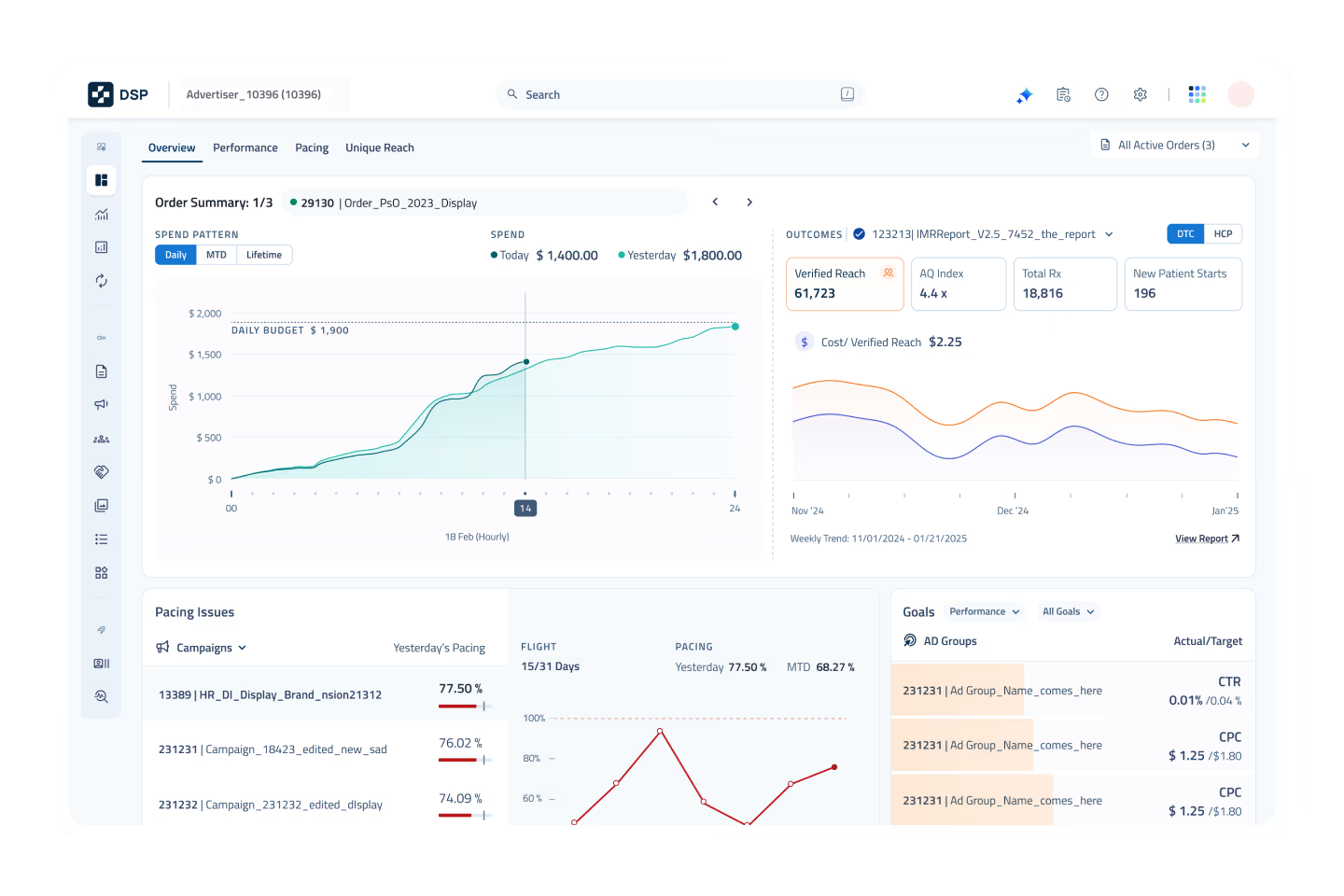
A healthcare-specific DSP does all of that and adds the infrastructure that pharmaceutical marketing requires. This means native integration of clinical and prescriber data for audience construction, HIPAA-compliant data handling architecture, KPI tracking tied to pharma-specific outcomes like script lift and patient starts, and access to healthcare-exclusive inventory such as EHR placements that general DSPs simply cannot reach. The difference between running a pharma campaign through a general-purpose DSP and a healthcare-built one is the difference between adapting a tool and using a tool built for the job.
How AI Is Transforming Modern Pharma Marketing
Artificial intelligence is reshaping pharmaceutical marketing across the planning, activation, and measurement lifecycle. In audience prediction, AI models can identify HCPs most likely to respond to brand messaging based on prescribing trajectory, patient panel characteristics, and peer influence networks before a campaign launches. In campaign optimization, AI can continuously reallocate budget and targeting parameters in response to outcome signals in real time.
Pre-launch planning is another high-value AI application: predictive models built on real-world clinical data can help brands estimate likely uptake patterns, size their addressable prescriber universe, and set realistic commercial projections before the first impression is served.
But AI in healthcare advertising must operate within strict boundaries. Optimization toward health outcomes while remaining HIPAA-compliant and NAI-compliant requires purpose-built AI infrastructure — not general machine learning models repurposed from consumer advertising contexts. The constraints are real, and the platforms that have engineered around them are the ones whose AI actually performs in pharmaceutical environments.
The Connected Data Ecosystem
No single data source tells the full story of a pharmaceutical campaign's audience. The most sophisticated campaigns connect multiple data types — clinical data, media data, identity data, and first-party brand data — into a unified ecosystem that enables each to inform the others.
Clinical data identifies the right audience. Identity resolution connects that clinical signal to the digital profiles where those individuals can actually be reached across channels. Media data tells you which exposures drove engagement and downstream action. First-party data from a brand's own patient support programs, HCP portals, and CRM systems adds another layer of signal. When these data sources are connected inside a modern pharmaceutical marketing platform, the result is a targeting and measurement capability that no individual data source could achieve alone.
Real-Time Measurement and Analytics
One of the most significant advantages of modern pharmaceutical marketing technology is the shift from post-campaign measurement to real-time campaign intelligence. When clinical data is refreshed daily, marketers can see script lift, patient start rates, and audience quality metrics as a campaign runs.
This changes the nature of optimization entirely. Rather than waiting for end-of-campaign reports to inform next year's strategy, teams can make targeting adjustments, reallocate budget across channels, and shift creative rotation based on what the data is showing in real time. The result is campaigns that improve throughout their run.
Navigating the Regulatory and Compliance Challenges in Pharmaceutical Marketing
Pharmaceutical marketing operates under a regulatory framework that has no equivalent in other advertising categories. Understanding this landscape, and building the competency to navigate it strategically rather than just reactively, is one of the defining capabilities of a mature pharma marketing organization.
FDA oversight governs the accuracy, balance, and substantiation of pharmaceutical promotional content. The FDA requires that drug advertising not be false or misleading, that material information about risks not be omitted, and that claims be adequately substantiated by clinical evidence. For prescription drug advertising directed at consumers, the "brief summary" and fair balance requirements mandate that risks receive prominent communication alongside benefit claims.
HIPAA requirements govern the handling of protected health information (PHI) in pharmaceutical marketing contexts. When campaigns involve patient-level data, whether for audience targeting, measurement, or personalization, the data must be handled in compliance with HIPAA's privacy and security rules. This has significant implications for technology infrastructure: data partnerships, audience construction workflows, and measurement pipelines all need to be built or certified to meet HIPAA standards.
NAI (Network Advertising Initiative) standards apply specifically to interest-based advertising using health data. The NAI's code of conduct imposes significant restrictions on the use of health-related data for targeting purposes, including requirements around notice, consent, and the categories of health data that can be used in advertising contexts. These standards sit alongside HIPAA, and compliance with both simultaneously is a significant technical and operational challenge.
Pharma brands that treat compliance as a strategic competency rather than a legal burden move faster, run cleaner campaigns, and build more durable trust with the HCPs, patients, and regulators they depend on.
DeepIntent: A Pharmaceutical Marketing Solution Built to Drive Outcomes
Every challenge covered in this guide (verified HCP audiences, clinical data integration, omnichannel activation, HIPAA compliance, real-time measurement, outcomes-based optimization) is exactly what DeepIntent was built to solve.
DeepIntent is the only DSP purpose-built for healthcare advertising. Unlike general-purpose platforms adapted to handle pharma's requirements, DeepIntent was engineered from the ground up around the unique demands of pharmaceutical marketing: the need for verified audiences, the centrality of clinical data, the complexity of regulatory compliance, and the imperative to measure outcomes that matter.
Verified audiences built on the DeepIntent platform give pharma brands access to HCP audiences constructed from real prescriber data, and patient audiences derived from real-world clinical signals. The difference between these audiences and the inferred proxies offered by general-purpose platforms is measurable and significant.
Omnichannel activation through DeepIntent's channels platform spans programmatic display, CTV, EHR, DOOH, video, and audio, with consistent audience data and unified measurement across every channel. Brands do not need to stitch together separate platforms to execute an integrated HCP-plus-DTC strategy.
HIPAA-compliant infrastructure and NAI-standard data handling are built into the platform, not attached as a wrapper. Every audience workflow, every data partnership, and every measurement pipeline operates within the compliance requirements that pharmaceutical marketing demands.
Outcomes-based measurement, powered by clinical data refreshed daily, gives campaign teams a real-time view into script lift, patient starts, and new-to-brand prescribers, which are so much more telling than impressions and clicks. That visibility into downstream outcomes is what enables the kind of optimization that moves commercial results, not just media metrics.
The guide has mapped the landscape. DeepIntent is the platform that makes it executable. Explore DeepIntent's solutions and capabilities, and see how the platform connects every piece of a modern pharmaceutical marketing strategy.
Ready to See DeepIntent in Action?
See how DeepIntent's purpose-built pharmaceutical marketing platform can help your brand reach the right audiences, activate across every channel, and measure what actually matters.