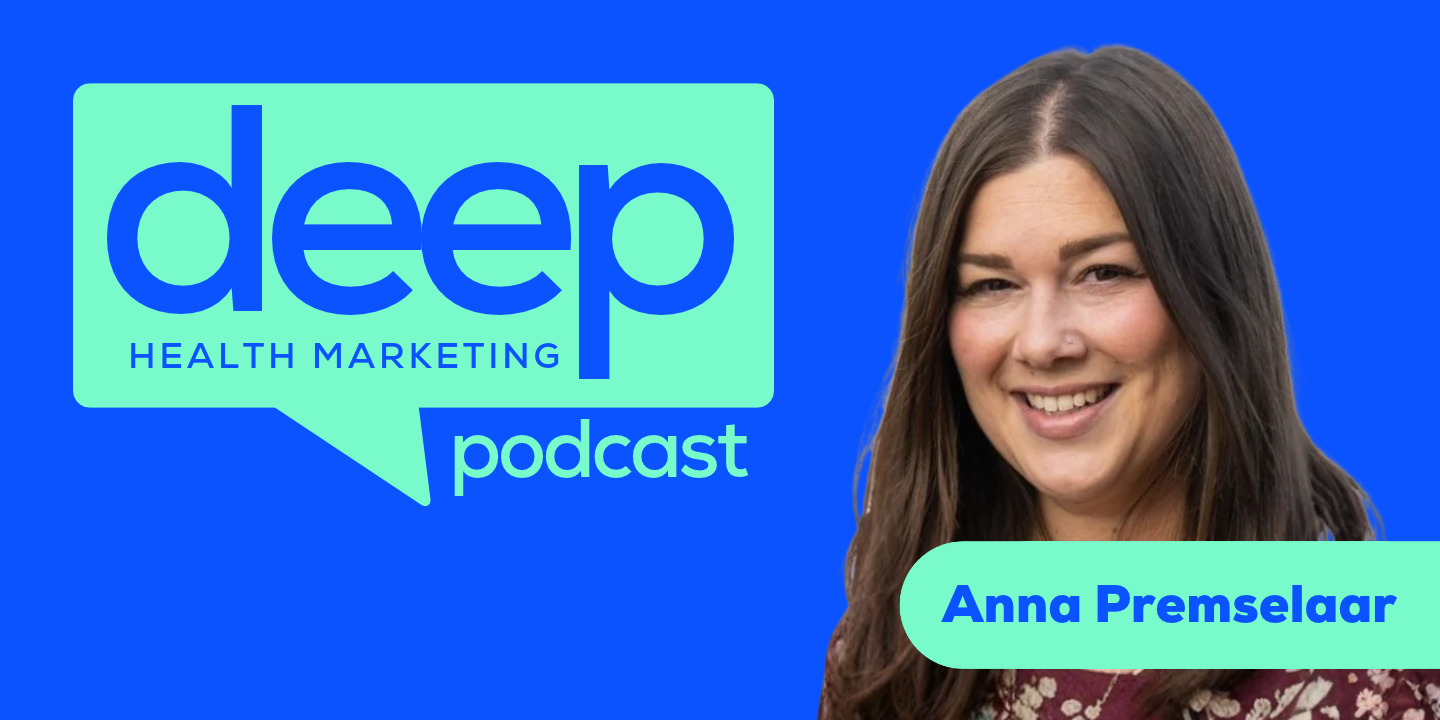
A healthcare journey is personal, and Anna Premselaar’s began with a casual conversation at work. A colleague’s suggestion to check her insurance led her to a mammogram she might otherwise never have scheduled, and to a diagnosis that came sooner than the usual guidelines would have allowed. In this episode of Deep: The Health Marketing Podcast, Anna talks with host Jen Werther about trusting her gut, speaking up for herself in a system where details can slip between doctors, and learning that every patient’s path looks different.
This transcript has been edited and condensed for clarity.
Jen Werther: Anna, thank you so much for joining us.
Anna Premselaar: Thank you. I'm so excited to talk to you.
JW: Before we get into it, I'd love for the listeners to get to know you a little bit. Tell us about yourself.
AP: First and foremost, I'm a mom. I have two boys, three and six, so life is kind of hectic right now. I'm also a fundraiser. I work at our local JCC, and it's really helped me find community where I live. For fun, I'm a foodie and a thrifter. But mom is my number one role for sure.
JW: Which is the hardest role.
AP: Yes.
JW: In my opinion.
AP: Yes.
JW: You shared your journey with me, and I'm happy we're talking about it here today. You started this journey with what seemed like a small conversation at work. Take us back to that day.
AP: Wow. Apologies if I get emotional. It started about a year ago, in the summer of 2025, in June or July. I was having a casual conversation with my friend and colleague Danielle about how so many young women in their 30s are being diagnosed with breast cancer. I was perplexed as to why, because insurance and our doctors tell us that 40 is the age to get a mammogram. So why do I have to wait until 40? Danielle said, "Why don't you check your insurance and see? Maybe it's covered earlier." And I thought, there's no way. Forty is when we're supposed to go.
I followed her suggestion, and otherwise I probably wouldn't have. I called my insurance and found out it's covered one time between ages 35 and 39. And I thought, I have to go.
JW: I think about your story often. That one conversation with your friend Danielle led you to get that mammogram.
AP: Yes. I can't thank her enough.
JW: Do you think part of that moment was instinct, your gut telling you, "I think you need to check this out"?
AP: Oh, absolutely. It was definitely a gut feeling, like maybe this is a sign. I'm not religious, but I knew in that moment that I had to go.
I didn't schedule the mammogram right away. I already had my annual appointment with my GP on July 31st, and I wanted to ask her opinion. She happens to be a breast cancer survivor, luckily. She wrote me a prescription right away for not only a mammogram but an ultrasound. Sometimes women do the mammogram first and come back for the ultrasound, but she said, "You should just do both at once." So I called and got an appointment for September 10th for my first mammogram.
JW: What did you know going into the mammogram about your genetics?
AP: Nothing. I knew I'm Ashkenazi Jewish. I'm about 97%, and my father's 100%. When I was pregnant with my first son, who's six, I did a panel where you and your spouse are tested to see if you carry the same genetic conditions. But that testing doesn't include BRCA or other mutations like CHEK2. That's a different test.
JW: And it's amazing that, with the statistics being higher for Ashkenazi Jewish women, they wouldn't test you.
AP: Right. About one in 40 Ashkenazi Jewish people carries a BRCA1 or BRCA2 mutation, compared to one in 400 in the general public. And it's not just women. You can inherit BRCA from either parent, which many people don't know. They think that because it's breast cancer, it comes from the mother. In my case, I found out, then my father got tested and learned he was BRCA positive. My mom had been tested five or six years ago because she wanted to make sure I wasn't a carrier, but no one ever told her it could come from the father.
JW: It's about creating awareness of the full story. You can go before 40 if your insurance covers it or you're willing to pay out of pocket, and you can learn about your genetics. You mentioned in a previous conversation that your dad had cancer. Can you talk about that?
AP: Absolutely. My dad had cancer about three years ago. I believe it was squamous cell carcinoma, which is typically a skin cancer, but it was in his throat. He went to MSK, which is the best, where I go as well. They ask about your background, and all the doctors knew he's Ashkenazi Jewish. His father, my grandfather, died of pancreatic cancer. BRCA is associated not only with breast cancer but with prostate cancer, pancreatic cancer, melanoma and others. So he told them his father died of pancreatic cancer. Did he have any genetic testing while he was there? None. Unfortunately, that was a missed opportunity.
JW: Huge. If your dad had gotten genetic testing back then, it could have led you to get tested before last summer.
AP: And my brothers and sister and aunt. It's wild to me. There were multiple missed opportunities, and that was just one of them. They're amazing doctors, but they're very focused on what they're doing, understandably, and there's not much communication between them sometimes. I think that's where the missed opportunities happen.
JW: I can't imagine what it was like. So you went for your mammogram, and I'm assuming you got a call. Tell us what happened after that.
AP: I had my mammogram on September 10th, and only 10 or 15 minutes after leaving the mammogram and ultrasound, they called and said I needed a biopsy.
JW: Ten to fifteen minutes after?
AP: Yes. During the ultrasound, the technician was focusing on one area, and I had an inkling that it was weird. She took out a little ruler to measure, and I thought, that's strange. But then I met with the nurse afterward, and she examined me and said, "Everything looks good. Everything's fine." Then 10 or 15 minutes later I got a call saying I needed a biopsy. I was in hysterics. I knew right then and there. And 80% of biopsies are benign. I know so many people who've had multiple biopsies that turned out to be benign. But I just had this feeling: nope, it's cancer.
I had the biopsy on September 16th, and the waiting is the hardest part. I tell my friends who get biopsies that it's worse than going in for surgery. I had to wait two days. Then on September 18th, I was on my way to work around 8:45 in the morning, and I got a phone call from the radiologist who did the biopsy at Englewood Hospital. She asked if I was driving. I said yes, and she said, "Pull over." That's all I needed to hear. I remember the exact spot where I pulled over, in Montvale, New Jersey, right by Anchor Seafood, which I've yet to go to.
JW: It's really good.
AP: I heard it's great. But now it's forever associated with the spot where I pulled over. I'm getting so into the moment, like, oh my God, is this real?
She told me everything: a 1.6 centimeter tumor, triple negative breast cancer. Luckily it was stage one, but grade three, and triple negative is the most aggressive form of breast cancer. She said I was extremely lucky. I didn't feel anything when I went to the mammogram. I went on gut instinct alone, and lo and behold, I had breast cancer. She said that if I had waited until 40, it could have been stage four, metastatic. It's just wild.
JW: It is. Thinking about what would have happened if you'd waited, do you think instincts and small impulses deserve more credit when it comes to our health?
AP: Absolutely. I truly believe you need to follow your gut and your instincts. If you think there's a chance, you have to go. And even if you think, this can't be me, as so many people do, just go. What is the harm in going? In my case, I wasn't told to go, and I followed my gut. You have to be your own advocate, a thousand percent.
JW: One of the themes of this season is that healthcare is personal. Seemingly small moments can have life-changing consequences. Was there a moment when you almost didn't act?
AP: That's a really good question. I don't know if it's luck, but I feel so fortunate that I acted and didn't have a second thought about it. But there are so many things that could have swayed me the other way, and that happens all the time. My doctor might not have been a breast cancer survivor. So many doctors I know of say, "You don't have to go. You don't feel a lump, there are no symptoms, you can wait until 40, that's the recommended age." I might not have gone if that's what my doctor had told me, because I really do trust my doctors. Another reason I might not have gone is if my insurance didn't cover it. I would have thought, well, there's a reason I don't have to go. Many people won't go if insurance doesn't cover it. So there could have been many times I would have said no, but the gut instinct kicked in after that conversation with my colleague.
JW: What would you say to someone who's been putting off a test? I do this often myself. I'll do it when the kids are in camp, or I should call the insurance company and see. Life gets in the way, but what would you say to someone who's been putting things off?
AP: It's what I said just yesterday to my own mother. She's put off her mammogram and her colonoscopy, and I said, "Mom, of all people, what are you doing?" My mom travels a lot, so life does get in the way, and it's very difficult. What I would say is pick up the phone and make an appointment. Even if it's been six months or a year since your last visit, put it in your calendar as something you have to do. Do whatever you need to do to make it a priority. And put an alert on it. I always set alerts 30 minutes before. If that's what's going to help, then that's what you have to do. There's no excuse.
JW: Would you have gone to the doctor if insurance hadn't covered it?
AP: Wow. No one's ever asked me that. I think I would have asked how much a mammogram costs. From what I've heard, it's maybe $400 to $800. I feel lucky that I can afford it, and I probably would have done it. It would have been a difficult decision, but I probably would have. It's just so sad how many people wouldn't.
JW: Anna, you've been through hell the last six to eight months. I've seen you and spoken to you, and I know what you've been through. What can you tell us about your treatment journey?
AP: After I was diagnosed on September 18th, I did not leave the car until I made my appointments. I could not move until I took the next step. I used to be a teacher, so I'm very type A and a planner. I thought, before I call my parents, I am getting appointments with the doctors and transferring from Englewood to MSK.
Fortunately, or not so fortunately, I have a friend who was a month or two ahead of me in her breast cancer journey. She was diagnosed in July or August, so she was already at MSK, and she gave me all of her doctors. I see the exact same doctors she does, and she's been a huge support system for me. I was shocked to get an appointment within a week or two, and I had my double mastectomy on October 14th.
A 1.6 centimeter tumor is right on the cusp. For triple negative breast cancer, if it's over 1.5 centimeters, you usually do chemo first and then surgery. But my doctors got together and decided to do the double mastectomy first, get it out, and then do chemo. I was really grateful to feel that it was out. Then I recovered for six to eight weeks, and I had what's called the red devil, AC-T chemo, because it's bright red. I had it every two weeks for about four months, from December 2nd to March 17th, my last chemo. Losing my hair was almost harder than losing my breasts, because my hair is so much a part of my identity. This is a wig. My hair is starting to grow back, but it's not quite there yet.
After chemo, I had to decide what kind of reconstruction I wanted. There are a lot of options now. I went with a more natural option called DIEP flap reconstruction. I was lucky enough to get a little tummy tuck, using my stomach to recreate my breasts. I feel really fortunate, but some days are better than others. Some days I look in the mirror and think, who is this person? I don't recognize myself. And some days I'm just so grateful.
I have to say that this journey, as hellish as it was, has given me a new perspective on life. It's wild that it takes such trauma to learn what being truly present and truly grateful is. I used to be a very anxious person, and I still am, but not nearly as much. I almost feel happier, as crazy as that is to say. I'm able to live in today and embrace today. This journey has taught me so much about being grateful for the small things.
JW: I can only imagine. What resources or organizations helped you get through your journey?
AP: Before I was diagnosed, I didn't even know there were resources. I knew Susan G. Komen was a breast cancer organization, but vaguely, and I didn't know much detail. Then I started to hear, first from a nurse and later from a few other people, about an organization called Sharsheret, which is based in Teaneck, New Jersey. They're the only Jewish nonprofit focused on breast and ovarian cancer, helping women who are either predisposed through genetic mutations or diagnosed with breast or ovarian cancer. But they help everyone, not only Jewish women or men.
They've been so supportive. They have social workers and genetic counselors on staff. I spent hours on the phone with genetic counselors, understanding what BRCA means for me and my family. They sent me care packages: a mastectomy kit, chemo-safe makeup and toothpaste, a pillow and a robe. I truly felt like this was an organization that was there for me every step of the way. It's unbelievable how many organizations are out there that people don't know about. They also help financially, including with mammograms. I didn't find that out until after the fact, and I wish I'd known beforehand.
JW: So even if you didn't have the money to pay out of pocket, there are organizations that will help you.
AP: Yes, there are a lot out there.
JW: That's amazing. I heard you speak at their event, and I assume you'll continue to be an advocate, not only for creating awareness in your community but for getting the word out about Sharsheret. From what I heard and saw, it's truly an amazing organization.
AP: They really are. They do amazing things. They have webinars and lifesaving education, and they're truly there to get the word out and create awareness. Now I feel part of that cause and mission, and I'll help in whatever way I can.
JW: This whole experience, I would imagine, changes everything: how you move through the world, how you think about health. And your journey is probably never over. What can you tell the listeners about that?
AP: There's this misconception that once you're done with treatment, whether that's chemo or, for some people, radiation, there's a big celebration and you've survived and you're back to normal life. That's just not the reality. I want people to understand that there's a before cancer and an after cancer. My life will never be the same. It'll be a new normal.
So many people ask me, "How do you feel now? How are you?" It's such a hard question to answer, because I don't have closure. Every journey is different. Everyone I've met who has had breast cancer has a different story, so you can't really compare. There's positive breast cancer and negative breast cancer, different stages and different treatments.
For me, my risk of getting cancer again goes way down after five years, so in my mind I'll have some closure in five years. Until then I see my oncologist every two to three months, so I feel like I'm still in it. Even though I'm a survivor, I don't quite feel that way, because I have this fear of recurrence in the back of my mind. I've heard of so many people having it come back, and I don't think BRCA is on my side with that. As someone who has it, I also have a 50% chance of ovarian cancer, so during my DIEP flap a month ago, I had my ovaries and tubes removed as well. It's a journey, and there's no finite finish line. It continues.
JW: You've had a lot of doctors, from the oncologist to the breast surgeon, and I'm sure many others. Did you have to help coordinate? Were they good about talking to one another? Healthcare systems are complicated, and sometimes you have to be your own biggest advocate. Was there a time you really had to stitch everything together?
AP: A thousand percent. You have to be your own advocate. Two things happened that I want to mention. First, I love my doctors, and I'm so fortunate to have had them. Because they're all at MSK, the breast surgeon and the plastic surgeon have worked together, and the oncologist knows both of them. In terms of knowing each other and working together, they have done so.
However, after you finish chemo, you don't get scanned regularly, which was a shock to me. I need peace of mind. So I came to my oncologist, as I always do, with questions, but this time I came with research. I'd found a fairly new blood test, maybe five years old or a little more, called Signatera. It checks for cancer cells in your blood. I thought, I want that. I don't trust myself to find a lump, and I didn't feel anything the first time. A recurrence could come back in your brain, your liver, your lungs. It's not necessarily just in your breast and lymph nodes. I trust medicine. So I brought it up, and she said, "If you want that, we can do that." I had to ask for it. It wasn't presented to me. I did my first one a couple of weeks ago, and I'll be doing it every three months. You have to ask the questions. You have to do your own research, which is also scary, because you find other things that have nothing to do with you.
The second instance was after my double mastectomy in October. My breast surgeon said to me, "The tumor was near the skin, on the edge. I believe I got it all, but if you want, we can scrape some more during your next surgery."
JW: Yes, please.
AP: I said, "Yes, yes, let's get it all out." So I scheduled my next surgery, and as it got closer, about two months out, I started thinking. My breast surgeon has nothing to do with my DIEP flap surgery. That's all the plastic surgeon. I'm also going to have my gynecological surgeon there, because she has to take out my ovaries and tubes. But the breast surgeon took all the breast tissue out during the mastectomy. So does the plastic surgeon know this has to happen? Is he going to do it? Is she going to do it? I had to reach out to my breast surgeon, remind her, and ask if she was available. She said, "Yes, absolutely. I'll be there and I will do it." But I have to question whether she would have reached out to me. I don't think so.
And it's not her fault. She's amazing, but she has so much on her plate and so many patients. How is she supposed to remember the minute details? I had to reach out and say something.
JW: That's an amazing story. You have a million things going through your mind at every appointment. Having someone else there, your husband or your mom, as a double check and another listener must be helpful too.
AP: Absolutely. And in the beginning, I do recommend bringing someone with pen and paper. My mind was all over the place and I wasn't sleeping. You can also ask the doctor if you can record the conversation, which they'll often say yes to, or rely on a relative or loved one to take notes, because I wasn't able to at the time.
JW: Understandably so. Anna, as it relates to your health, what was life like beforehand?
AP: Before I was diagnosed, I had Hashimoto's thyroiditis, which many people live with. It's hypothyroidism, but that was really the only issue. I'd never had surgery. I go to my GP once a year, my gynecologist, my dermatologist twice a year, and the dentist twice a year. I do all the things I'm supposed to do. Besides being a little overweight, I didn't really have any health issues. There was nothing really wrong with me until, bam, cancer.
JW: A lot of women and men take their health for granted, and their lives, until moments like these and the lifelong journeys that follow. Do you now think holistically about what you can do mentally and physically?
AP: Absolutely.
JW: Your story is so powerful. What is the one thing, or a handful of things, you'd want listeners to take from this episode?
AP: I appreciate you adding "a handful," because choosing one thing is so hard. Follow your gut, and advocate for yourself. Don't postpone. Go to the doctor. Go to the checkups. It's not worth the risk.
JW: Anna, I cannot thank you enough. I'm so grateful for you and for your story, and for continuing to be there with you on your journey. This episode has been so impactful, and I really appreciate you coming on to tell it.
AP: I'm so grateful for this opportunity. My meaning in life now is to bring awareness to others about the importance of knowing your body and following your gut, and having the chance to share this with so many of your listeners is an honor. Thank you for choosing me.