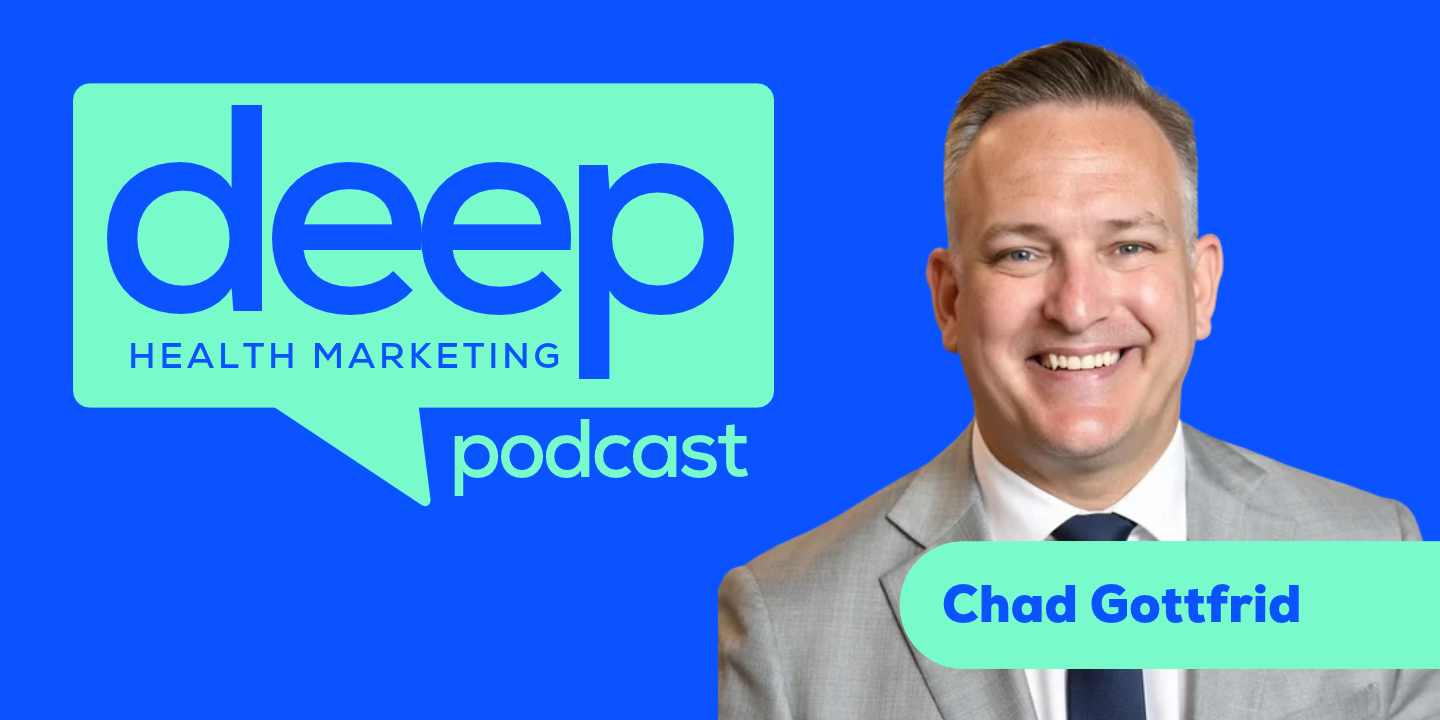
On this episode of Deep: The Health Marketing Podcast, healthcare marketing leader Jen Werther talks with Chad Gottfrid, founder of Lane4, about what it takes to bring EHR media into the programmatic world. Gottfrid, who has spent nearly 30 years in pharma, explains how a supply side platform built for EHR opens up access and real-time reporting, and why he believes the future of healthcare advertising comes down to speed, efficiency and transparency. He also shares how Lane4 got its name and what DJing has in common with marketing.This transcript has been edited for clarity.
Jen Werther: Chad, congratulations on officially launching Lane4. In your own words, what is Lane4?
Chad Gottfrid: Lane4 lives in service of EHRs. We built a supply side platform to help EHRs maximize their ad inventory and sell it the way the market wants to buy it.
JW: For anyone hearing about Lane4 for the first time, what problem are you solving?
CG: Roughly 90% of pharma media budgets are controlled and activated by agencies. Outside of pharma, 80 to 90% of ad inventory is sold programmatically. Until now, EHR media was never set up to sell that way. We've built a platform that lets EHRs sell the way agencies and brands want to buy.
JW: Where does the name Lane4 come from?
CG: A couple of years ago, in more towns than I care to admit, I was a competitive swimmer. If you're in Lane 4 at a meet, you've earned it. That's where they put the fastest qualifying swimmer, based on past competitions and all the work you've put in. And once the race starts, you have to earn it all over again. To me, Lane 4 is a reminder that you have to be willing to compete and earn your way to success. As a sole owner, I could have come up with a lot of crazy names, but I thought that was a good reminder.
JW: I wasn't expecting that answer, but I love it. Walk us through your career before Lane4.
CG: I've been in pharma for almost 30 years. I started out of college at Merck in a call center, then earned my way into the field as a cardiovascular rep in New York. I moved on to LDM, the first company to sell an aggregated network of EHR inventory, and we were very successful. LDM became PDR, and PDR became ConnectiveRx. By then it was a big organization, and I wanted to find what was next.
I ended up at Swoop right when they decided to offer self-service consumer audiences for programmatic execution. After a while, I went to lead sales at a competitor, Medix Health, where I became CRO. We had a lot of success there, and Medix was eventually acquired by OptimizeRx. Eight years after leaving point of care and EHR, I was right back in it, with a much more expanded view of media.
JW: We met when you were doing copay cards, so you've had a lot of pharma experience. What prepared you for where you sit today, at the intersection of healthcare technology and advertising?
CG: All of it. You can't be in pharma for 30 years and not take something away from every stop. In my earlier time in point of care, I came to understand its value in the marketplace. At Swoop and Medix, I got out of the point-of-care lens and learned how agencies bought and sold media outside of it, and the role of ad tech. Coming back, I realized how narrow the aggregators' view was and how old and antiquated the systems for buying EHR were. I decided we needed to shake things up.
JW: What was the aha moment, and how long was it until Lane4 launched?
CG: The idea started to solidify about two years ago, but it goes back to my time at Medicx. When I got there, they were selling audiences as a managed service, where they also managed the media buy. That didn't align with how people wanted to buy. Programmatic agencies and programmatic desks were emerging, and they wanted self-service audiences. Medicx struggled until we moved to self-service, and then revenue took off and the company was acquired.
I took two lessons from that. First, you have to sell the way the market wants to buy. Second, there's real value in being a first mover. Swoop was the first mover to self-service in consumer audiences, and that's a big reason it's still regarded as the leader. When I came to OptimizeRx, I saw a managed service business in a world that wanted to buy self-service, and no first mover to programmatic in EHR. Whether the company did it or I left to do it myself, it was going to be done.
JW: You've said healthcare marketing has become incredibly sophisticated, but it still misses one of the most important moments: the treatment decision. What do you mean by that?
CG: Many agencies are doing impactful things for brands, but few campaigns or media plans capture the moment of the clinical decision as often as they should. The moment gets missed because brands lack access and the transparency they get in other channels. That leads to reduced budget investment in the channel, which hurts brands and certainly hurts EHRs. So we've focused on democratizing access, bringing in a new level of transparency, and making EHR as easy to buy as every other channel. If we do that, we'll do a better job of not missing those critical moments in care.
JW: For listeners who may not know, what does it mean to bring EHR programmatically through an SSP?
CG: A supply side platform isn't new technology. We updated it and purpose-built it for EHR, which is a little quirky. We're doing three things. First, we're a single source of integration for EHRs, so they never have to do another media integration with another company. Second, we're democratizing access. If you're a demand side platform, a brand, an agency or another aggregator, you're welcome to bid on the inventory. Third, we offer it through real-time bidding, which lets demand side partners see what they're buying, including where the ad will run, before they buy it.
We also provide real-time reporting, and it's deterministic. You're not guessing who saw the ad or waiting two to four weeks to find out. Typically within 80 milliseconds, you can see which HCP was engaged, on what page, and what ad was rendered. Because the reporting is real time and deterministic, we can also feed it into third-party media measurement. There will always be a few quirky things about EHR, but we're taking the standardized approach every other media channel has taken, so buying is less complicated for brands and agencies.
JW: So the tagline is "EHR is quirky."
CG: It is. EHRs make money from advertising, but it's not their primary source of revenue. For most endemic channels and other point-of-care solutions, advertising is how they make their money. Because this is a third or fourth line of business for EHRs, the ads can't distract physicians. If a physician has a bad day, it's a bad day for the EHR. Integration has to be easy, and EHRs need to see what they're making on every ad so they don't feel someone else is taking advantage of them. Still, because of the value of the inventory and the technology we can provide, we can make this a very good channel for pharma manufacturers.
JW: What's the biggest misconception you hear about EHR?
CG: That it's overly complicated. It's quirky, but every type of media has its quirks, and most media buyers are well educated across many kinds of media. If you're on a brand or agency team using a DSP, it's not rocket science. With a little help and experience, you can be very effective with EHR campaigns.
JW: How does programmatic change the future of point-of-care marketing?
CG: It's not just EHR programmatic. It's programmatic for point of care overall. Brands buy media for value, and they want measurable value in terms of script lift. Beyond that, programmatic levels the playing field between supply and demand. It helps everyone understand they're getting a fair price, and it creates transparency, control for the agency and measurability. Without those, I don't see how EHR evolves beyond being a media plan diversification play. Every brand is doing a little EHR in some respect. We want to create the transparency and control that let EHR become a core investment in a media strategy, and from there, drive the value we know it can.
JW: I think of EHR as an enhancement at the moment the HCP is with the patient. All right, let's do some rapid-fire questions. What's the biggest lesson you've learned as a founder?
CG: Things take time. I meet regularly with a group of founders, and two years ago I told them I was ready for EHR to take off programmatically. One of them said, "You've got this thought out, but it's going to take time." I didn't see why. It just made sense to me. But people have to start thinking differently and aligning budgets that way, and inventory has to be available before it takes off. That takes time.
JW: What's one assumption you had that turned out to be wrong?
CG: I understood the value of programmatic to the supply side, how pharma budgets align to programmatic, and that everyone on the demand side wants to buy EHR programmatically. I thought it would be easy for EHRs to understand, too. But there are old tropes about programmatic, like that it's a race to the bottom, and sometimes I was explaining programmatic to people with no media experience at all. It was a harder explanation than I expected. The market is hearing more about programmatic now, and the conversations are getting easier. After some practice, I may have gotten better at explaining it.
JW: It's okay. If you ask my husband what I do for work, he still can't explain it.
CG: I'm in that boat with you.
JW: What excites you every day?
CG: I always talk about living in service of EHRs. It's neat to start with an EHR that has no idea what its media can do for it, what programmatic is, or what strategies we can deploy as an SSP to maximize its revenue, and then watch them ask questions and get excited. When they say, "Okay, Chad, let's integrate, how are we going to do it?" I tell them it's our job to integrate in the way that makes the most sense for them. Taking them from not understanding programmatic at all to getting integrated is a fun journey.
JW: If you could give yourself advice from seven or eight months ago, what would it be?
CG: Give yourself some grace. Starting a company is hard. There are a lot of highs and lows, and it can be lonely. If you believe in the problem you're solving and the value you can provide, take your time and build it right. Don't worry if it doesn't happen tomorrow. It's going to happen.
JW: Finish this sentence: The future of healthcare advertising is...
CG: It comes down to speed, efficiency and transparency. For speed, I mean real-time bidding and reporting, using data as it happens. We can't have delays in the data, especially with AI in the mix. If we get data faster, we make better decisions faster. Efficiency is about AI, but it's more than that. In EHR, we need to make things easy to buy. And on transparency, whether we like it or not, things are becoming more transparent, which is sometimes good and sometimes bad. When it comes to "What am I buying, and what did I get?" I think people are willing to invest more when they can answer those questions. I don't know that's new, but there's some blocking and tackling we've always done that still needs to be done, whatever the channel or technology.
JW: You've been busy launching this company. What do you do for fun?
CG: I'm a DJ.
JW: Where are we DJing these days? Belmar, Point Pleasant?
CG: If you're in the King of Prussia area of Pennsylvania, you go to a local bar, and you see a mediocre DJ still trying to hold on as a 50-year-old spinning the 1s and 2s, that might be me.
JW: So you went from swimmer to DJ to healthcare advertising, and now Lane4. After 10 years of knowing you, I didn't know you were a swimmer, and I definitely didn't know you DJ.
CG: My kids say I have no taste in music, which is what 17-year-olds do. But DJing isn't much different from marketing. I sit behind my rig and watch the audience to see what they respond to. For me, it's usually '90s house or '90s rap. I watch for someone tapping a foot or starting to move, and I lean into that. You're trying to figure out what people are into.
JW: You're servicing clients and looking for signals. Those are signals.
CG: If you really want to go 360 on it, Jen, that's probably it. People who show up early in the night have probably seen better DJs, but as the night goes on and the drinks get flowing, they get on the dance floor, and it's not so bad.
JW: Chad, it was great having you on the podcast. Thanks again for joining us.
CG: It's been a pleasure, Jen. I appreciate it very much.