Every advertiser competes for the same finite pool of prescribers and patients. Outspending a competitor matters less than out-seeing them: knowing where they're investing today, and just as usefully, where they've left the market untouched. Those overlooked specialties, geographies, and patient segments are usually sitting in plain sight, if you know where to look in the claims data.
This is whitespace mapping, the discipline of sizing a competitive category, identifying the gaps competitors are leaving open, and activating against those gaps before anyone else does. Historically, this took weeks of stitching together claims data, campaign logs, and analyst judgment. With DeepIntent Helix AI™, it's a conversation: ask a question in plain language, get back a data-grounded answer you can act on the same day.
Below are three ways any advertiser can use Helix AI to move from "who's winning the category" to "who should we go after next." To make it concrete, each one includes a real prompt run live against Helix AI. We've used psoriasis as the example therapeutic area throughout.
1. Size the Landscape
Before you can find whitespace, you need an accurate picture of the whole space. That is, how large the addressable prescriber universe is, how it's currently split across competing brands, which specialties are driving that volume, and how that's trending quarter over quarter. Helix AI pulls directly from claims data to answer this in one step, replacing what used to be a custom analytics request.
What This Looks Like
- Total addressable HCP or patient universe for your category, for any date range (not just the trailing 12 months)
- Market share breakdown by competing brand, specialty, or geography
- Quarter-over-quarter trend to see whether the category, or a competitor, is accelerating or plateauing
Example Prompt
Show me the total addressable HCP universe for plaque psoriasis in the U.S., broken out by current biologic prescribing—Skyrizi, Tremfya, Cosentyx, Otezla, and Sotyktu—from the months in Q4 2025–Q1 2026, segmented by the top 3 specialties.
Why It Matters
A single conversation surfaces both the size of the category and which competitor has momentum. For example, the results here show that Skyrizi grew prescriber count +20.9% quarter over quarter, the fastest of the five, while Sotyktu declined -37%.
2. Find the Segments Your Competitors Are Leaving Open
Once you know the shape of the category, the next question is where the gaps are. Helix AI can isolate a precise competitive segment—prescribers on one brand but not another—and profile it by geography, channel reachability, and competitive context in a single pass.
What This Looks Like
- A precisely defined competitive segment: on Brand A, not on Brand B
- Geographic concentration of that segment
- Channel affinity, or where this segment is reachable across the media mix
- Competitive context, meaning how this segment sizes up against the category as a whole
Example Prompt
Among HCPs treating psoriasis, identify those who are currently prescribing Skyrizi, but not Otezla. Show their geographic concentration, channel affinity, and key competitive insights.
Response: 2,963 HCPs prescribe Skyrizi for psoriasis but have never written Otezla, roughly 1 in 5 of all Skyrizi prescribers nationally (14,957 total). Top states by concentration: CA, FL, NY, TX, OH.
Why It Matters
Competitive mapping turns prescribing behavior into a media strategy. Instead of buying "dermatologists in top markets," a brand can now defend the exact HCPs who chose a competitor over their brand, a behavioral signal no demographic segment can replicate.
For example, in this analysis, three things jump out:
- Where you compete. Just five states hold 41% of the audience. Media weight should follow the prescribers, not the population.
- What you say. Internal Medicine (40%) and Dermatology (30%) together are 70% of the cohort, two very different creative conversations inside one target list.
- How you spend. Seven of eight channels reach 80%+ of these HCPs. The challenge is sequencing the message across channels they already use.
Winning share in pharma media has less to do with total spend than with where that spend lands. Competitive mapping is how brand teams find the right prescribers to spend it on.
3. Turn Whitespace Into a Live, Targetable Audience
Insight only creates value once it's activated. The final step is converting the identified whitespace segment directly into an audience (prioritized by prescribing volume, with competitor overlap excluded) and pushing it into market. Helix AI closes the loop between analysis and execution, so the same conversation that surfaced the opportunity can also build and export the audience against it.
What This Looks Like
- Audience build defined by the same criteria used to identify the whitespace, prioritized by volume decile
- Automatic exclusion of HCPs already prescribing their brand
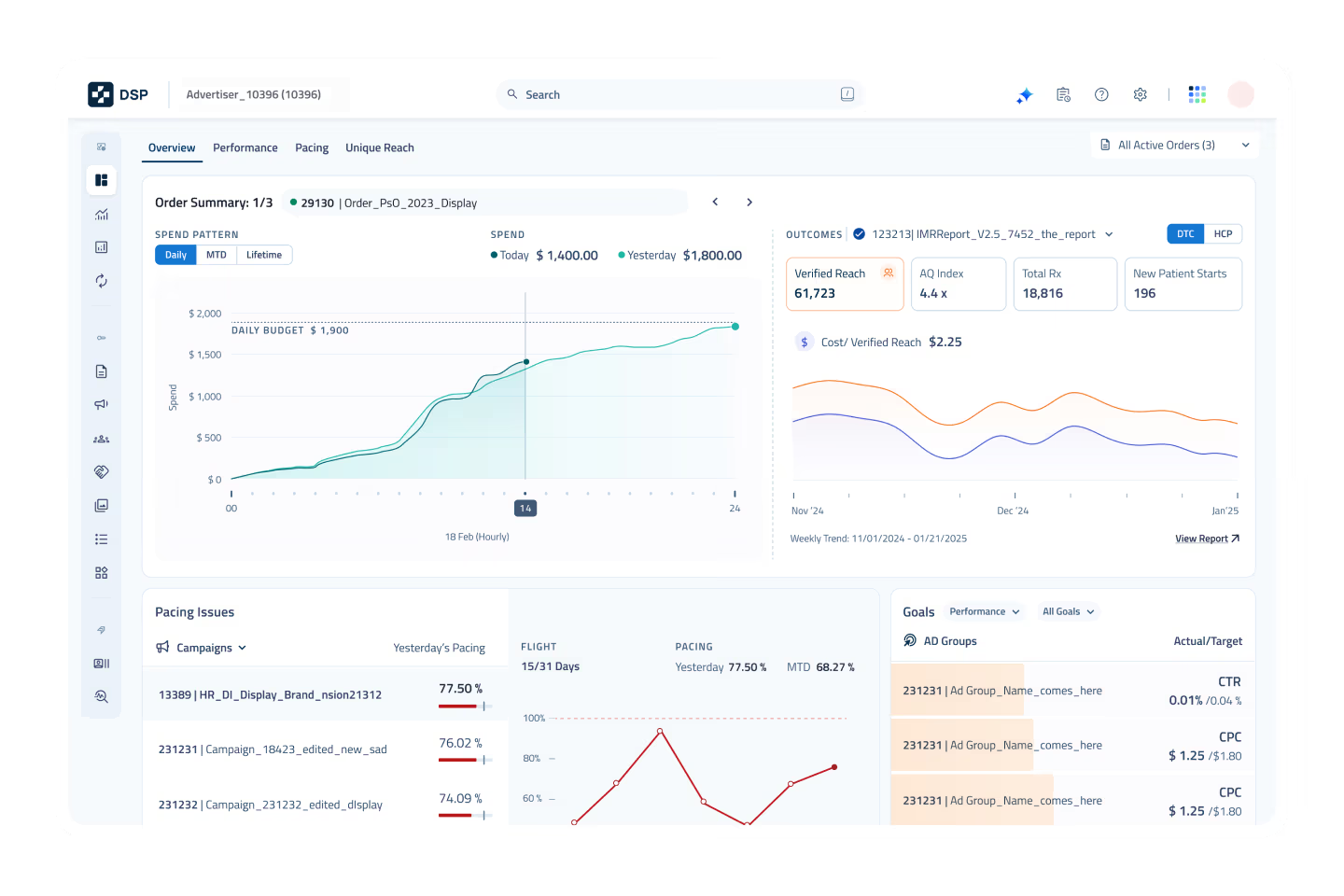
- Direct export to My Audience for DSP activation, with no manual hand-off between analysis and media
Why It Matters
Whitespace has a shelf life. Competitors move, too. The brand that closes the gap between finding an opening and acting on it is the one that keeps it. With Helix AI a competitive conquest audience can be built in under a minute using a simple prompt.
Example Prompt
"Build an HCP audience of the top-decile HCPs by [Condition] claim volume, excluding anyone currently prescribing [your brand], and export it for DSP activation."
See your category's whitespace in the next 10 minutes. The same three steps — size, identify, activate — work for any brand, in any competitive category.
Note: all figures above were pulled live from DeepIntent Helix AI on July 1, 2026, using the DeepIntent demo advertiser seat. Figures will vary by seat, lookback window, and refresh date.