Pharma companies have been increasing their spend on healthcare DSPs at three to four times the rate of generalist platforms. The reason is straightforward: generalist DSPs were built for broad advertising verticals, and healthcare marketing has requirements those platforms were never designed to meet. This article explains what a healthcare DSP is, how it differs from a general-purpose platform, and what to look for when evaluating one.
What Is a Demand Side Platform (DSP)?
A demand side platform is software that allows advertisers to buy digital ad inventory programmatically across many publishers and supply sources at once. DSPs connect to supply side platforms (SSPs), where publishers make their ad inventory available, and use automated real-time auctions to purchase impressions on an advertiser's behalf. The result is faster, more precise media buying at scale, with targeting and optimization capabilities that manual buying cannot match.
For most industries, a generalist DSP covers the basics well: audience targeting by demographic and behavioral signals, real-time bidding, and performance reporting on standard media metrics. For pharma marketers, those basics are a starting point. But pharma marketers need more.
What Makes a Healthcare DSP Different from a Generalist DSP
Clinical Data and Identity Resolution for Both HCPs and Patients
A healthcare DSP is built around clinical data, specifically medical claims, pharmacy records, diagnosis codes, and prescribing behavior. These signals allow marketers to build audience segments that reflect actual clinical reality rather than inferred demographic proxies. A generalist DSP has no access to this data layer and no infrastructure to handle it compliantly.
For patient campaigns, this means reaching people who are actually diagnosed with or at risk for a given condition. For HCP campaigns, it means targeting physicians by specialty, prescribing volume, and therapeutic area focus.
HIPAA-Compliant Infrastructure from the Ground Up
Healthcare accounts for roughly 30% of the world's data volume, and an increasing share of it flows through digital advertising channels. That creates significant compliance obligations that generalist platforms are not equipped to handle.
A healthcare DSP must meet HIPAA de-identification standards for every audience it activates. The most rigorous platforms undergo independent certification from a healthcare data compliance organization to verify that those standards are actually met, not just claimed. This infrastructure has to be built in from the start. It cannot be retrofitted onto a platform designed for consumer advertising.
Healthcare-Exclusive Inventory That Generalist Platforms Cannot Access
Healthcare DSPs have direct relationships with publishers and inventory sources that are specifically relevant to clinical audiences: medical journals, point-of-care networks, EHR platforms, and health content sites. This inventory reaches HCPs and patients in contextually relevant environments that generalist platforms typically cannot access or do not prioritize.
For pharma marketers, context matters. An ad served to a physician while they are reviewing clinical content or patient records carries different weight than the same ad served in a general consumer environment.
Measurement Anchored to Prescribing Behavior
Standard media KPIs, clicks, impressions, and reach, tell pharma marketers how many people saw an ad. They do not tell marketers whether those exposures moved any prescriptions. A healthcare DSP closes that gap by measuring and optimizing toward outcomes that reflect real-world clinical impact.
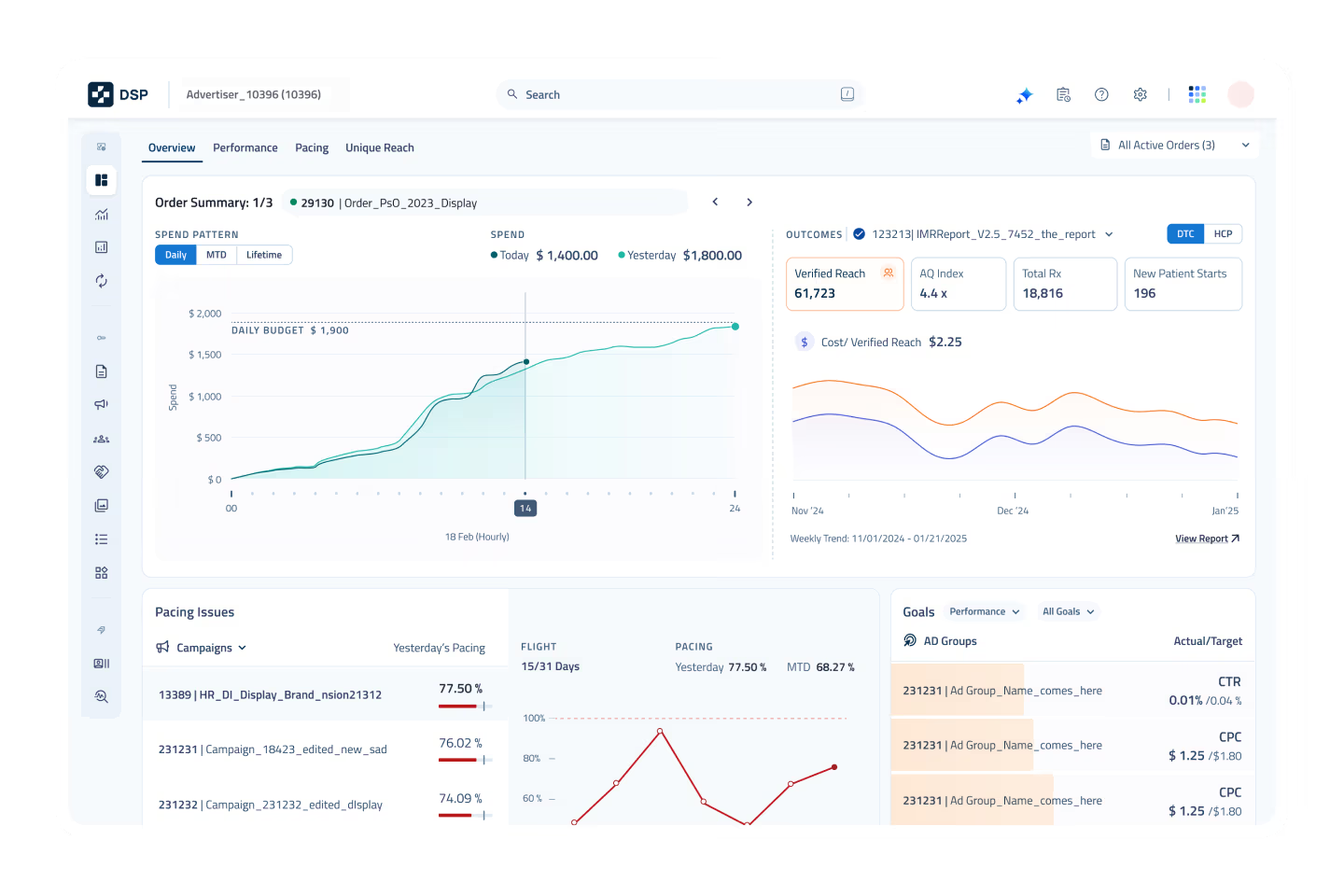
The metrics that matter in pharma include audience quality (the number of unique, clinically relevant patients or providers reached), script performance (total prescriptions including refills and new prescription starts), and cost-per-verified patient. A healthcare DSP should track all three throughout a campaign, with data refreshed frequently enough to support in-flight optimization decisions.
Identity Resolution Across HCP and Patient Audiences
When pharma marketers use generalist DSPs for HCP campaigns, they often need to stitch together data from multiple platforms. That cross-platform data transfer causes approximately 30% data loss, reducing both the accuracy of targeting and the efficiency of spend. A healthcare DSP maintains a unified identity graph across both HCP and patient audiences, keeping data intact and enabling consistent targeting logic across channels and campaign types.
Healthcare DSPs and the Pharma Industry
The pharma industry's shift toward healthcare DSPs reflects a broader maturation in how the category approaches digital advertising. As budgets have moved from traditional channels into programmatic, the limitations of generalist platforms have become harder to work around. Compliance exposure, audience imprecision, and measurement gaps compound at scale in ways that are difficult to absorb when campaigns are running across CTV, display, and point-of-care simultaneously.
Healthcare DSPs address these challenges by treating clinical data, HIPAA compliance, and outcomes measurement as core infrastructure, not optional add-ons.
How to Evaluate a Healthcare DSP
When assessing a healthcare DSP, the most important questions are about data and measurement. Where do the clinical audience segments come from, and how are they kept current? Has the platform been independently certified for HIPAA compliance? Can it measure script lift and audience quality in real time, or only at the end of a campaign?
Equally important is the platform's HCP data. Specialty, prescribing behavior, and NPI-level targeting should be available natively within the platform, without requiring external data integrations that introduce data loss.
Finally, ask about inventory access. A healthcare DSP should have established supply relationships in the environments where patients and providers are most reachable: point-of-care networks, health content publishers, EHR platforms, and connected TV.
How AI Is Shaping the Next Generation of Healthcare DSPs
AI is changing what healthcare DSPs can do in real time. Predictive audience modeling allows platforms to identify which HCPs or patient segments are most likely to convert based on early campaign signals, then automatically shift delivery toward those high-value audiences. Real-time optimization against clinical outcomes, rather than just media metrics, is increasingly the norm.
The most effective applications of AI in a pharma DSP context keep human oversight in the loop. Regulatory and clinical complexity means that fully automated decision-making carries real risk. The right role for AI is to surface better options faster, with marketers retaining control over how those options are applied.
The DeepIntent Difference: A Healthcare DSP Built for Better Outcomes
DeepIntent was purpose-built for healthcare and pharma advertising. The platform combines a clinical data foundation built from medical and pharmacy claims with HIPAA-compliant audience activation, healthcare-exclusive inventory access, and outcomes measurement anchored to real-world prescription data. Campaigns are optimized toward audience quality and script performance throughout the flight, giving marketers the data they need to make decisions while campaigns are still running.
For pharma marketers who recognize the limitations of a generalist platform, the difference a purpose-built healthcare DSP makes is measurable. Speak with our team to see how DeepIntent works in practice.