Connected TV (CTV) is rewriting the possibilities of pharma marketing. In this episode, John Mangano talks with Toby Katcher, SVP of Video Strategy and Investment at CMI Media Group, about how CTV is changing the way healthcare brands reach patients and HCPs. Toby explains how data, precision targeting, and interactivity are making TV measurable, accountable, and more personal than ever. From niche patient segments to clinician engagement, this conversation reveals how modern video strategies are redefining impact. Tune in to learn why the future of healthcare advertising starts on the biggest screen in the house.
Transcript:
John Mangano (JM): Welcome to Deep, the health marketing podcast. I'm John Mangano. Everyone's watching something on TV, but how those shows actually get delivered has completely changed over the last five to ten years. The shift from over-the-air television to streaming is undeniable, and as consumer viewing habits change, marketers have to rethink how they use television in their campaigns — especially in pharma, an industry that's relied heavily on TV advertising for decades. To help us make sense of it all, I'm here with Toby Katcher, SVP of Video Strategy and Investment at CMI Media Group. Welcome, Toby.
Toby Katcher (TK): Great to see you.
JM: This show is about the people — the patients, the providers, and the people doing the marketing. Before we dive into TV, tell us a bit about yourself. How did you end up in pharma marketing — was this the path you expected when you started your career?
TK: Honestly, no. Like a lot of people that age, I wasn't entirely sure what I wanted to do coming out of college — I actually went back to my old high school job for a while, trying to figure things out. I'm from a small community on Long Island, pretty well known there, and a lot of friends and colleagues kept telling me, "You've got the personality for advertising, you should really look into that." I took that to heart — I'm a bit of a dinosaur, so yes, I actually picked up the Sunday Times and started applying for jobs. Lo and behold, I landed in media strategy and investment at J. Walter Thompson.
My first real project was on a large CPG client that had a few pharma brands in its overall media mix, and pharma kind of followed me from there. I've made plenty of moves since, eventually landing at CMI Media Group, but pharma has shown up sporadically throughout my whole career. I also come from a family with some ties to healthcare, so it was always part of our dinner table conversations growing up. It ended up being this natural intersection of the personal and the professional that brought me to where I am today.
JM: I started my career in direct marketing, which was highly analytical, and I could never quite wrap my head around how the TV side approached analytics — it always felt like such a different world for measuring success and even just quantifying reach. How did you end up specifically on the television side, versus other areas of marketing?
TK: I'm a child of the '80s, born in the '70s — so the heyday of traditional TV and sitcom culture. I was a bit of a "boob tuber" as a kid, so I had a genuinely strong affinity for TV, particularly big-screen entertainment, and that's really what drew me toward advertising roles in the first place. Being able to have real influence in a medium I already felt so passionate about was just a natural fit — it brought everything together.
JM: Before we get into pharma specifically, I want to go down a fun tangent — I'll ask a few TV questions, and I want the first show that pops into your head. First: what was your favorite show in high school, and what got you so excited about it? Mine was Miami Vice.
TK: High school — wow, wasn't expecting that direction.
JM: I'll give you a second. Looking back now, I honestly can't believe I watched it religiously — but I grew up in Miami, so at the time it felt extra cool, being right on home turf.
TK: Absolutely. Mine's technically a bit before high school, but I'll go with The A-Team. I had a massive attachment to that show — for a solid stretch of my childhood, I made people call me "Mr. T." I had birthday cakes themed around it and everything.
JM: Did you have a Mohawk?
TK: I did not — I don't think my mother would've ever signed off on that. Ironically, I'm probably closer to being able to pull one off today, considering I can barely grow hair up top anymore. But yeah, that really was a golden era for television — so many hit shows, from Knight Rider to Miami Vice to The A-Team, plus your more family-oriented sitcoms, maybe crossing generations a bit here, Family Ties, Facts of Life. It was such a heyday for entertainment — nothing quite like it had really been done before, so there was this real openness to different kinds of stories and perspectives. Exciting time.
JM: What's a show you loved back then that, looking back now, you're like, "I don't really get what I saw in that"?
TK: I can think of one, though I almost hate to bring it up, since I was so deeply invested in it while it aired — I recently read an article where the show's writers finally opened up about it. Lost was such a massive cultural phenomenon; I was completely addicted, reading spoilers, hunting for Easter eggs, in a whole group chat debating whether everyone was actually dead the whole time. The finale left a lot of people pretty frustrated, honestly, not unlike a handful of other shows since. But hearing the creators finally explain their actual point of view on the show's longevity and how they wrapped it up — it was kind of disheartening, honestly.
JM: What are you watching these days?
TK: Really depends on the environment. I have almost-6-year-old twins, so it could be anything from Super Wings to My Little Pony. My wife pulls me into her NCIS habit. I've recently watched Tracker, and The White Lotus. I consume a lot of different formats — sometimes it's VOD, where I'm deliberately choosing exactly what I want to watch, and other times I still flip on traditional cable and just channel-surf, occasionally landing on a movie I've already seen a couple dozen times, just for the familiarity of it.
JM: Now, heading up video strategy at CMI, you're seeing a lot of this change firsthand. We're looking at television in a way marketers never really could before — addressability is starting to look almost as sophisticated as digital advertising. What do you think defines television today as a medium, especially for pharma, and how is that different from just a couple years ago?
TK: The modern definition of television is really a unified video ecosystem — legacy linear, addressable, CTV platforms, FAST channels, even digitally native OLV content, all under one strategic umbrella. To the consumer, it's all just "TV." For us as marketers, it's much more nuanced, and every individual tactic has its own specific use. If anything, that complexity has only improved video and TV's overall performance. Traditionally, TV sat at the top of the funnel as a mass-awareness driver, but now we have the ability to be far more niche and targeted, delivering specific messages that help move people further down that journey — not just through halo effects on other channels, but within video itself, which now has much greater measurability and accountability from an activation standpoint.
JM: Let's focus on the consumer, or in our world, the patient. Viewing habits are changing simply through how content gets delivered. It used to be a safe bet that if you were marketing an insomnia brand, placing ads late at night would reach the right audience, since presumably people can now watch anything, whenever they want, though I'd guess insomniacs are still mostly awake at the same hours. How has that shift changed how you plan a campaign, and your expectations for actually reaching your intended patient?
TK: It really has to be a holistic strategy. Every audience is different, consumption habits vary widely, and we need to read the right signals to make sure we're reaching that specific audience at the right time, in the right place, with the right message. We have more data at our disposal than ever, and we're leveraging a lot of that, along with proprietary tools, to design campaigns that meet audiences exactly where they are.
Traditional linear TV has historically relied on behavioral assumptions — someone with insomnia is probably up late, watching late-night TV. Now, with far more data available, we can bring much more precision to the many different tactics within video — whether that's a more data-driven approach to linear buying, making smarter strategic buys across suppliers, something as specific as an audience that skews toward Wheel of Fortune over Family Feud, a particular network, or a particular daypart. We can apply those signals to our upfront buys, and then also remarket to those same people through CTV or other tactics, using technologies like ACR data, programmatic pipelines, and direct IO activations with suppliers, leveraging both first- and third-party data to reach audiences at scale, wherever they're most engaged.
JM: That's a big shift from traditional television, this real interconnectivity. Digital marketers used to try to "connect the dots" through inference and assumed logic, but television now lets you do something closer to one-to-one — you can target someone who's actually seen a specific TV ad with a follow-up digital ad, and even see if that same person later visited the brand's website, in a way that just wasn't possible before.
TK: Right, though there are still real nuances within each specific tactic. Within a linear TV household, you've got different levels of targeting granularity — from fully addressable tactics, to data-driven linear buying, to your more standard age/gender demographic proxies. Each has its place in a campaign, depending on your brand's specific objectives and desired outcomes. A lot of these newer tactics are really just letting us get closer to the intended audience, and reduce a lot of the wasted reach through more strategically precise targeting.
JM: Patients are one piece of this, but you're coming from CMI, which is legendary for its impact on HCP marketing specifically. How are you leveraging television for HCP engagement now, and how has that changed in the last couple of years?
TK: HCP targeting has its own nuances too, but I think it's worth stepping back and remembering: HCPs are consumers too. They still watch entertainment content like anyone else — they're not wearing their white coats 24/7; they take time to relax and unwind. So we're reaching them not just through targeted video within endemic health environments, but through general entertainment content too. There's real value in reinforcing a message across multiple touchpoints, speaking to them directly through these platforms.
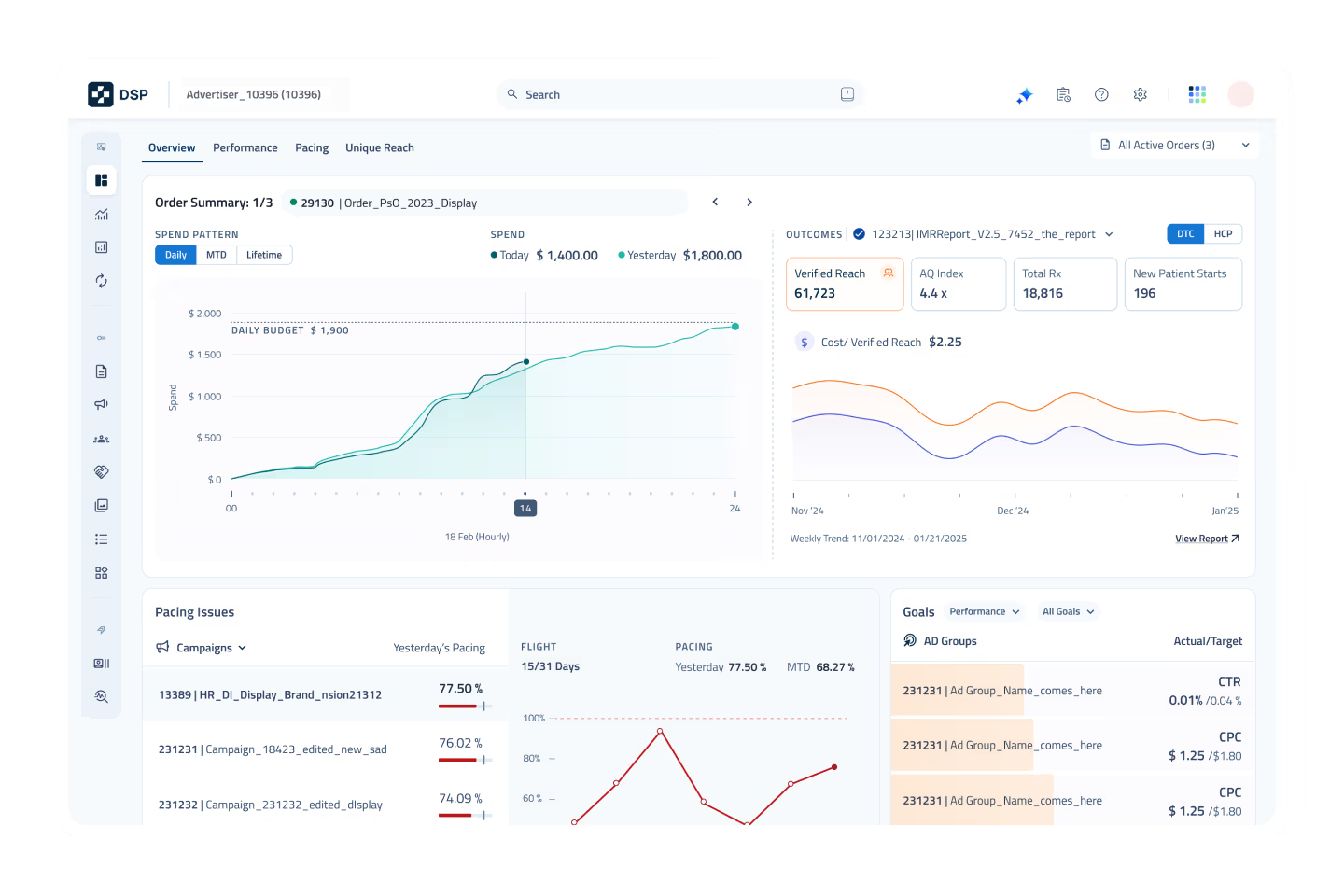
Connected TV and streaming, built on digital infrastructure, give us a lot more capacity to layer in incremental messaging beyond just the video asset itself — overlays, canvas-style interactive units, QR codes that can send a physician directly to a brand site for more information, or prescribing information. There are even formats where we can build microsites that live directly within the creative unit itself, housing additional content like KOL videos. There's a lot we're leveraging now to reach HCPs with more impactful, layered messaging.
JM: How do you approach the actual messaging to HCPs? I've seen a range of strategies — some brands reaching HCPs with essentially a DTC-style message, others taking a very different approach. What trends are you seeing in how television messaging is used specifically for HCPs?
TK: Let's be honest — CTV really took off during Covid, when production for a lot of new creative was essentially frozen. So yes, a lot of brands leaned on consumer-facing assets for HCP targeting too, since, again, HCPs are consumers — there's real value in that consumer messaging reaching them as well. But we're increasingly seeing more HCP-specific messaging too, now that production capacity is fully back. Where we do see clients repurposing DTC assets, those interactive overlays and canvas-style units give us the ability to take a consumer-facing spot and make it feel more HCP-relevant, directing the call-to-action to an HCP-specific site or QR code, or layering in incremental information more specific to a physician audience versus a general consumer one.
JM: And this is all essentially new, thanks to CTV, right? Historically, no one was using linear TV, local or national spot buys, to reach the genuinely niche audience of practicing physicians.
TK: Correct. Historically, linear TV was purely a mass-reach vehicle — if a brand ran a spot during Survivor, the assumption was that both consumers and any physicians happened to be watching were reached equally; primetime television, peak viewership, wasn't discerning between audiences. We used whatever research we had available at the time to identify the networks, programming, and dayparts with higher affinity or higher indexing toward our target audience. Now, with far more data available and new platforms and technologies, we can build much more precise, audience-specific plans upfront — pinpointing the exact daypart, program, and network that genuinely resonate with a specific audience, whether that's HCPs or consumers.
JM: That matters so much, because being able to target a specific segment, HCPs in this case, means less waste and reaching people the industry may never have effectively reached before. That's a great segue into our next topic — beyond HCPs, there are plenty of small population segments, whether that's a rare condition, or a condition that disproportionately affects a specific ethnic group, or an uncommon lifestyle. Historically, we simply couldn't market to them cost-effectively. But now, with CTV's targeting capabilities, we can reach them in a way that's both privacy-safe and cost-efficient.
TK: We work across a lot of sensitive and niche disease states here at CMI, and I'd actually push back slightly on one part of that — we always technically had the capacity to reach those audiences, but only with significant overage, wasted reach. And there's another kind of "overage" worth mentioning too: word of mouth. Caregivers and colleagues have always shared information they picked up from a TV ad with someone else who might've missed it — someone recently diagnosed with a condition might mention a treatment they'd seen advertised to a friend or colleague who hadn't seen it themselves.
But the tactics available to us today really let us micro-segment, especially through CTV — layering in behavioral data, geography, and even third-party claims data, to target specific disease states and indications directly.
JM: Which opens up real opportunity for people who might never have heard that message otherwise, since some brands simply can't afford to market to an entire population, and historically, that meant no message reaching anyone at all through paid media.
TK: It's genuinely opened the door for a lot of brands that traditionally never considered TV and video an option, assuming it was simply out of reach budget-wise. Linear TV is still fairly costly from a mass-awareness standpoint, but with CTV, we can now hone in on genuinely targeted impressions, eliminating a lot of that waste and driving real efficiency, both in overall pricing and in the validation and measurement we can now bring to that audience.
JM: Looking ahead, with all the technology and change we're seeing now, and what you expect down the road, where would you like to see this industry head?
TK: I'd like to see the marketplace start thinking about TV more holistically, as one unified capability, rather than siloed the way it's often treated, linear TV in one bucket, CTV in another. To the consumer, it's all just TV. It's really about understanding your audience and reaching them in the right place, at the right time.
Broadly across the industry, not just pharma, we're still seeing a lot of repurposed linear TV creative running on CTV. I'd like to see more creative genuinely built for each specific tactic, helping drive both consumers and HCPs further down the funnel toward action. Personally, I'm also excited about the consolidation I expect in this space — we saw this cycle before in linear TV, with the launch of countless cable networks and the eventual consolidation into massive conglomerates, Disney, NBCUniversal, Warner Bros. Discovery. There are more and more CTV apps popping up every day right now, and I expect to see some of that start to consolidate too.
JM: It feels a lot like the early internet — more and more websites launching, a lot of overlap and duplication, and then gradual consolidation, where the "long tail" isn't quite as long anymore, and more order emerges, even if it's still the internet, so there's plenty of chaos left. I think television is going through that same cycle right now — moving from chaos toward more order, in a way that can be properly monetized for networks, while still being genuinely useful for marketers trying to reach patients. We've talked a lot about what's changing — what's stayed consistent in marketing to patients, despite all this change, something the industry can't afford to compromise on and needs to stay focused on?
TK: It's not just about impressions anymore, it's about outcomes and real impact. Measurability is genuinely at the core of everything we do now, making sure we can validate performance across our own work, our suppliers, and every partner involved. Clients are holding us more accountable than ever, so it's critical to have absolute clarity upfront on the KPIs and desired outcomes, and build a campaign that's fully aligned in support of delivering those, whether that's script lift, audience quality, or something more engagement-focused, like downloading a specific patient guide. We now have real accountability within CTV and other platforms to validate video's performance, not just within its own channel, but through halo effects across other channels like search and social.
JM: We've talked a lot about the shift toward CTV, but there's still substantial viewership on linear TV. What does the future look like for the combination of the two?
TK: There's certainly a real shift in viewing habits happening, though it's ultimately about personal preference. US adults now spend more than an hour a day watching digital video versus traditional TV, but most people still consume both. That balance shifts a lot by demographic — video now accounts for over 50% of people's total leisure time, and with 77% of the US population now having access to CTV, we're clearly seeing that shift. But there are real nuances by audience and demographic in how it's actually consumed. Younger generations today are very digitally native, having grown up consuming a lot of content through social platforms and YouTube, while older generations tend to stay more attached to familiar formats like cable and linear TV, though even they're adapting, my own 70-plus-year-old mother now consumes most of her content through CTV.
JM: Sometimes the industry itself pushes us in unexpected directions — I wanted to watch a live sporting event recently, didn't have the right app, and it was honestly easier to just pull out an old HD antenna and catch the game over the air than sign up for yet another streaming service I didn't actually want.
TK: There's definitely a lot of nuance specifically in the sports marketplace too. I'm technically a displaced fan myself — my family relocated to the Southeast during Covid, but I'm a die-hard New York fan; I grew up around New York sports, my grandfather actually worked for the Mets and the Giants. So for me, watching a Mets game isn't as simple as flipping on SNY, I have to navigate between traditional and CTV viewership just to find my own teams across these different environments. The evolution of video has genuinely created some real complexity for consumers, and as consumption habits keep evolving, those access points will keep shifting based on what people actually prefer.
JM: One thing you mentioned is how interactivity in CTV, QR codes and other actions, is really shifting TV from a passive medium into something more interactive. Tell me more about that.
TK: It's genuinely valuable for a lot of reasons, especially in healthcare specifically. First, it adds real measurement capability — we can track engagement directly through interactive overlays and canvas units, whether that's QR scans or click-based interactions. We've even worked with partners who can generate heat maps showing exactly where consumers are engaging most within a given video asset. That gives us genuine insight we can use to optimize campaign performance across CTV specifically.
It also brings real freshness to creative. As I mentioned, a lot of clients still repurpose consumer-facing or linear TV assets directly into the CTV space, but overlays and interactivity simply aren't available in linear TV, so it creates genuine differentiation, almost the appearance of a distinct asset. And from a healthcare compliance standpoint specifically, these overlays give us real opportunity, for instance, incorporating a scrolling ISI or prescribing information directly within a canvas or overlay unit, creating incremental space to deliver brand-specific information compliantly.
JM: That's a piece I think the broader ad tech world, mine included, hasn't fully pushed far enough yet. At this point, our televisions are basically giant iPads mounted on the wall, or flat PCs, capable of far more than one-way video streaming — two-way communication, web browsing, pulling additional information, genuinely computer-level interactivity. We may never get all the way to mouse-driven clicking around, but there's so much more available than what's currently being used. Stepping outside pharma for a second: imagine watching a trendy show where the lead character is wearing a specific pair of glasses, and you could click to order them directly to your house. There's just so much more possible that we haven't fully tapped into yet.
TK: Definitely — shoppable formats are something we're only just beginning to explore, and we're actively looking for ways to make shoppable formats genuinely healthcare-relevant. This technology simply didn't exist ten years ago, and while most smart TVs today don't yet have built-in web browsers, the underlying digital capability is already there, or already emerging. I think that's coming, more direct interactivity, going straight from a CTV ad to BrandX.com within the smart TV itself, creating real immediacy, letting someone search for more information without switching devices or leaving whatever they're currently watching. It could all happen within the same platform.
JM: As our space keeps evolving, what's the one thing you'd be fully "all in" on?
TK: More niche targeting within live sports, and expanded engagement and interactivity options generally. Being in healthcare specifically, we always have to take a cautious, compliance-first approach to any new, innovative tactic. But if there's one thing I'm genuinely all in on, it's continued innovation and growth in this space.
JM: Excellent. Well, thank you so much, Toby, for your time — this has been a great conversation.
TK: Thank you, it's been an absolute pleasure.
JM: This has been Deep.
Links
Relevant Blog Posts: CTV Is Rewriting the Rules of Pharma Upfronts. Are You Ready?