Sheyda Karvar, EVP and Head of Media Strategy & Analytics at Fingerpaint Media, leads a team of about 60. The brands she works with rarely fit an off-the-shelf audience, so her team builds its own from claims data and has put AI to work faster than most agencies would. In this episode of Deep: The Health Marketing Podcast, she explains to host Jen Werther how that works in practice and what her team does with the time AI gives back.
Sheyda also says where she’s headed next with dynamic creative, and why a creative-first agency turned out to be the right home for a media strategist. She closes with advice for early-career planners and a moment from a new business pitch she still thinks about.
This transcript has been edited and condensed for clarity.
Jen Werther: Shey, welcome to the show.
Sheyda Karvar: Thanks for having me.
JW: I'm so happy we finally got you on.
SK: I'm always excited to talk to you.
JW: Same. Let's start at the beginning. How did you get your start in media planning, and what drew you to the industry?
SK: I actually started in operations and project management at Razorfish, because Publicis Health Media, where I worked later, wasn't even an agency yet. One of my main jobs was project-managing custom programs. I worked on Gilead's HIV business, and if we had a custom program with BuzzFeed, which was really big at the time, I was the PM working with BuzzFeed and our media strategists.
What drew me to planning and strategy were those conversations: being part of the workshops and ideation sessions where we came up with new partnership ideas. At the time, we were doing a lot of custom quizzes and editorial partnerships. Being in the room to see that problem-solving happen, figuring out what kind of content would pull our audiences in, is what pulled me into planning.
That ops background turned out to be a great asset for where I am now at Fingerpaint, because I had to build the media department from scratch. Understanding the processes, people, roles and platforms we needed to build a successful agency came from that background.
JW: I think project management and ops help with everything day to day. I'm a big check-the-list girl. I still handwrite my notes, but as you can imagine, I also have trackers and status documents to keep me on track. Project management is a great skill.
SK: It forces you to think about who needs to be involved in a decision or project, and about timing. That's important in media planning because so many stakeholders go into the strategy and implementation. Thinking through the process and all the steps ahead has been really valuable.
JW: Take us back to your first media planning role. What did the planning process look like? What tools were essential? What was your day-to-day work?
SK: They threw me right in. My first media planning account was the Dupixent launch, which was crazy to be part of, but very exciting.
I'm going to sound like I'm dating myself, but back in my day, everything was manual. It was all spreadsheets. You picked up the phone, called the partners you'd sent RFPs to and negotiated rates and added value with them. We had binders of insertion orders. It all took a lot of time.
But the part that was so great then, which I see fading, is the relationships. You had to be on the phone or in person. Your partners were in the office with you once a week going through performance and ideas. I think we've lost a little of that in this virtual world.
There was also no programmatic at the time, so we weren't buying audiences. There was no audience data available to us. We relied on surveys from our research arm at Publicis about the websites and content a sample of 20 people said they used. We would plan millions of dollars against those survey responses, or maybe a social listening insight. It was very limited.
JW: I may be dating myself even more, but did you use a fax machine?
SK: No, I didn't use fax machines. I came after the fax.
JW: My first media planning role was at Mindshare. I got there and they said, "Can you go fax this?" And I said, "I don't know how to use a fax machine." To this day I don't really know how, but I learned very quickly back then.
SK: We were photocopying. I remember carrying around binders in case Mediaocean crashed, because back then you had outages and systems that often didn't work. It's crazy to think about.
JW: You mentioned limited audience data. As a media planner, I remember using MRI and Simmons, and my whole career has been in pharma. I remember the cross tabs, the index and the composition. You'd ask, "What about women with rheumatoid arthritis? Which publications are they reading?" And it was all based on syndicated research.
Compare that to now: we can target physicians one-to-one, or reach patient populations in a HIPAA-compliant way using claims data. What does that look like in your day-to-day, and how different is it from early in your career?
SK: The most obvious difference is on the HCP side. Back then it was all personal promotion and rep-triggered emails, and buying inventory on a publication's website was about as targeted as you could get to the specialists you wanted to reach.
Now we can do deterministic, one-to-one NPI-level targeting programmatically on some of the professional portal platforms. And it goes a step further than static target lists. HCP claims data and DSP infrastructure have converged, so you can build an NPI list, push it to a DSP, measure reach, frequency, script lift and so on, and then optimize. That didn't exist. We didn't even dream of it. We did the best with what we had: survey data, syndicated research and the reach scores certain websites had.
Being able to do that has changed the game, not only for targeting but also for measurement and attribution.
JW: Pharma media has always operated under unique constraints: the ISI, regulatory review, the sensitivities that come with pharma. How did those realities shape the way you planned campaigns early in your career, and how does that look today?
SK: Like you, I've only ever known pharma, so it was always part of the job. What was interesting about being a strategist in those early days is that everything was first to market. Those BuzzFeed partnerships were first to market. So was any editorial partnership, and certain kinds of video. Social for pharma didn't even exist when I started planning and buying. With everything being first to market, managing MLR teams and bringing them up to speed on what the digital landscape looked like was a critical and very time-consuming part of the job.
JW: And it slowed everything down, right?
SK: We'd present something in, say, October that wouldn't launch until March, not of the next year but the year after. We had to do so many concept reviews and hope the MLR team would understand that it was privacy-safe, that we weren't saying anything we shouldn't and that fair balance would always be in the unit.
I think it made me more creative and more eager to solve the problem. Now I'm at an agency whose roots are in creative, and from very early on I've thought about creative and media alignment. The message needs to work with the medium, not only for performance but because of that regulatory reality.
JW: We can all say things have gotten easier as we've been able to automate and take a more forward-looking view. It's enhanced planning, strategy and buying, including all the new channels that have emerged. Was there a specific moment, platform or capability where you thought, "This industry is never going to be the same"?
SK: As I mentioned, the launch of programmatic, of course. But CTV changed the game in a lot of ways. I was a very early proponent of CTV once it became accessible to media buyers. It's the biggest screen in the house, with undivided attention, but the cost of entry for linear broadcast and cable was prohibitive. CTV democratized that access for brands of all sizes.
Going from needing massive broadcast budgets to buying that valuable inventory programmatically was a huge shift for the industry and for many of my clients. We could target it to specific HCPs, layer in patient-modeled audiences and measure outcomes.
Being at a creative agency when it took off, especially on the HCP side, amplified it even more. I was working with creative, inspiring people who understood that telling a strong story on that screen could drive real impact, and we could buy that placement for them to tell it.
JW: At a lower cost.
SK: At a lower cost, and more targeted.
JW: Today planners have access to more channels, more data and more automation. What's the most significant capability today that didn't exist before?
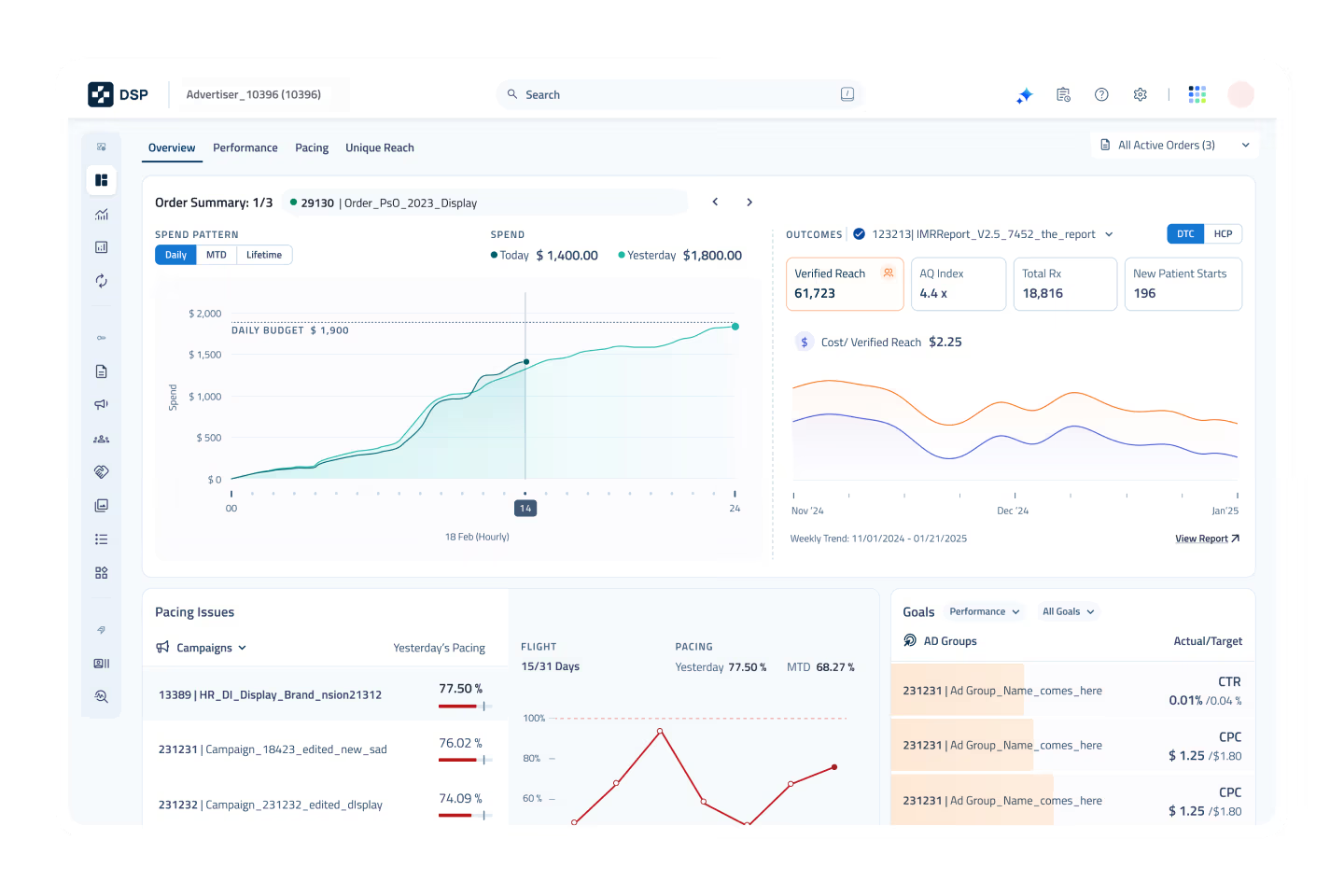
SK: The ability to use claims data to build very specific, custom audiences. We talk to our clients all the time about how static their target lists are. A list is a point in time, and we're lucky if it's refreshed twice a year or quarterly. Having DSPs with access to real-time claims data, so we can quickly reach an HCP who's showing the same behaviors as our target list, has been really valuable. So has being able to set triggers based on that real-time activity.
On the patient side, at Fingerpaint we work on a lot of rare disease treatments and specialty products. Our patient populations aren't off the shelf, like someone newly diagnosed with rheumatoid arthritis who has used one biologic. Getting to a potential rare diagnosis usually involves a complicated series of misdiagnoses, tests ordered and treatments tried and failed. Being able to get to granular claims data, layer it in different ways and build those dependencies and triggers has been a game changer for us and our clients. And of course, we can activate on it quickly.
JW: Let's switch gears to your career path. You started at Razorfish, moved to Publicis Health Media and now you're at Fingerpaint. Going from a holding company to an independent agency must be quite a transition. Tell me about that journey.
SK: I joined Fingerpaint seven and a half years ago, which is crazy to think about. Publicis Health Media was an amazing place to start my career, but I was looking for something different. I didn't want to go to another holding company. I wanted to see the other side of the business.
Fingerpaint's roots are in creative. When I joined, they had been a creative agency for 10 or 15 years. They had clients who were excited to explore media and wanted to keep everything in one integrated shop, so they invested in building a media capability. I was one of three people on the team at the time. We saw an opportunity to do things differently: bring media and creative together, match message to medium and build a more integrated story and journey for our clients' campaigns.
We've grown significantly since then. That message resonated with a lot of the manufacturers we work with: an integrated model where every piece of creative has a place, and where our data and media insights inform the creative and vice versa. We're at about 60 people on the media team now.
JW: Wow.
SK: We've grown a lot. We have amazing clients who inspire us to push the envelope and are always receptive to our crazy ideas.
For me, the biggest distinction wasn't holding company versus independent. It was going from a media-focused holding company to a creative-rooted independent, and getting to work in integrated teams with creative, scientific strategy and brand strategy to tell that story. With the rise of omnichannel, personalization and dynamic content, I'm in the perfect place for this shift in our industry.
JW: You went from operations to media planning to leading a whole media department. Explosive growth brings a lot of challenges, especially as you transform the company to take on automation and AI. Talk to me about that transformation.
SK: About a year into my time at Fingerpaint, there was a specific shift: I wasn't just being asked to plan and run campaigns, but to build out the practice. For more than six years since, I've been accountable for our tools, infrastructure and partners, and I've made a lot of those decisions. That's very different from a holding company, where those decisions are made far above you. I've always been an early internal advocate for knowing when to invest in technology and when to lean on our media partners for certain capabilities.
With the explosion of AI, being at a smaller, independent agency means we don't have a ton of hoops to jump through or layers of decision-making. We've been able to adopt tools and platforms very quickly, on our own or with our partners. We decide on the best tool within days, not weeks or months.
A lot of what we've done with AI has been automating tedious tasks. Our junior associates are hungry to do more strategy, but they were getting bogged down in financial management and campaign performance management. We've automated about 75% of those manual tasks with the AI tools at our fingertips, and we did it within a couple of weeks.
We've put that time back into piloting A/B tests of creative and different data segments, and into digging deeper into performance. That produces richer insights and optimization recommendations that go beyond shifting budget. For example: if a certain creative message is resonating on one channel, should we pull it through to another?
So the first thing AI did was eliminate and automate those tedious tasks. Now we can focus on using AI for data mining and audience targeting, and enhance our work with the time we've reclaimed.
JW: You mentioned earlier that in this virtual, hybrid world, we've lost some of the relationship side. At DeepIntent, we're telling people to use some of the time we're giving back to develop strategic relationships and get in front of the clients and agencies we work with. Do you think some of that reclaimed time will go back into relationship building?
SK: I hope so. We call our media vendors partners because they're as invested in a campaign's success as we are. In some cases, probably more. We've always encouraged that. With more time, we can dig into performance and have more calls and meetings with our partners to understand why something is performing the way it is and ideate together.
We can also build those same relationships with our clients. Recently we developed visual performance snapshots that we send weekly. They aren't a data dump of charts and graphs. They're high-level insights about what we've observed and what we've changed, so clients get a quick touchpoint and a soundbite they can take to their leadership. AI made that possible at scale. We're grateful for it, because otherwise that extra touchpoint would take days to put together.
JW: You've been wildly successful, and you're leading a huge media team. What advice would you give listeners who are early in their careers?
SK: That's a great question. I'd tell them not to silo themselves. There are a lot of narrowly focused specialty roles right now, whether it's point of care or audience strategy. But the best thinking happens when you're sitting next to your counterparts in creative, in analytics and in scientific strategy.
Something valuable that needs more focus is understanding the science behind what we do. We work in healthcare and pharma. Understanding the patient journey, the mechanism of action, the competitive set and the clinical context we're serving ads in makes us better strategists. Being in roles where you can cross-pollinate and get exposure to other sides of the business is critical to becoming a well-rounded strategist and translating all of that into media placement, buying and optimization.
JW: Definitely. I give the same advice: lean in, ask questions and don't silo yourself. So what's next for you and Fingerpaint?
SK: Our focus right now is AI-powered dynamic creative. Now that we have all this data and can target at such a granular level, the technology exists to trigger messages based not just on digital behaviors but on real-world behaviors.
That means implementing creative at scale that meets people where they are in their journey, with ads tailored to the context and to where each person is. Then we can bring together all our data with that personalized creative and learn what resonates with our audience from real in-market campaigns and signals, instead of going back to syndicated research and focus groups.
JW: Awesome. I know you recently got married and moved to the West Coast. What's one thing about living on the West Coast that you didn't expect?
SK: I didn't understand when people talked about the weather. You think, how good could it actually be? But every single day is 70 to 80 degrees with blue skies and palm trees. Being able to walk outside every day is incredible, and it changes your mood no matter how stressful your day is. That's why everyone here is so relaxed.
I've lived in Philadelphia and New York most of my life. We walk fast, talk fast and expect things quickly. When I first moved here, I'd be walking right behind someone on the street, because in California people take their time, enjoy the weather and breathe the fresh air. And I'm thinking, "No, we have places to go."
The weather has an effect on your mood and your level of calm. No matter how bad your day is, when you walk outside and the sunshine hits your face, it's amazing. I didn't realize the impact it could have.
JW: I've heard that. Maybe one day I'll get to experience it.
SK: Everyone should.
JW: What's your favorite industry event?
SK: I love an industry event because I love seeing people in person. That goes back to old-school relationship building.
The most inspiring event for me was outside pharma: South by Southwest. When you're in pharma and want to be inspired, it's a great place to see the convergence of tech, advertising and culture, how they affect each other and what brands outside pharma are doing. I came back very inspired by the potential out there and eager to bring our clients along on that journey.
JW: What's your favorite work memory from the last couple of years?
SK: A couple of years ago, as we were building out Fingerpaint Media, we hit a turning point. We weren't just being invited to pitch full-service media and creative business. Some of the top 20 pharma companies were inviting us to pitch media alone. That was really exciting.
I remember two new business pitches in particular. Some of the people presenting our capabilities and ideas were team members we'd hired as associate media planners or media planners. They had come up at Fingerpaint, grown quickly and taken advantage of every opportunity. I stood in the back of the room watching these incredibly smart people I'd known since their first or second job out of college.
That was my "we've made it" moment. We were pitching big clients and big brands, invited solely for our media capabilities. And the people we'd seen that spark in were standing up in front of the room, selling in ideas and being the strategists we knew they could be. They finally got to showcase it.
JW: That's amazing. I love that.
SK: I love my team. I have the best team in the business.
JW: You do have a very good team. I have that moment too, when I look around at the people who started early at DeepIntent and continue to shine. It's such a great feeling to say, "You killed it. You've grown into a wonderful leader."
Shey, thank you so much for joining the podcast. We were thrilled to have you.
SK: Thank you for having me. I hope I get to see you in person soon.
JW: Me too. We'll have to coordinate next time you're in New York.
SK: Or come to California and enjoy the weather.
JW: I do need that sunshine. I'm looking quite pale.
SK: We're ready for you.