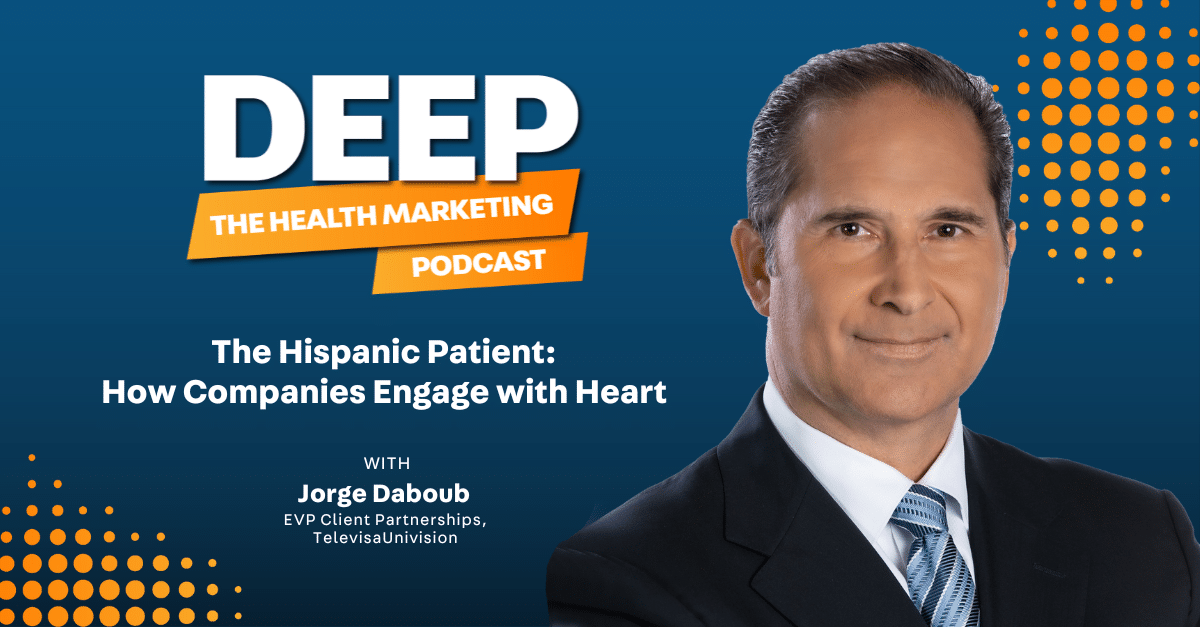
In this episode of Deep, John Mangano is joined by TelevisaUnivision’s Jorge Daboub (EVP, Client Partnerships — Pharma & Healthcare), an expert in health marketing to the Hispanic community. They dive into the often overlooked Hispanic market in pharma and healthcare, discussing the major gaps in media reach, data representation, and opportunities for growth. Jorge shares insights on the unique cultural factors that influence Hispanic health behaviors, such as family caregiving and spirituality, highlighting the underrepresentation of Hispanics in health data and clinical trials. He explains how misconceptions about insurance and financial barriers have created blind spots in marketing strategies. Jorge emphasizes the importance of culturally relevant content and the need to build trust with the Hispanic community, particularly through Spanish-language media. The conversation also touches on the successes seen by brands that have embraced marketing to Hispanics, noting significant returns on investment. Jorge highlights the opportunities available for pharma companies to engage with this growing segment of over 60 million people, and why understanding cultural nuances is essential for better health outcomes and business success.
Transcript:
John Mangano (JM): Welcome to Deep, the health marketing podcast. Today we're going to talk about the Hispanic market — a segment that is too often missed in pharma, and one that's very important to me personally. It's one of the fastest-growing and most flourishing segments, yet there are major gaps in media reach and data representation. In fact, it's estimated that half of pharma campaigns do little or no marketing targeted to the Hispanic market. That means 60 million people — roughly the population of the United Kingdom — aren't receiving messages that could help their health.
In this episode, we hear from Jorge Daboub of Televisa Univision, one of the most knowledgeable people in marketing health to Hispanics. Welcome, Jorge.
Jorge Daboub (JD): Thanks, John. Glad to be here.
JM: Jorge, before we get into all things pharma, tell me a little about yourself. What gets you excited?
JD: There are a number of things. Certainly my family — I'm a father of four young adults, two boys and two girls, happily married for 32 — actually 33 — years to my soulmate. As for hobbies, I love staying in shape: swimming, hiking, and horseback riding. Those are a few of my personal passions.
JM: Do you do those sports with your kids?
JD: I can't really swim with my kids — two of them are very strong water polo players and swimmers, so there's no way I could keep up with them.
JM: You've been at Televisa Univision for over 30 years now — probably the preeminent expert in the Hispanic market as it pertains to pharma and healthcare. What are you seeing today? Is the industry covering the market proportionate to its scale in the country, or are we missing it?
JD: It's interesting — I'd say it's spotty, John. There's a portion of the category — I'd say about half — that's actively engaging with the marketplace, and we see more and more brands looking to engage with Hispanic consumers. Then you have the other half, which puts Hispanic patients in the "DEI bucket" — they check that box, but they don't actually integrate Spanish-language media and consumer engagement into their overall strategy or media mix. That's a real miss for them.
The advertisers who have truly embraced the marketplace are seeing tremendous success. Some are seeing returns on investment of two-to-one relative to the general market. It's an exciting space, and a huge opportunity for growth — many brands in therapeutic categories still have first-mover advantage, even though it's a very competitive general-market environment.
JM: How does the Hispanic patient behave differently from the non-Hispanic patient in the US?
JD: Across therapeutic categories, there are universal behaviors that apply to all patients. Where you start to see nuance is in how culture impacts behavior. And yes, the Hispanic market is diverse — people from all parts of South America, Central America, and Latin America. But we see some very significant commonalities across most people with roots in Latin America: the love of family, caregiving, spirituality, and a certain deference in interactions with physicians. Looking at the health continuum, there are some really interesting nuances in how culture shapes behavior — and those are the insights we try to help our clients better understand, so they can use them as levers to engage more authentically and drive better health outcomes.
JM: As we get more media, more targeted media in digital and CTV — is that giving brands an advantage in getting closer to the Hispanic market?
JD: There's a lot of fragmentation happening across media in general, but it's not as significant in the Spanish-language market. When you look specifically at health content — whether endemic health content or content relevant to a specific disease state, or health and wellness broadly — there's still a real shortage of culturally and linguistically relevant information available to the market. That's the big opportunity for advertisers.
As a company, we're committed to promoting health and wellness. In fact, 20 years ago we launched Univision's health platform. We worked with academic health centers, nonprofit health foundations, consulted with the Office of Minority Health, and worked with experts in health promotion to launch a platform focused on health and wellness, illness prevention, access to care, and information on early detection and aggressive management. Beyond that, there's still not nearly as much information available as there is in the general market. So despite more fragmentation and more connectivity for consumers overall, there are fewer resources reaching Hispanic patients and their caregivers.
JM: Where do you think the industry can focus to close that gap?
JD: First, there's a huge opportunity on the data side — a lot of data underrepresents this market. Clients need to make sure the data they're leveraging is representative of all segments of the US population, including Hispanics. If you look at what the FDA mandates for clinical trials, they haven't historically required that trial population samples be representative of the overall population. Fixing that will help ensure everyone is represented in the data being captured.
I also think AI presents a lot of growth potential to engage with Hispanics more culturally and relevantly — as long as the data and insights feeding it are accurate. So it's a huge opportunity, but also a big watch-out. Clients need to make sure the data is representative of the marketplace, and where there are gaps, they need to layer in additional filters to make sure the data actually reflects all segments of the population.
There's also opportunity in developing content and humanizing the patient journey — understanding the consumer segment, developing content, and partnering with organizations that can not only educate clients on how culture impacts health behavior and where gaps exist, but also help develop content that's relevant and authentic, helping patients engage earlier in their journey. This segment is now roughly 20% of the US population — a segment that could really drive demand and make a difference for a lot of these brands.
JM: And 20% is over 60 million people — that's California and Texas combined. That's a lot of people. Are these data disparities really a function of collection, or is it about different insurance situations? A lot of people probably have an outdated picture of the Hispanic market. When you're talking about 60 million people, it seems nearly impossible to generalize — they're likely represented across every socioeconomic situation and multiple ethnic groups. So how is the industry missing this, and how do we solve for it?
JD: I think there are misconceptions about the marketplace, blind spots, and also real issues in how the data is captured and modeled. To give you an example — about three years ago, our company decided to build a Hispanic household graph. We thought we could just plug into existing data to build our data spine. What we found was that the data we were tapping into significantly underrepresented Hispanics, by as much as 50%. So we had no choice but to build our own household graph, leveraging the hundreds of millions of device IDs and information we have on our audience. It's the first Hispanic household graph. That's something we can partner with organizations and companies on, to help make sure their data is more representative of the entire Hispanic — or at least Spanish-speaking — population.
In terms of research, a lot of the time we see that only sub-segments of the Hispanic market are captured. Clients and agencies often get good representation of the English-dominant Hispanic population, but that's only maybe 20% of the total — they're missing the other 80%. So it's about making sure all segments of the population are represented, so you get a truly representative sample.
As for misconceptions — for example, that Hispanics don't have insurance. Recently, I was in a meeting where someone asked about barriers to entry, and there was a reference to whether Hispanics even have insurance. The fact is, about 84% of Hispanics have insurance. Yes, that's lower than the general market, which is roughly 92–93%, but the market has come a long way, and a very significant portion is insured.
JM: Absolutely. If you had to break it down to three misconceptions our listeners should know are no longer true — or never were — what would they be?
JD: One is insurance, which I just covered. The second is that Hispanics don't have the financial means to afford some of these medications. And the third is that if you don't show up in the data, it impacts both planning and proof of performance. So one is a true misconception, and the other is tied to how the data itself is modeled.
JM: So data bias ultimately gets misread as "not reaching" individuals, when in fact you are reaching them — they're just not being captured in the data you're using to measure that reach.
JD: If I may add one more misconception — that you can reach Hispanics through English-language media alone. People forget that behind the data, there are individuals, and when people are sick, they're vulnerable. It doesn't matter who you are or where you're from — if you or a loved one have any kind of health condition, you're vulnerable, and you want access to the best information and treatment as quickly as possible. So it's about making sure that information actually reaches these individuals, so they can take action and improve their situation.
JM: And you want to speak to them in literally the language that they trust, the one closest to who they are.
JD: You want to build trust and connect emotionally with consumers. The "language of the heart," as we say, is Spanish. Even I find that when I'm thinking about health conditions, I often gravitate to Spanish. And that's what we see in the marketplace, especially because health is such an emotionally driven topic.
JM: What's the industry doing right when it comes to the Hispanic market — not necessarily just health or pharma, but overall? Where do we see success in reaching Hispanic patients?
JD: The health insurance category has really taken note of the size and scale of this marketplace and what it means for their business. They're constantly working to understand key behaviors — how culture impacts behavior, even something like how people respond to calls, and whether you need different protocols to drive better outcomes.
I was talking to someone from a research company about their work with a client — they found they weren't closing calls at the same rate as in the general market. What they discovered was that the person calling in was often a caregiver, not the person who was going to be insured — and the call center operators weren't set up to engage with caregivers, only with the person being insured directly.
They had to evolve their protocols to have a proper conversation with the caregiver in order to drive greater impact. It's subtle, but it makes a big difference — a good example of how culture impacts behavior, and how understanding that key insight can matter a lot.
Within pharma, some clients are doing very well — they have top-down support for engaging with all segments of the US population, including Hispanics, including in Spanish. Their data is representative, their research reflects all segments of the population, and they partner with organizations that can help identify blind spots or gaps in their information. They're not afraid to ask, and they don't let "perfect" get in the way of doing the right thing — both to provide relevant information to the patient and caregiver, and to drive demand for their business. This is a community that's actively looking for health solutions, highly engaged, very responsive, and very loyal — and those brands are reaping the benefits of engaging consistently with the market. Then there are other pharma clients that aren't engaged with the community at all — they fall into the DEI bucket, but that doesn't really benefit the broader Hispanic population, or the brand.
JM: The Hispanic population is so diverse — even comparing epicenters like Miami and Los Angeles, you're looking at very different communities. What are the differences marketers should be aware of, and what are the similarities they can use to unify their messaging?
JD: A good analogy: think about comparing the general-market culture of someone from Georgia versus someone from California versus someone from the Northeast. When you engage with the US population in English, you're leveraging commonalities — common language, and some cultural elements depending on the category. It's the same in Spanish. You have Hispanics born in the US — second, third, fourth generation — and people who migrated here from different parts of Latin America: Mexico, Central America, South America. The largest population of Salvadorans outside of El Salvador is in Los Angeles. There are clusters all over the country, and each country of origin has its own celebrations, traditions, and slightly different food — some similarities, but also real differences.
The commonalities are language, and the fact that around 90% of Hispanics identify as Catholic or Christian — there's almost an ethos of Catholicism woven into the market, in terms of spirituality. In some ways that's a coping mechanism, but in other ways it's very powerful and nurturing in how people engage with health, wellness, prevention, and even coping through treatment. Interestingly, despite disparities in healthcare access, Hispanics tend to have longer lifespans than most other segments of the population, except Asians — even with more issues around metabolic conditions — and I think that nurturing family environment plays a role.
So, yes, celebrate the differences within each subsegment, but market to the commonalities, and you'll reach the broader market effectively. You also have to be careful with language — always use a neutral Spanish, and avoid colloquialisms, because a term of endearment in Mexico could be an insult in Puerto Rico. So don't overcomplicate things, John.
JM: Absolutely. Where do you think the next five years will take us with the Hispanic population? It keeps growing and will probably hit 25% of the US population before long. How does that change the dynamics, if at all?
JD: You already see this happening in key states — Florida, Texas, California — and in certain DMAs where Hispanics are already the minority-majority, or close to it. Looking ahead, that's the general demographic trend. From an economic standpoint, Hispanics are driving a lot of growth — it's exciting when you consider the financial power of the Hispanic marketplace. If it were a country of its own, it would rank as roughly the sixth-largest economy in the world, with something like $1.2 to $1.3 trillion in spending power. It's also a younger-skewing population, which is critical to the country's future.
Culturally, you already see Hispanic influence celebrated in music — Latin music is mainstream in many cases now — and Mexican or Peruvian food is widely enjoyed and celebrated.
In health specifically, there's a lot of opportunity, and the market is making real progress. I think clients are starting to see the benefit of engaging with a community that can help them hit their financial goals — which matters from a corporate standpoint — but is also a community that deserves access to information. DTC advertising is fundamentally about informing consumers about symptoms, triggers, treatment options, and encouraging them to consult their doctor. If that information isn't reaching the people who need it, it's only going to exacerbate gaps in health outcomes.
JM: I don't know if you've formally researched this, or if it's just from your presence in the industry, but what percentage of pharma marketing or pharma brands are missing the mark on the Hispanic market?
JD: Looking at clients rather than individual brands, I'd say roughly half of pharma clients are active — with one brand or across all their brands — in the Hispanic market, and the other half aren't active at all. There's so much potential, so much upside, and such a real need that these clients could fill by informing patients about treatment options — for conditions where prevalence is sometimes on par with, and sometimes significantly higher than, the general market.
We talked earlier about misconceptions — this next one isn't a misconception, more of a blind spot. There are entire drug classes where this shows up. For example, in the CGRP category for chronic migraine, Latinas represent roughly a third of the patient population, and yet a major brand didn't activate in this market until fairly recently, even though that drug class has been on the market for three or four years. So there's huge opportunity for brands that face intense competition in the general market to have first-mover advantage in the Hispanic market. As I mentioned earlier, we have one partner — one brand — that saw a two-to-one return on investment relative to the general market, even though their general-market performance was already strong.
JM: I've seen research showing that the Hispanic market can convert to a brand even faster after ad exposure than the non-Hispanic market, partly due to how they manage their health.
JD: The research I've seen suggests it's about three times faster. There's less clutter, they're highly engaged with media, actively looking for health solutions, very responsive, and more loyal than the general-market consumer — a "stickier" consumer overall. It's hard to go wrong engaging with this segment of the population.
JM: And ultimately, if we're not doing it, it's negatively impacting people's health. We're talking about a market segment, but segments are made up of people — mothers, sisters, kids — who simply aren't getting the treatment they could be getting. I don't think it's intentional, but by missing this market, we're leaving people out of something really important.
JD: You're absolutely right, John. People need to remember, when they look at this data — and we've talked about underrepresentation already — that at the end of the day, these are human beings, people who are suffering, who could really benefit from treatments that are either life-improving or life-saving.
JM: The US has an amazing history of taking in immigrants and, over time, celebrating their differences. My grandparents came over from Italy — I don't think they ever imagined that being Italian would eventually feel like it's no different from anything else, which is how it feels now. We weren't always treated that way, but there was a time we were seen as a minority; now pizza is considered an American dish, along with a million other things — it's part of American culture. I think as the Hispanic market and Hispanic immigration continue to grow in influence, it becomes who we are as Americans, not a group separate from the rest of us. We're becoming one.
JD: And you know what, John? Culturally, it's a natural fit — a community rooted in Christian values, a very aspirational segment of our population. They're here to live the American dream, and many already are — making that progression your ancestors made, but faster than most other immigrant populations that have come to the US. They're reaching educational and income milestones quickly. Look at how Miami has transformed — the Cuban American community is now hugely influential, financially, economically, and politically, in Florida. You see this pattern in different regions where Hispanics have contributed enormously to our economy and every part of our lives.
Yes, it's a transformation, but this is a population that came here specifically to live the American dream. I was born in Mexico City and moved to the US when I was 15. Despite our challenges as a country, this is the best country in the world — I've had the good fortune to live in Mexico, travel throughout Latin America, and live in Canada and Europe, and there's no better country than the US. A lot of Hispanics feel exactly that way. They're proud to be here.
JM: I'd agree. Jorge, you mentioned AI earlier, and inherently there's bias based on the data it's trained on. On top of that, some states are now specifically restricting the use of ethnicity data for things like AI, in the name of privacy. Do you think that poses a problem?
JD: I think it does pose a challenge. There's already bias in the data, and this could make it even harder to get true representation of the Hispanic marketplace. Marketers and business leaders really have to lean in and make sure the data is representative of the Hispanic market specifically, so they get an accurate read relative to the rest of the patient population. That's a big watch-out. AI can be very powerful and help brands engage more effectively with consumers, but it all depends on whether the right data is being used, and used the right way, to drive outcomes and engagement.
JM: It's interesting because it all ties together — when you're building a marketing plan, you have to be conscious of representing every market, including the Hispanic market. And that responsibility extends to the data scientists building the underlying models — they need that same awareness, or they'll unintentionally sabotage the marketing effort without even realizing it.
JD: That's correct. The government is also acting on this — for example, with clinical trials, they're now requiring brands and molecules, during phase three trials, to have all segments of the US population represented. That means clinical data will actually be representative of Hispanics, African Americans, Asians, and others, which will make a real difference. But brands still have to lean in and make sure the data is representative — otherwise it's just going to make the challenge of engaging Hispanics the right way even harder.
JM: Absolutely. As we close, what are the three things you'd want our audience to remember about the Hispanic market?
JD: Ensure your data is representative of the marketplace, so that your strategic plans are built on solid ground — that also helps with proof of performance, so research is critical. If there are gaps or blind spots in the data, partner with organizations that can help you understand the key insights and levers. And finally, integrate Spanish-language outreach into your DTC and point-of-care plans — allocate budget to reach all segments of your patient population, and leverage Spanish-language media across social, audio, and television, wherever you're already investing in the general market, to increase your overall reach and effectiveness.
JM: Well, thank you, Jorge, for joining us today.
JD: Thank you so much, John.
JM: That was a great discussion with Jorge, and it really reminds us that brands need to pay attention to the Hispanic market — and it's a shame that not all of them do, because it's such an important part of not just our population, but the American experience. It's encouraging to see the FDA mandating representation in clinical testing, but we need to start marketing with representation too. It'll be interesting to see how we can improve the underlying data, since that's a big missing piece that affects measurement and even how AI learns about this market.
I want to talk a bit more with my colleague Amit Chaturvedi, an executive here at DeepIntent, a spouse to a medical professional, and someone with a really unique background as a longtime member of the media community, having spent many years at Time Warner. We're going to discuss how diversity impacts marketing, and what we, as an industry, can do better. Thanks for joining, Amit.
Amit Chaturvedi (AC): Hi, John. Thanks for having me.
JM: What did you think of what Jorge had to say?
AC: I've known Jorge for a while now, and one thing that always strikes me when I hear him speak is the depth with which he communicates his message, specifically around the Hispanic marketplace. It makes sense, given how long he's been at Televisa Univision — but the passion behind how he articulates his points is always impressive.
JM: I agree — especially the way he speaks to pharma, because pharma is its own language, just as Hispanic marketing is its own language, and he speaks both fluently, with a real understanding of the connection between the two. That makes him an invaluable resource to the field.
One thing that concerned me a bit, as a data person myself, was the degree of data inaccuracy he described. How does that concern you?
AC: Ultimately, data inaccuracy — a lack of both breadth and depth of data — has implications up and down the value chain. The most significant one is the impact on quality of care. Setting aside the top-of-funnel stuff, like media, marketing, or content creation in local languages — at the end of the day, the bottom-of-funnel activity centers around quality of care. When health data is incomplete or inaccurate, the worst-case outcome is that healthcare systems struggle to allocate resources effectively.
You can trace that same theme — incomplete or inaccurate data — from the top all the way to the bottom of the funnel. If your data is incomplete at the top, health statistics end up underrepresenting reality, media planning and messaging become inaccurate, content creation in specific languages suffers, and ultimately — the most important point — healthcare systems can't allocate resources effectively. Jorge's point about data completeness and accuracy really does impact the entire funnel, top to bottom.
JM: Fundamentally, this is about more than data — it's people, and families watching loved ones suffer through conditions without getting proper care. Is it a matter of data classification — are we capturing this data but just failing to identify individuals correctly — or is it more that certain populations are simply falling off the radar entirely, undercounting the prevalence of conditions out there?
AC: I think it's likely a combination of both — one is cause, the other is effect. Whenever I start a project, I'm largely a data person like you — I need data to get my thinking started. But beyond the data itself, there are also cultural differences in health behavior. In Hispanic culture, similar to some other cultures — including the one I was raised in — healthcare isn't just a personal matter, even though it's your own health. Family often plays a big role in how healthcare decisions get made.
So the data element impacts planning all the way down to resource allocation, as we discussed. But the other piece — the one you can't fully quantify — is cultural differences in health behavior. That's more the "art" side of it; the data is the "science" side. Once you understand the cultural nuance and combine it with more complete data, that gives pharma companies or hospital administrators a broader view, which sparks more creative approaches to improving quality of care.
JM: Amit, could you give us an example of how that shows up differently across cultures?
AC: Sure. My wife is an endocrinologist, so I'll use her as an example of a care provider. Endocrinology is one of those fields where the pain you feel — say, in your arm — doesn't necessarily originate there; it could be coming from somewhere else entirely and just presenting in the arm. So a physician has to think creatively when a patient presents with symptoms.
Over the 20-plus years she's been practicing, one pattern that shows up often with Hispanic patients: younger individuals, in their twenties or thirties, will show up to an appointment with a significant other, a parent, or even a grandparent. It's almost like a family activity, going to see the doctor — regardless of how fluent that person is in English or Spanish, or whether they're bilingual. That's just the culture they come from. For patients who don't come from that background, the visit is often a much more transactional interaction.
Second is the role of the physician — there's almost a level of deference given to someone who's attained that level of education, which becomes apparent as the conversation goes on.
When my wife was training during her residency and fellowship at NYU in New York City, patients would show up who were Spanish-speaking, from somewhere in South or Central America, and at that point she spoke limited Spanish. Given how busy the emergency room was, the hospital had done years of research and realized patients could show up speaking up to a hundred different languages on any given day. Healthcare providers needed to be able to communicate effectively with all of them.
So instead of relying on broken back-and-forth Spanish — this was before real-time voice translation apps were widely available — the hospital had physically installed two-way phone systems. A patient would pick up one handset and speak into it; my wife, the provider, would pick up the other. The call routed to an interpreter overseas who could translate in real time.
That might seem like a basic thing today, but think about the capital investment required to make that happen in a hospital serving thousands of patients daily — figuring out the patient population, the range of dialects, and building a reliable pool of interpreters available around the clock, able to translate accurately in both directions without creating an awkward dynamic between provider and patient. That hospital had made that investment. Many haven't. And all of it starts with the hospital needing good data — on their patient population and the languages they speak — to be able to allocate the resources that make that kind of high-quality, compassionate care possible. If they'd started with inaccurate or incomplete data, all of that downstream allocation would have been compromised.
JM: And there's a piece not everyone realizes — it's not just that more family members show up to the visit, they genuinely influence the decision-making around the patient's care.
AC: Absolutely.
JM: So if you can't communicate with the whole group, decisions may end up being made with only partial information, simply because they couldn't understand what was being said.
AC: A hundred percent, I agree.
JM: That's a good segue into marketing — obviously, the most important moment in anyone's healthcare journey is the time spent with their provider. But stepping back, as marketers, we're often the ones responsible for getting those conversations and doctor visits to happen in the first place, and that messaging has to start somewhere. As someone who's spent time in media and marketing, and now here at DeepIntent, what would you recommend marketers and agency people in healthcare and pharma do to be effective in today's multicultural, Hispanic-focused communications landscape?
AC: I'd break it down into three buckets. First, culturally competent messaging — making sure messages resonate culturally with the Hispanic population, understanding that we're talking about different countries of origin, dialects, and cultural nuances. A one-size-fits-all approach can come across as offensive to people within this population. Related to that is language inclusivity — understanding regional dialect differences to maximize reach and relevance. Marketers often use a blunt instrument here, even though the majority of the Hispanic population also speaks English — but people who speak more than one language often don't think in English, and may not be thinking about their healthcare in English either. So it's important to use formats appropriate for both Spanish-dominant and bilingual audiences.
The second bucket is leveraging Hispanic media channels — Spanish-language television, radio, digital platforms, and relatable, culturally aligned social media influencers. That all helps marketers reach this audience much more effectively.
The third — and I'll go back to my comfort zone here — is data: segmenting the Hispanic population appropriately, since not all Hispanics share the same healthcare needs. That means segmenting by age, health behavior, and language preference, and understanding that certain chronic conditions — diabetes, hypertension, thyroid cancer, in my wife's field, for example — disproportionately affect this population relative to others. And it means partnering with data providers who specialize in this nuanced dataset around Hispanic demographics, so the insights actually reflect real-world behaviors and healthcare access patterns.
JM: That's an interesting point, because medicine has a lot to do with genetics specifically, and I'm not sure everyone realizes that the Hispanic population, globally, actually spans every ethnicity and race. If you look across the Americas, where most Hispanics originate, it's a region of immigrants, much like the US — Indigenous peoples, people with African origins, European origins, and Middle Eastern origins as well. So there's a cultural piece they share, though it varies by country, but also genetic differences, since people come from so many different places — and that's a big part of the equation when it comes to health outcomes.
AC: A hundred percent agree. Jorge is actually a great example of exactly what you just described — his family has Middle Eastern roots, deep roots in Mexico, and he's also Canadian. Put all of that together, and what you get is Jorge. But his healthcare needs may not be the same as yours, and mine likely won't be the same as either of yours.
JM: Exactly. Well, thank you, Amit — this has been fantastic.
AC: Thanks, John, I really enjoyed this conversation.
JM: This has been Deep.
Announcer (Voiceover): You've been listening to Deep, the health marketing podcast. Deep is a presentation of DeepIntent. Opinions shared by guests represent their own perspectives, not the views of their company or organization. If you'd like to learn more about the guests, the show, or the topics discussed, check out this episode's show notes in your podcast app, or visit deeppodcast.com. If you have a question or a suggestion for the podcast, drop us a note at podcast@deepintent.com. If you like the show, please leave a comment and give us a five-star rating on your favorite listening platform, and be sure to subscribe so you never miss an episode.
The Deep Podcast features original music by Diaphonic. The show is produced by Robert Haskett, with Ben Abramowitz, and hosted by John Mangano. Thanks for joining us.