In this bonus episode of Deep: The Healthcare Marketing Podcast, host John Mangano sits down with DeepIntent Founder and CEO Chris Paquette for a candid, wide-ranging conversation on the future of healthcare marketing—and what it means to get it right.
Chris shares the story of how his unique background led to the creation of DeepIntent. He explains how healthcare advertising is transforming through Health Intelligence™—a combination of real-time data, programmatic media, and AI that delivers smarter, more relevant campaigns.
From the rise of patient empowerment to the challenges of data fragmentation and media scale, Chris offers practical insights and a bold vision for the years ahead. You'll also hear how the industry can create more n-of-one experiences, why personalization must be privacy-safe, and what pharma innovation teams should focus on right now.
Transcript:
John Mangano (JM): Welcome to Deep. I'm John Mangano. Today we have a bonus episode — Chris Paquette, CEO of DeepIntent, joins me to discuss what the future of healthcare marketing looks like. Welcome to the show, Chris.
Chris Paquette (CP): Thanks, John, it's great to be here.
JM: As you know, we like to talk about the people behind healthcare and pharma — we always focus on patients and providers, but also the people who make all this healthcare marketing real. You have an amazing story. How does someone go from being a data scientist at a hospital to founding one of the most innovative healthcare ad tech companies?
CP: My path actually started even before the hospital. I got my degree in bioengineering, and I started out literally hand-coding neural networks in Excel, believe it or not — basically doing data science before "data science" was a trendy thing to call it. My first job out of college was at an advertising technology company focused on search, where I learned the ropes as an analyst, with a strong product focus. I got to know the technology very deeply and built a real appreciation for performance in advertising.
From there, I had a bit of a detour at Memorial Sloan Kettering, where I was tasked with building one of the hospital's first data science teams, focused on clinical operations.
While I was there, the most pressing challenge we faced was combining different health data sets to build machine learning models that could actually deliver value to patients and providers. That sat right alongside another problem: delivering timely, relevant messaging and information to patients, to help improve their quality of care — and not just patients, but providers too, helping them be more prescriptive about the kind of care and care pathways those patients should follow.
So, long story short, I came into DeepIntent with a fairly multifaceted background, and the way I think about it is that I merged those two worlds — healthcare and advertising technology — to essentially create the earliest version of what DeepIntent is today: that combination of healthcare and ad tech, doing everything we do now.
JM: And it's remarkable, because our research shows it genuinely makes a difference in people's health and their lives. What's been the most impactful thing you've seen the industry do since you started?
CP: I'd say it's almost a microcosm of the industry itself: every time we deliver a message, there's an actual audience, a patient, or a provider on the other end of that ad. I think back to my time at the hospital, having those conversations directly with patients and providers — obviously one-on-one conversations. We've since built a platform that's essentially having one-on-one conversations millions and millions of times a day. Taking that same kind of experience and scaling it programmatically, using data to make each message more relevant and customized to each patient's and provider's specific journey — that's the most exciting part of this, to me.
So I'd say the single most disruptive, most transformative change I've seen, over almost 10 years building this company, has been the widespread, deeper integration of health data to improve the relevance of how we communicate with patients and providers.
JM: Even just looking at the past year, so much has changed — ad tech is leaping forward, whether that's AI, or how we're unifying data through clean rooms, plus all the legislative changes we keep hearing are coming. What do you think will be most influential over the next 12 months?
CP: The biggest changes on the horizon: first, the increasing consumerization of the patient. Brands are now offering drugs directly through their own websites to consumers — think Wegovy, Ozempic. And thanks in part to technologies like generative AI and large language models, patients are becoming increasingly empowered, taking more ownership of their own health. That shift toward patient empowerment is going to keep accelerating, and it opens up a lot of new opportunity for us to rethink how we engage with patients.
Second is the continued fragmentation of media. We all know about walled gardens — search, social, and so on — but the world of advertising is much bigger than just the open, premium web.
Third is the rise of genuinely disruptive technologies — AI, LLMs, generative AI — fundamentally changing how we interact with data and information. We need to be ready for that. As long as we keep doing right by patients, consumers, and providers as our North Star, both we, and the industry as a whole, will stay well-positioned for success.
JM: So how do we actually solve for that?
CP: At DeepIntent, we believe the answer is what we call "health intelligence." To be specific, that's a combination of near-real-time data feeds, real-time media opportunities, and what we call real-time AI, all brought together to deliver four core value propositions: speed, choice, precision, and scale.
Think of our business like this: DeepIntent sits at the center of a bow tie. On one side, you have this massive healthcare data ecosystem — enormous amounts of data about patients, providers, and the healthcare system generally, at any given moment. On the other side, you have the world of advertising opportunities — the media ecosystem, all the publishers and channels we work with and partner with, to reach patients, providers, and consumers in real time, programmatically.
When you bring those two worlds together, DeepIntent sits right in the middle. What we do is take the most current representation of what's happening in the healthcare system, process that information into actual insights, and use those insights to decide who to reach and with what message. The more we can reduce the latency in processing and acting on that data, the more relevant and precise we can be — which is really how we address the trends I mentioned.
JM: Let's dig into speed specifically. We live in a time when everything moves faster than ever, and in healthcare, the benefits are very real — less pain for patients, healthier people, lives saved. I think Melissa Gordon-Ring from Initiative Media put it well in an earlier episode:
Melissa Gordon-Ring [from Episode 1]: "We're getting things to market faster than we've ever been able to do before. Speed through the lens of transformation, and the ability for us to make real differences in patients' lives, faster. One of my clients talks about 'patients are waiting.' So I look at things through that lens specifically, around speed and what that really means."
JM: Where do you see speed driving the greatest innovation in helping patients?
CP: Hearing that quote from Melissa, who's brilliant — the way I process it is: as a service company working on behalf of pharma and their agencies, we can help create more relevant messaging and more immersive experiences, better aligned with what a specific patient actually needs, and more personalized to what that patient or provider is currently going through.
The challenge is that other verticals outside healthcare operate under far fewer regulatory constraints. They can process data and react in real time — a consumer adds a product to their cart on a brand's website, and you can retarget them almost instantly. It's not that simple with health data. The conversion signals and behavioral signals we work with just don't arrive at the same speed as they do in CPG or finance.
So we've had to work around that — at DeepIntent, we've really pushed hard on reducing data latency, because the faster we can get conversion and behavioral signals into the platform, the faster we can act on them to personalize the experience. For example: if you're a patient visiting your doctor, there may be insurance eligibility checks or prior authorizations happening behind the scenes. If we can capture that prior-auth signal in the platform, we could trigger messaging to your provider, letting them know a patient with a specific condition — someone potentially eligible for a particular clinical trial, say — is likely to show up at that office within the next six to nine weeks. We can send that message to the provider automatically, algorithmically, with no manual intervention required.
That lets us build a deeper contextual understanding, both for message delivery and for optimizing campaigns based on the actual response — whether patients are going on script, or doctors are writing more, or fewer, prescriptions. We can adjust pricing, buying, and placement decisions, and figure out which publishers are actually driving those outcomes — analyzing all these dimensions and optimizing faster than other platforms, and certainly faster than a person manually sifting through that same data, which could take months. It's a genuinely exciting time. When we talk about speed, we really mean "learning rate" — how quickly can we learn what's happening in the market, and how quickly can we act on it?
JM: For listeners who aren't as deep into this as you are — patient privacy is still fully protected on a one-to-one basis throughout all of this, right? Can you unpack that a bit?
CP: Absolutely, a hundred percent — and honestly that's almost a given for us. We've invested heavily in patented approaches to how we manage and process that data, specifically so that no individual patient can be re-identified. Frankly, we don't care about any single individual's data. What we care about is drawing patterns — figuring out what's working or not working in a campaign, and using those aggregate signals to become more effective in delivering the message we believe will drive the best impact, both for the advertiser and for the broader cohort of patients, consumers, and providers we're reaching. We always operate at the aggregate level.
Think of your own doctor — they extract patterns from seeing patients over and over throughout their career, and that experience makes them better, more effective clinicians over time. That's exactly how we treat our AI. We don't care about understanding any one individual patient's specific condition — we care about the patterns we can extract, so we can predict what information is likely to be most relevant to that type of patient or consumer.
JM: In a lot of ways, that's actually more powerful than any single doctor. A healthcare provider might see a thousand patients over a career, and there are millions of providers out there — but we can analyze patterns across millions, even tens of millions, of patients, and learn things you simply couldn't uncover from a much smaller sample. That's what makes it so interesting.
CP: Exactly right. Here's a real example: roughly 80% of migraine sufferers are women. As a doctor, you'd naturally see that pattern show up in your own patient population. So how should that influence how a pharma brand delivers advertising? Chances are, you'd want to skew toward reaching more women — maybe women-oriented publications, or specific channels or streaming apps. That's a great example of exactly what we're after: looking at the aggregate data, and using it to make delivery more relevant, more effective, and more efficient for our clients.
JM: Another point you raised is the relevancy of pharma advertising generally. You really can't work in pharma marketing and meet anyone socially outside the industry without them asking, "Oh, are you responsible for all those ads? Because I didn't know I had this thing — and I don't." We deal with that constantly as marketers, and we know the overall value delivered far outweighs the minor inconvenience of learning about a condition you thankfully don't have. But there's still a lot we can do to be more relevant. Mike Caruso from SSCG, in one of our very first episodes, described exactly what's at stake for pharma marketers:
Mike Caruso [from an earlier episode]: "Anything that's going to help serve more relevant messaging to the right people is going to help overall health outcomes. Serving it to the wrong patient isn't doing anyone any good — it's probably causing a negative reaction toward the company and the brand itself."
JM: Chris, how do you think we solve pharma's relevancy problem?
CP: That's a great point from Mike. We've all seen irrelevant pharma ads — you turn on your local news, or even watch the Super Bowl, and there are pharma spots that just don't hit home. We actually ran research with Magna Media Trials last year and found that 55% of patients feel like they're regularly seeing ads that simply aren't relevant to them. That's exactly the premise behind why we exist — pushing for better, more data-driven advertising, because we know that when we do successfully reach the right patients, the benefit is significant: higher treatment adherence, more informed patients, better-informed conversations between patients and their doctors.
It's genuinely important that we find those needle-in-a-haystack opportunities to help patients make the right decisions for their health, whether that involves a specific drug or not — the goal is healthier patients, full stop. That's why we're pushing this idea of "health intelligence," keeping data central to how we analyze real-time trends. Going back to the migraine example: finding those insights that let us be more efficient and relevant — I wouldn't want to run a bunch of migraine ads on predominantly male-oriented publications when women make up 80% of that patient population. Precision really is the whole goal here, and our entire product roadmap is built around using large data sets, real-time AI, and the scale of programmatic advertising to choose exactly which ads go to which audiences, based on what's actually going to perform.
JM: It really comes down to: if you can reach just one more patient for every dollar spent, that's potentially many more people getting onto treatment and achieving a better health outcome.
CP: Right — but it's also about reaching them in the right context, in environments most likely to actually drive behavior change, or that are simply most contextually relevant. That's where data helps enormously. Looking ahead, I think our industry is moving toward genuinely "n-of-one" experiences — highly customized, highly personalized, built around each specific patient's information needs. That has to happen in a privacy-safe way, with proper opt-in and consent, of course. But I think we're heading toward fundamental changes in how patients interact with information, and a lot of that will come through AI. We're paying very close attention to how we can rethink the way patients, and providers, engage with information going forward.
JM: What challenges do pharma brands face in accessing their own data and integrating it with what they already have, and what trends will pharma need to manage over the next 12 to 24 months around data management, accessibility, and choice?
CP: Honestly, pharma companies themselves struggle just to consolidate their own data. Any large organization has significant data silos, different stakeholders, disconnected systems. So there's real value just in connecting the systems that already exist within a given pharma company — that's the first-party data side.
Then there's the broader data ecosystem, which I think is where you're really getting at — there are a lot of different data providers out there now. Some aggregate data, some originate their own. What I think will happen is simply more choice emerging. A lot of our work is bringing different types of data sets together — some providers offer better value or utility for a specific brand than others.
Some data providers have stronger coverage for one set of conditions than others do for that same condition. From our perspective, we think of DeepIntent as a kind of middleware — a connector across all these different data sets. We want to hand clients the tools to find the data sets that will drive the most impact for their specific brand objectives, and also provide recommendations on which will drive the best results given their campaign goals. So when we talk about "choice," our role is to provide the connectivity — but ultimately, it's the client's choice which data set is the right fit for the job.
JM: Having real data choice matters, but ultimately every campaign also needs scale — our goal as pharma marketers is reaching as many patients as efficiently as possible. What is DeepIntent doing to maximize scale and effectiveness for clients?
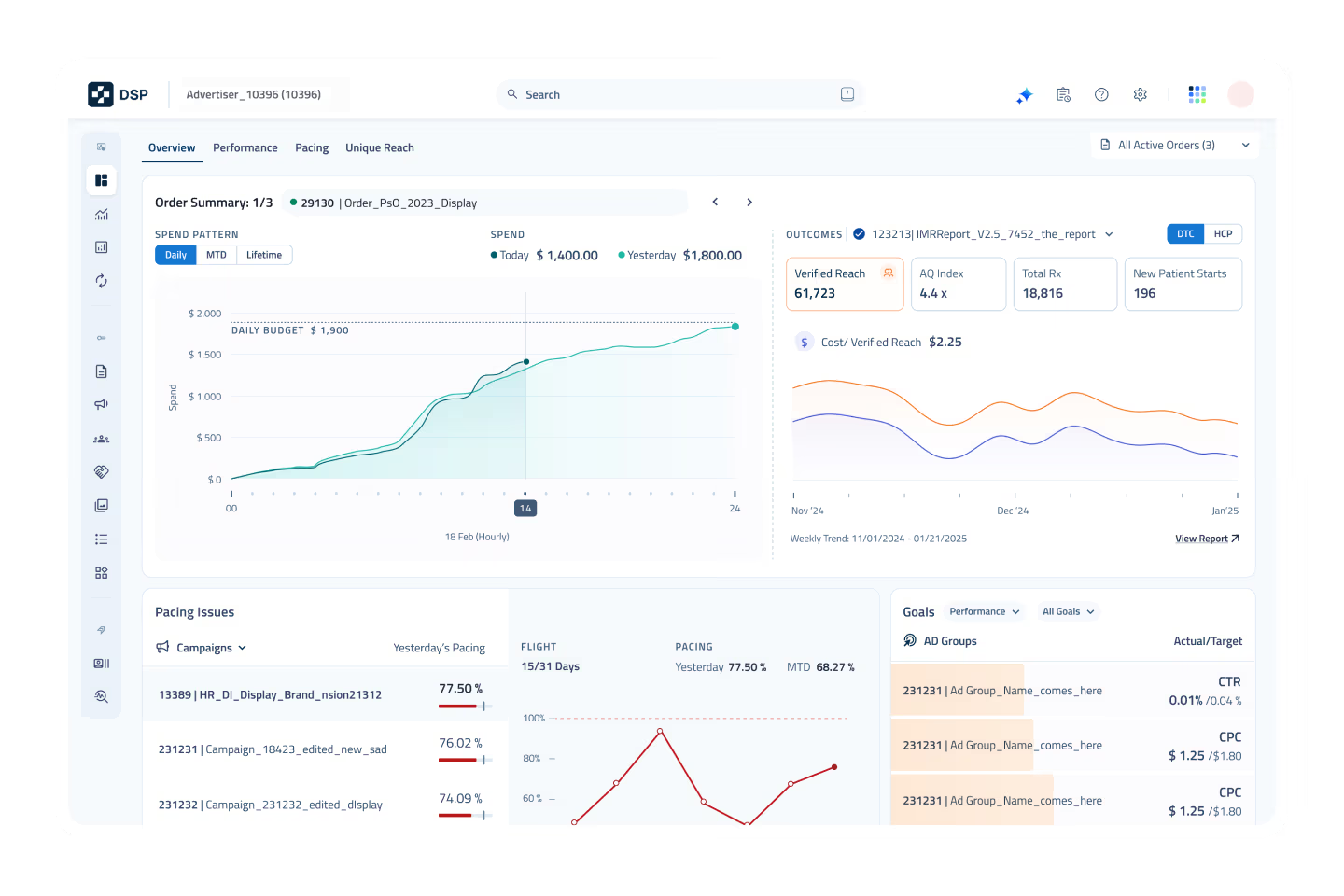
CP: Simply by using a demand-side platform, you get access to a huge amount of inventory and media opportunities spanning most, if not all, of the digital channels that matter most to a pharma marketer. The advantage of using a healthcare-specific DSP is that the integrations, the data, the technology, and the optimization are all purpose-built around a single goal: the most effective possible healthcare campaign. By definition, you're using a programmatic platform that can make decisions at scale — who to serve ads to, who not to — based on data deeply integrated into how bids and impressions are bought, what price you pay, and what ultimately drives the most efficiency for your specific campaign goals.
One of the core ideas we build around is putting "health intelligence" first, not just in how we reach audiences — we have a product called Health First Audiences, which we believe is the most performant way to reach patients, providers, and consumers — but also in how we curate inventory. We're connected across streaming TV, audio, digital, out-of-home, newsletters — a huge range of inventory. What we want to do is pull all of that together, apply our audience intelligence, and package and curate the best opportunities for a given advertiser, using data to underwrite the whole process.
Part of our roadmap this year is making it easier to identify the highest-value publishers and opportunities most likely to perform for a given campaign's specific goals, again grounded entirely in data. We imagine a world where a client comes into a healthcare DSP — ideally ours — with full confidence that data is being used to make better, more informed decisions about finding their patients and providers, across any channel. That's really the purpose behind what we're calling Health First packages.
JM: We've talked a lot about where our industry is headed — let's look outside it for a moment. There's some genuinely interesting work happening with AI and other technologies elsewhere. What can we learn from outside health that might give us an advantage within it?
CP: I touched on some of this already — using generative AI and LLMs to distill massive amounts of information, and make it easier to understand what's happening across a campaign, natively within the platform itself. We're also experimenting with better recommendation approaches. But at the end of the day, what matters most is the quality, strength, and recency of the signal coming into the platform.
A lot of it comes down to picking up learnings and best practices from other industries that have gotten further ahead in integrating real-time intent signals, or real-time consumer context, and building products on top of that — whether for more accurate, relevant advertising, or simply understanding what's working or not working in a campaign, and being able to react quickly, optimizing publishers and channels in or out as needed.
JM: We work with a lot of innovation groups within pharma. If you were meeting with a brand innovation team at one of our pharma clients, and they asked for the top three things to focus on right now, what would you tell them?
CP: The biggest challenge our industry faces today is solving for fragmentation. When we talk about the omnichannel experience we've discussed for years, I believe the biggest obstacle to achieving it is data fragmentation and channel/media fragmentation. So if you're anyone at a pharma company touching marketing in any way, your first priority should be figuring out how to unify and federate all your data into a single, coherent model — one clear representation of your provider and patient populations.
Once you have that unified, definitive representation, you can start doing things like real personalization through next-best-engagement or next-best-action strategies — quantitatively analyzing which publishers, channels, or partners will drive the best results for you. From there, you can start connecting the results of your digital campaigns to your personal promotion efforts, and your broader non-personal promotion campaigns too. There's a lot of opportunity here, but the North Star right now is solving for fragmentation, and finding the right partners who think about the problem that way is genuinely valuable — it'll save you an enormous amount of wasted time, potentially years, compared to trying to solve it entirely on your own.
JM: Last question. If you were speaking to someone just starting their career in pharma ad tech, what advice would you give them?
CP: Data is the most important thing you can focus on. Every marketer should get genuinely comfortable understanding data, not allergic to it, because the world we're actively building right now is data-driven, full stop. Why? Because consumers, patients, and providers all expect to be heard, and expect the information they receive to be personalized to their own context, their own needs, their own stage in their specific journey.
It's important for marketers to think of themselves as more than just marketers — really, as advocates for each individual patient, at scale. The only way to do that well is through data. So my advice to anyone entering healthcare or pharma marketing: get intimately familiar with the data you have, the data that exists beyond your own organization's walls, and the partners who can help connect all of that together.
JM: That's great advice. Chris, thank you so much for joining us.
CP: Thank you for having me, John — always a pleasure.
JM: This has been Deep.
Announcer (Voiceover): You've been listening to Deep, the health marketing podcast. Deep is a presentation of DeepIntent. Opinions shared by guests represent their own perspectives, not the views of their company or organization. If you'd like to learn more about the guests, the show, or the topics discussed, check out this episode's show notes in your podcast app, or visit deeppodcast.com. If you have a question or a suggestion for the podcast, drop us a note at podcast@deepintent.com. If you like the show, please leave a comment and give us a five-star rating on your favorite listening platform, and be sure to subscribe so you never miss an episode.
The Deep Podcast features original music by Diaphonic. The show is produced by Robert Haskett, with Ben Abramowitz, and hosted by John Mangano. Thanks for joining us.
Links
- Chris Paquette on LinkedIn
- DeepIntent
- Memorial Sloan Kettering Cancer Center — referenced as Chris's prior employer
Relevant Blog Posts: DeepIntent Launches Helix™