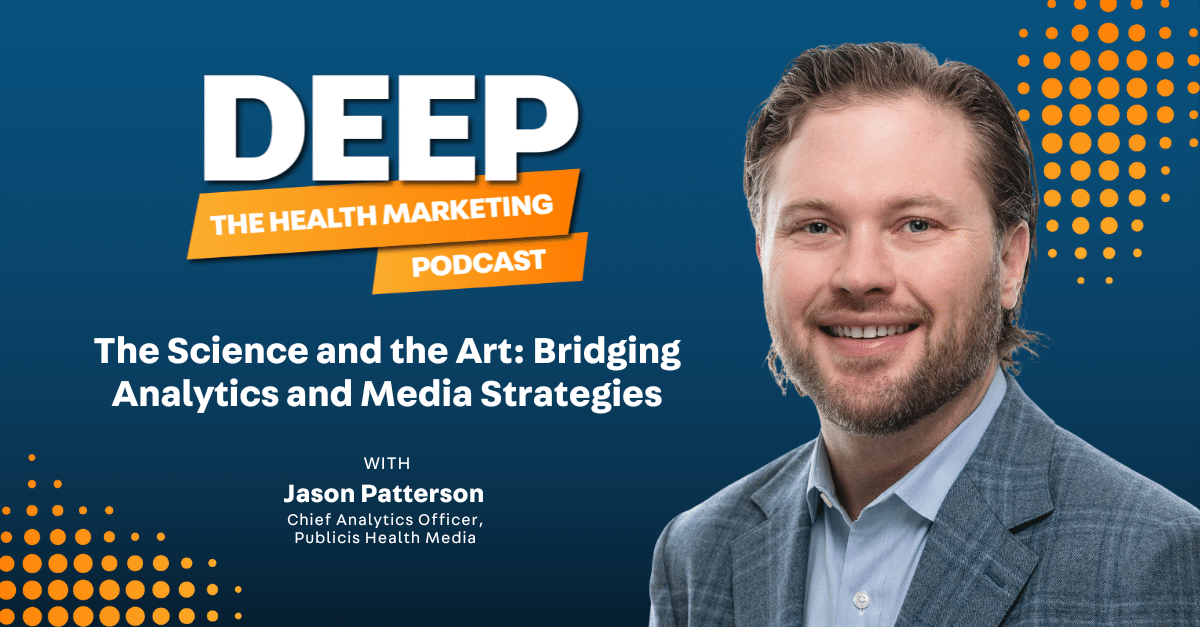
In this episode of Deep, John Mangano talks with Jason Patterson, Chief Analytics Officer at Publicis Health Media, about the evolving landscape of media, analytics, and advertising in healthcare. With a career spanning leadership roles in top media and analytics companies, Jason offers unique insights into how client expectations have transformed over the years and how they will likely continue changing. They discuss the critical balance between media strategy (an art) and analytics (a science), the importance of transparency in client and partner relationships, and how the right data can drive better decisions and improve patient outcomes.
Transcript:
John Mangano (JM): Welcome back to another episode of Deep, the health marketing podcast. I'm John Mangano. Today we're going to talk about pharma analytics. We often hear that pharma is behind other industries in terms of what we can do — but in analytics, we're actually ahead of most other industries, especially CPG.
In today's episode, Jason Patterson, Chief Analytics Officer at PHM, and one of my favorite people I've had the chance to work with, reveals his secrets to success: transparency and curiosity. In this episode, he discusses the evolution of the media landscape, the significance of data in improving advertising strategies, and the role of AI. Even with all the changes happening in the industry, Jason remains genuinely positive about what the future has to offer. Jason, it's so good to have you here today.
Jason Patterson (JP): Hey, John, thanks a lot. It's really awesome to sit here and talk with you again.
JM: Jason, we'll learn a lot about your experience in the pharma marketing world and in analytics, but more importantly, we're all people, and what drives us most tends to be the things that happen outside the office. What excites you outside of work?
JP: The biggest thing consuming my life right now is being a father of three preteens. I often joke that I actually go to work to relax, because when I'm not at work, we're driving to dance, watching baseball games, going to school events — it's great, getting to see the world through their eyes, but that's what consumes me. It's just as busy at home as it is at work these days.
JM: You have a very interesting background. Right now you're the Chief Analytics Officer at PHM, but when you look at your career, you've spent a lot of time on both sides of the fence — on the media side and the analytics side, at an agency, but also earlier at Mindshare and Starcom, as well as some of the top media analytics companies in the industry, including comScore, where you and I got to work together, and Nielsen. So you have an interesting vantage point, understanding both sides of the equation. What's the thing that gets clients most excited and matters most to them?
JP: A lot's changed over that time span you just laid out, and I've always focused my career on really understanding how advertising and marketing works, in order to improve it. There's no question that today we're spoiled with data and technology. When you think about what gets our clients most excited, it's really about the ability to find out what's wrong and fix it. That's where I focus a lot of our efforts — using data to help improve our plans, not just to report how well we're doing, but to actually improve the plans and get more out of the money our clients are investing.
JM: You sit in an interesting position within the media agency, because ultimately you end up in a role that's a bit like a referee, often between your own media buyers and, say, the endemic publishers, the programmatic vendors, or all the parties the investments are being made with. What's that like?
JP: I don't know if I'd classify it as a referee — a referee is someone sitting between different parties saying "that's wrong" or "that's right." Our role is really around identifying vulnerabilities. As we do that, we're an extension of what we do as an agency. Our agency isn't an analytics firm — it's a media buying organization, stewarding and strategizing investments on behalf of our clients. A media strategy is a hypothesis. We go to market to reach the right audiences, to communicate the value and benefits of the treatments our clients are delivering. We choose placements where we think we'll reach our audience and where the message will resonate. There are financials involved, different levels of investment across different channels, different tactics, different creative formats.
So our role isn't to declare what's working and what's not — it's to guide where we see vulnerabilities. But there are also realities of investment: we're buying TV for a very specific reason, programmatic for a very specific reason. We're careful not to be the sole judge of performance. Instead, we partner with our strategy teams to help guide the right decisions. To use your referee analogy — what we're not doing is being the ultimate source of truth on whether things are working or whether we're doing a good job. Our clients have their own internal analytics that show what's working, and it goes beyond media — it's Salesforce data, sampling, product, packaging, all of it. We do our part to inform different areas, but we're not dictating with certainty everything that's happening in the market.
JM: I appreciate that. I've worked opposite you for many, many years and have always been impressed with how you navigate everyone. As an endemic partner myself, I always thought my campaigns were performing as well as they could — and sometimes they weren't — and you helped us optimize. You've always been so good at balancing that. What's your secret? What's the approach that keeps everyone focused, on the client side as well as the publisher and vendor side?
JP: The key thing I talk about with my clients, and with our internal partners, is transparency. As a media agency, we're gatekeepers of a lot of data. You also have data that informs your platform. Our clients have data that informs overall success. I don't look to create a black box — I think the only way to improve performance is for everyone to be aligned on what we're trying to accomplish.
Going back to my earlier point: from an analytics perspective, we're not media strategists. Strategy is very much an art, and analytics is very much a science, and combining the two can get a little messy. But when you're transparent — when we're clear with our clients and partners upfront about what success will look like, that our goal is improvement, not a reduced budget or the cheapest possible eyeballs — we're trying to improve patients' lives and build business performance for our clients. When we're transparent, it gets everyone aligned — not just around which data sources we're using, but how we're applying the information from those sources too.
JM: What are the top three things you're focused on right now?
JP: It's a bit cliché to say the world's evolving and changing, cookies are going away, and technology is proliferating — but audience creation, audience management, and ID-based activation are becoming really critical. We're focusing on all of that. There's regulation coming — or already here — that's going to affect how we're able to invest in the marketplace.
But from a measurement perspective, the thing I'm constantly focused on is what's next. You listed off a lot of places I've worked over my career, and at every one I did very different things — even within my time at PHM, from the day I started to now, I've done very different work. It's really about what we can do to continue understanding efficacy. We're not just buying TV, digital, programmatic, audio, and point of care anymore — TV has become a digital medium; there's advanced TV, there's CTV. So we're focused on making sure we can continue to measure all aspects of the plan.
If it were three things: first, continuing to understand how the marketplace is changing — we can't evolve measurement unless we understand that. Second, making sure we keep pushing the industry on how we incorporate that into measurement and analytics, and how we still find opportunities for improvement. And third — the constant that will never change — our goal is to continue improving patient outcomes and our clients' business. That underpins everything we're focused on.
JM: That's a good point. It's overused, but still my favorite quote — Wanamaker's: "Half the money I spend on advertising is wasted; the trouble is, I don't know which half." That quote is about a hundred years old, and everything in marketing has changed dramatically since then. It was originally a retail quote, but we're in pharma, and I always find that those of us in pharma tend to hold ourselves to a higher standard, simply because we know it's not about pushing widgets — it's about people getting better, being healthier, happier, and living more fulfilled lives. So does the equation change because pharma is so unique?
JP: I don't know if the equation changes. I think we're spoiled in pharma. It's still important for us to measure the patient — or, to borrow a term from another industry, consumer behavior. What stays constant is that the consumer, the patient, is in control — especially in pharma. They're more empowered than ever, with access to information about how to treat themselves and what treatments are available. They go to the doctor now far more informed than they were 30 years ago, and that's a great thing. We're here to make sure they're informed when they get there. At the end of the day, the treatment decision is a collaboration between patient and doctor. Our goal is to ensure they're informed going into that conversation. Whatever treatment is right for that person is what's going to be right for them — a banner ad doesn't always change that outcome, but it can help inform them as they go into that conversation.
JM: While some might look at pharma advertising as just advertising, it's really more about informing — more health education. I'm not sure consumers or patients viewing these ads always realize that's the impact happening, but I think that's how the industry sees itself. I'm sure you've done analysis that can quantify that. What's been your experience with the degree of education or insight gained from this type of advertising?
JP: I might rephrase the question a bit and answer specifically to what I'm thinking. Pharmaceutical advertising is not direct-response media. One of the challenges I face as an analytics lead is that there's still pressure — on us as an agency, on our clients, and really on everyone in the ecosystem — to drive business results fast. But the reality of our industry is that an ad or message seen today doesn't necessarily lead to a prescription tomorrow. The patient has to be diagnosed, has to make a doctor's appointment. Sometimes a patient has to go through two lines of therapy before they're even eligible for our client's treatment. It can take over a year — sometimes two or three years — before someone is eligible for what we're advertising.
That's the pressure we always face: how do we illustrate results, how do we identify leading indicators? Our targeting strategies are geared toward the qualified audience, and our measurement is geared to track performance against that — but at the end of the day, it takes time for a patient to go on treatment, and sometimes we lose sight of that in how we strategize and measure our business.
JM: I think the piece that connects to that is the influence of the HCP, as well as the payer — the insurance company that ultimately pays for the treatment. In some of my own studies, I've come across doctors who don't like pharma marketing, because they feel that they should be the ones deciding what the right treatment is. But I think they absolutely still do make that decision, because most of the brands we're talking about in pharma are prescription brands that require a doctor's decision on whether it's the right treatment. It's a fascinating dynamic — when it's all said and done, this is very complicated advertising. It's not about creating demand, like most advertising. It's fundamentally about building awareness of possible conditions, so a discussion can happen with a doctor who can actually determine whether that's the condition someone has.
JP: Yeah, I'll be honest — most doctors went to school a lot longer than I did, so who am I to tell them how to prescribe? I'm keenly aware of my role in the decision-making process. At the end of the day, what's right for the patient is what's right for the patient, no matter what message or banner ad they were exposed to.
That's what makes our industry fun and exciting — we're not selling toothpaste or cereal. We have to be very surgical, no pun intended, and smart about how we invest these dollars, because mass exposure isn't always the right approach. We often know where payer access is compromised, or which doctors are prescribing versus which aren't, and we can tailor our strategies accordingly. At the end of the day, it's about informing the patient — not just about the drug's availability, but how it's paid for, and all the other important factors — so that when the patient and doctor have that important conversation about their health, they're both informed about the options available.
JM: I think that's the unifying principle between healthcare providers, the pharma industry, and pharma marketers — we all just want people to be healthier.
JP: A hundred percent. There's tangible benefit to the products our clients bring to the world. They're real — they really do improve patients' lives, and people need to know about them.
JM: Earlier you mentioned that one of the key things everyone should focus on is getting ahead of change, and there's so much change happening right now, especially in analytics. What are the top three to five changes you're managing today?
JP: The availability of different data sources for measurement is becoming more and more prevalent — it sounds cliché, but there used to be two or three options for measurement, and now there are five or six, and more ability to take ownership of that. So we're focusing on that.
Cookies going away is the next thing. Cookie deprecation has significant effects on measurement — not just potentially, but definitely — because it will reduce the sample of exposures we're able to observe to understand what's working. We're working with the industry to make sure the right data flows, use cases, and permissions are in place so we can continue doing measurement.
But the thing I keep pushing on in analytics is transparency. I think the most important thing for an analytics function is maintaining that level of transparency, and it comes in different forms. There are third-party measurement sources that offer an unbiased view — going back to your referee analogy, the measurement provider is more like the arbiter that gets all the different organizations — the client, publishers, agency — aligned. As the ecosystem changes with cookie deprecation and privacy restrictions, it's going to get harder to maintain solutions that foster that kind of transparency. So we're doing what we can to preserve it — whether that's a client developing their own solution and making sure everyone understands what that means, or looking at specific one-off studies, like a survey approach, and making sure we're all aligned on how that will work and the value it provides. That's something we'll keep pushing.
JM: With these changes coming, does that mean the methodologies for analysis will change too? And what do you think that will look like over the next two or three years?
JP: The short answer is yes, methodology changes. I think the underlying concepts will stay consistent — we're always looking for who was exposed to media, all the different elements of that exposure, and what behavior we observed pre- and post-exposure, and who they are as patients in between. Conceptually, that will always be part of how we analyze investment. How we get there is going to evolve. The bad news is it's going to get harder; the good news is it's all being done for the right reasons, and we respect that — we're not looking for a solution that perpetuates the same issues we've always had with consumer privacy. But understanding patient behavior change will always be the centerpiece of what we do.
JM: I think a lot of people don't realize that when we talk about patient behavior, it's all aggregate — nobody's trying to know what an individual specifically does.
JP: A hundred percent.
JM: Just what the mass does.
JP: Yeah, HIPAA rules and privacy guidelines around how we measure will never change, and that's always important.
JM: And I don't think it hinders analysis at all — the protection is great. It just means, when it's all said and done, we're working with aggregate results, and those aggregate results can be applied to learnings and optimizations.
JP: Exactly right.
JM: You mentioned surveys — early in my career in pharma, surveys made some incredible changes in how the industry uses data. Back then we called it "big data." Do you think we're going back to surveys, or is there another alternative?
JP: I wouldn't say we're going "back" to surveys — it's not necessarily because of challenges with patient measurement. There's still a branding element to pharma and healthcare advertising. Look at TV — it's a mass medium, and it's saturated with pharma commercials. Yes, our clients ultimately want business results, but there's an awareness play at work too, especially given how long it can take to go on prescription, sometimes requiring first- and second-line therapies first. I think it's important for marketers to build brand equity and shape opinion about the treatments available, and the only way to measure someone's opinion or attitude is to ask them directly. We're doing more surveys — I think they help paint a fuller picture of what's going on, especially in terms of how we're investing.
We buy one channel for a very specific reason and another for a different reason — sometimes it's an awareness play, sometimes it's mass reach. I've always been critical of measuring everything the same way, and instead advocate for being clear about the specific role a given channel or publisher is meant to play for the client — that's not always a new patient start, sometimes it's shaping opinion, and so on. Surveys are still very relevant, and we're doing a lot of them.
JM: What do you think about AI's future role in our business?
JP: I'm pretty excited about it, though maybe for a different reason than most people expect. There's a common idea that AI can dig through data and surface the insight you're looking for — write your presentations, give you the insights and implications. That's a good use case. But where I get really excited, especially in the media world, is AI's ability to get us to a cleaner dataset faster.
As an agency, we administer buys through our buying system, traffic buys through an ad server, sometimes go direct to a programmatic platform, do upfront buys with TV providers, and there are different ways to buy connected TV. We're measuring patient outcomes through yet another source. The data going into advertising is very disparate — grounded in different nomenclature and taxonomies, and it's a human-driven process. Media buyers enter data into systems, analytics teams aggregate it — it's ripe for messiness.
That's where I'm excited about AI — putting a filter over that mess to create more agility in how we administer buys, and in how we organize data on the back end, instead of manually mapping and connecting data sources, and letting large language models do that for us. Then, from an analytics standpoint, our teams — connected to our strategy teams — can spend more time actually looking at the data, having conversations, collaborating on creative solutions with partners, and making optimizations.
JM: There's a lot of fear that AI will "take over" — probably no different than fears about robots taking over before that, or computers before that, and you always remind me how old I am by joking about how the wheel was probably feared as well. But it really seems like an efficiency gain — taking workload off people so we can focus on the bigger things where we add the most value.
JP: Exactly right. You have to embrace it — if you don't, it will take over your job. That's the critical piece. We're always challenged to find stronger, more efficient ways of working. You mentioned "big data" a moment ago — that was the cliché term ten years ago, and automation was used then to make sense of it, which made things more efficient in itself. There's always going to be a need to evolve how we work, add more value, and eliminate waste — this is just the next opportunity to deliver on that.
JM: With all the changes coming, what worries you most?
JP: This might sound a little conceited, but I don't know that I'm worried. Things are always changing, always evolving — the future is always uncertain. New technologies just challenge you to think differently, be more creative, more innovative. That's what I stay focused on. What I actually worry about is: is my family going to be healthy? How am I getting my daughter to school tomorrow? That kind of thing. Like I said, I go to work to relax, because that's where I get the mental space to do new, interesting things. We'll always get challenges thrown at us — you and I have been there, and it's almost fun when a real problem lands in your lap. Fire drills, not so much — but problems are genuinely fun to work through.
JM: And the market always adjusts. I think that's the key — there are a lot of really smart people in every part of this industry who help fill in the solutions with us.
JP: Exactly right. A lot of exciting things out there.
JM: Who do you think is in the best position to benefit from all this? I'd say patients.
JP: In the end, yes.
JM: As a patient myself, I think there are so many benefits we're already seeing.
JP: Exactly right. They're in control, and they should be. Who am I to say "you should buy this" or "you should use that"? That's not my role. At the end of the day, it's really about what we can do to inform people sooner and better, so they can make the right decision for themselves.
JM: And it's up to every patient — in many cases we're influenced by our parents' genetics, but we have more information than they ever did, so we can benefit from that, whether through treatment options, lifestyle changes, or otherwise.
JP: Exactly right.
JM: With everything coming our way, what steps would you recommend people take to prepare for the future?
JP: First, get educated, get informed — not just about your specific role, but the roles around you, the people you support, and the people who support you. Understand the current state, understand the barriers and threats in your way. There's so much information out there, and so many smart people — bring in the right people, do your homework, understand what's possible, and start forming your own point of view. For us as an agency, the biggest thing we do is write clear documentation and a point of view of what to expect — while knowing that it's going to change. You might put something on paper today, and next week something changes. So go back and fix it.
JM: You're probably one of the top people in health analytics, so let me ask you directly. You've said surveys are important and aren't going away — they're really the only way to understand how people feel about things. A lot of the measurement we use today is data-based, match-based, health-data-based — and some of that is at risk. Do you feel the methodology, or at least that category, won't dramatically change beyond methods, sample sizes, and things like that? Or is there something else you see as the next big shift in the industry?
JP: First, I'm going to dispute "top five" — I'm not even top five on my own team. I pride myself on surrounding myself with people who are way smarter than I am. I don't want to say everything's going to be fine — we're going to be challenged, we're going to have to be creative. I think we'll still have access to the right data sets, and hopefully the ability to connect them the right way, safely. But there's no question we're going to have to get creative to keep learning the things that matter — namely, are we improving patient lives? I don't want to sit here and say everything's fine. We're going to have to get creative, rely on different partners and entities across our ecosystem, and continue to build transparency and trust among them.
JM: We've done so much more with less — or at least the same with less. As we have less in the future, we can still make educated decisions that optimize our campaigns just the same. Jason, if you could wave a magic wand for what the future's solutions would look like, what would the end state be?
JP: There's going to be a lot of regulation, and that's going to become reality no matter what kind of magic wand I wave — I'm not suggesting I want that to not happen. Understanding the reality of the different ways we'll have to target, connect with, and market to patients, my hope is that we continue to evolve and enhance existing methodologies — not to perpetuate exactly what we're doing now, but to make sure we retain the ability to understand the efficacy of our investments.
What I don't want is to go back to slower methods — I'll say it: things like marketing mix models, which I do think are important, but which limit our ability to optimize in-market. So the magic wand I want is to continue having fast insights that let us make decisions. That could take different forms, but my hope is to maintain that overall approach.
JM: Thank you, Jason. In the end, it's about patients and people — not just the patients who get healthier as a result of our work, but also the teams we lead, and you've always been a great leader of your teams. To close, I want to focus on those entering the pharma analytics and marketing space. What advice would you give them as they start their careers and build their skill sets?
JP: My advice is: always be curious. No matter what role you're in — in college, right out of college, 25 years in, running a company or capability, or building client relationships — ask questions. Be curious. It's a cliché, but it's true: there's no such thing as a dumb question. And be committed to actually getting the answer to those questions. As long as people do that, it'll serve two purposes: you'll be more informed, and you'll also discover what you like and don't like in terms of your own career growth. So, one single thing: keep asking questions, and stay curious.
JM: Thank you, Jason.
JP: Thank you, John. It was great to be here — always a pleasure talking with you.
JM: Jason is always a great person to talk to — it's always a pleasure to work with him and hear his ideas. I've asked another colleague to join me for a few minutes to share some perspective on what we just heard. Katie Gallagher has measured pharma campaigns her entire career, and her take is always client-centric. Welcome to the show, Katie.
Katie Gallagher (KG): Hi, John. Thanks for having me.
JM: Jason touched on a lot of things. What stood out most to you, in line with what you're seeing with your clients?
KG: There's going to be a ton of data, a ton of change — but really it's about how we build a media strategy that you, your clients, and everyone else can align on, to actually improve the result or outcome you're trying to achieve. In this case, the outcome is really twofold: the measurement itself, and the patient outcome.
JM: A lot of the changes have to do with the market, but also with how clients are defining success. What kinds of changes are you seeing?
KG: I think the changes are both positive and negative. There's a lot more data available — Jason mentioned going from two or three measurement partners to five or six. But there's also more regulation, more privacy laws around where we can and can't target. It's really about adapting to that ebb and flow of data, to understand what we need to make good decisions. You can still make very informed, statistically significant decisions with confidence based on the data available, even as the volume, magnitude, or source of that data shifts over time.
JM: I think there's more than enough data to make a proper analysis and decision — it's just going to be different data than what we're used to today.
KG: Exactly. Transparency was another area Jason touched on — making sure everyone's aligned on the approach. Whatever the data source is, we need to be aligned on the methodology for how it's collected and what the end goal is, then let the campaigns run and assess the leading indicators and milestones along the way, hopefully still achieving the outcome we set out to reach at the start.
JM: Jason also mentioned that we're spoiled with data. Do you agree — that we have more data than we know what to do with, more so than probably any other industry?
KG: Yeah, I think we really are spoiled. Looking back at where we were 10 years ago, we're able to make decisions much more in real time now — the lag that used to exist in the industry isn't there anymore. That said, Jason also pointed out that decisions aren't instantaneous for pharmaceutical patients — they're making very important decisions about their life and livelihood, and it takes time to weigh options and consult with different doctors. Jason mentioned that time-to-conversion is sometimes months, sometimes years. But overall, we have more data to understand how patients and doctors are progressing toward that ultimate decision.
JM: When Jason says pharma isn't a direct-response media, I think that's spot on — pharma isn't really a direct-response industry. You can build a very fast analytics machine, but ultimately it takes people time to explore and understand their conditions. As long as you're faster than that timeline, you can make the right decisions with the efficiency you need to succeed.
KG: And just because it's not direct response doesn't mean we don't have indicators along the way telling us whether something is working. Leading indicators come in many forms. With digital media, some online metrics are very valuable — are patients and doctors seeing the ads, are they engaging with them? Those are the online indicators. I think the lag really comes from the offline behavior change — patients coming to terms with a diagnosis, or having symptoms but being scared to get diagnosed. There's a true human element that delays that decision-making process. Some people act immediately, others don't, and there are different indicators for whether they're consuming the message and whether it's resonating. That's where you bring in different types of studies and analyses, looking at them holistically to tell a story about how patients and physicians are progressing on their journey.
JM: Thanks, Katie.
KG: Thanks for having me, John.
JM: And a special thank you to my guest, Jason Patterson. And thank you for listening. That's Deep.
Announcer (Voiceover): You've been listening to Deep, the health marketing podcast. Deep is a presentation of DeepIntent. Opinions shared by guests represent their own perspectives, not the views of their company or organization. If you'd like to learn more about the guests, the show, or the topics discussed, check out this episode's show notes in your podcast app, or visit deeppodcast.com. If you have a question or a suggestion for the podcast, drop us a note at podcast@deepintent.com. If you like the show, please leave a comment and give us a five-star rating on your favorite listening platform, and be sure to subscribe so you never miss an episode.
The Deep Podcast features original music by Diaphonic. The show is produced by Robert Haskett, with Ben Abramowitz, and hosted by John Mangano. Thanks for joining us.
Links
- Jason Patterson on LinkedIn
- Katie (Catherine) Gallagher on LinkedIn
- Publicis Health Media (PHM)
- Mindshare
- Starcom
- Comscore
- Nielsen