At Fierce Pharma Week, healthcare leaders convened in Philadelphia to discuss the forces reshaping how therapies are brought to market and how patients and providers are engaged. Across the conversations, AI emerged as a powerful opportunity to rethink commercialization, connect intelligence to action, and make healthcare marketing more precise. We gathered six key takeaways on what that shift means for marketers.
1. AI's next healthcare opportunity is commercial, not just clinical.
AI is already changing how new medicines are discovered and developed. But scientific progress creates a downstream challenge: more therapies are coming, many designed for increasingly specific patient populations, while the infrastructure used to bring them to market remains complex, fragmented, and expensive. As DeepIntent CEO Chris Paquette argued in his Fierce Pharma Week keynote, commercialization now needs its own technological leap forward.
When a therapy may be relevant to thousands of patients rather than millions, broad assumptions and slow feedback loops become increasingly costly. That’s where precision medicine requires precision commercialization. AI can help commercial teams understand markets more deeply and make faster decisions about how to reach consumers and providers. The opportunity is to apply greater intelligence and precision to not just developing a therapy but bringing it to the people who may benefit from it.
2. Agentic AI matters most when it can connect intelligence to action.
Healthcare marketers already have access to enormous amounts of information. The harder problem is turning that information into a decision quickly enough for it to matter. Agentic AI can shorten that path by moving from signal to insight to recommendation to action, then learning from the outcome.
This is an important distinction in how marketers should evaluate AI. Generating an analysis or answering a question is useful, but the larger opportunity comes when AI can help teams decide what to do next and, with the appropriate permissions and governance, carry that decision into execution. That turns AI from a tool marketers consult into a system that can help work move continuously from understanding to action.
3. AI is only as useful as the foundation beneath it.
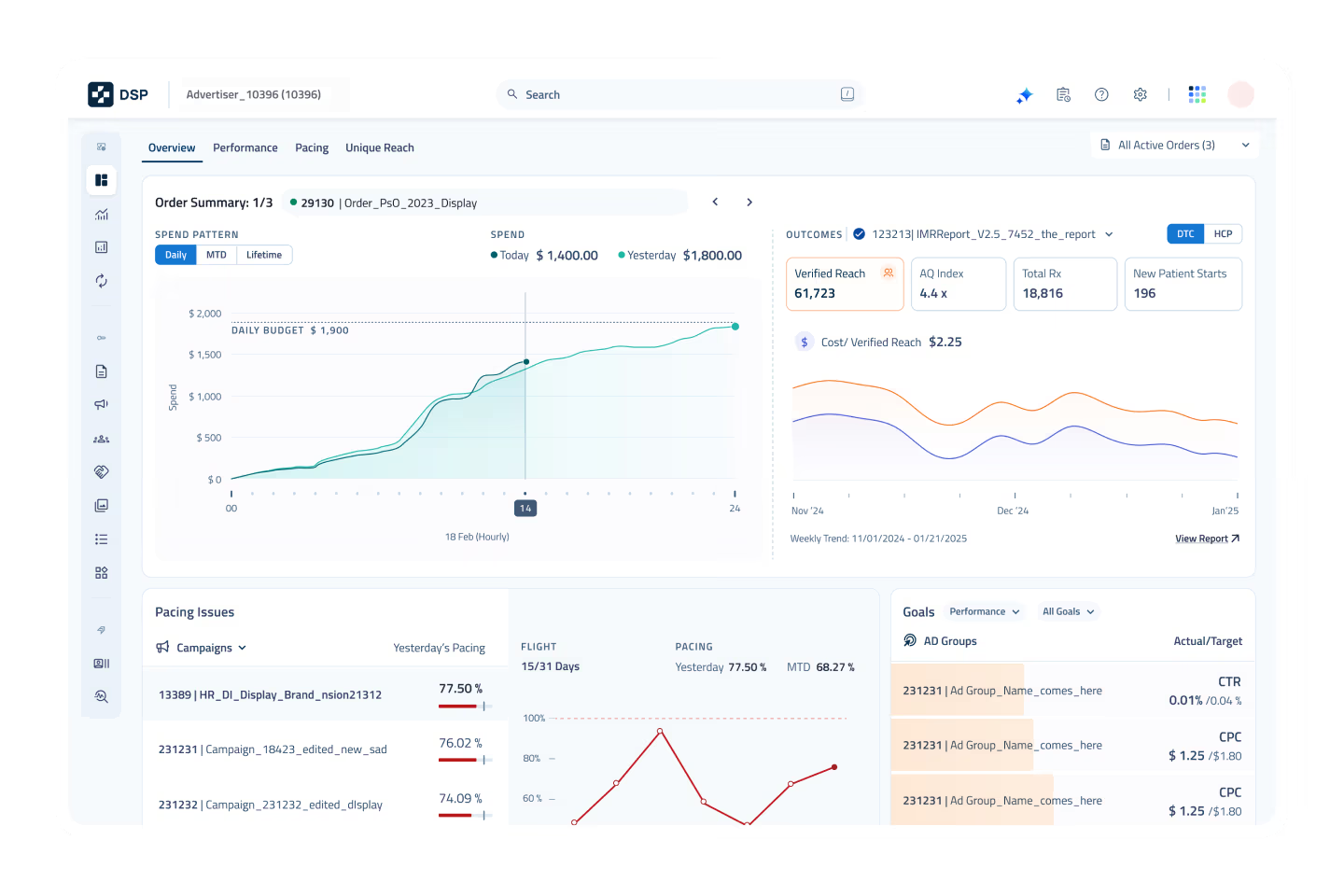
An AI agent can only reason from the context it has, and in healthcare, that context is unusually complex. Claims, market access, biomarker intelligence, media behavior, and other signals each reveal a different part of the care journey. Connecting those signals gives AI a richer understanding of the market, while connecting intelligence to planning, measurement, and activation gives marketers a path to act on what it learns.
But healthcare AI has a higher bar than simply producing a useful answer. The data informing that answer must be protected and governed appropriately, and marketers need visibility into how the AI reached its recommendation. That becomes even more important with agentic AI, where systems can move from analyzing information to recommending and taking action. Privacy, provenance, auditability, and explainability therefore need to be built into the architecture from the start. Pharma marketers need intelligence they can trace, interrogate, and ultimately trust before they act on it.
4. True omnichannel marketing requires shared intelligence.
Healthcare marketers have spent years expanding the number of channels available to reach patients and HCPs. But adding another channel does not automatically create an omnichannel experience. If every channel is planned, activated, and measured independently, marketers still have a collection of campaigns rather than a coordinated strategy.
AI creates an opportunity to organize those channels around shared intelligence. Signals from across a campaign can inform what happens next, allowing teams to coordinate decisions and optimize investments across channels rather than within each one independently. The shift is from being present in more places to making those places work together.
5. Healthcare marketing is becoming less schedule-driven and more signal-driven.
Traditional media planning tends to begin with a plan: define an audience, allocate channels and budgets, establish a schedule, then measure what happened. But patients and HCPs do not move through treatment decisions according to a media calendar. Their needs and behaviors change, and new information emerges throughout a campaign.
AI makes it possible for marketers to organize more of their decision-making around those signals. Instead of waiting for the next reporting cycle, teams can continually interpret what is happening and determine whether the next move should be to adjust an audience, change an investment, alter sequencing, or hold course. This expands the marketer’s role from campaign manager to commercial decision-maker. As intelligence, planning, activation, and measurement become more connected, marketers can spend less time managing handoffs and more time deciding what the market is telling them and what the business should do about it.
6. HCP and patient marketing can no longer operate as separate systems.
Pharma organizations have traditionally planned HCP and patient media through different budgets, teams, channels, and measurement frameworks. Yet both audiences ultimately participate in the same treatment decision. A Fierce Pharma Week panel featuring DeepIntent CRO Lisa Kopp Johnson centered on the implications of that disconnect: how communications should be sequenced between patients and HCPs, which signals should determine the next touchpoint, and how investment should move between the two.
AI gives marketers a better way to connect those experiences because it can process signals across audiences and help teams understand how one part of the journey should inform another. That means giving HCP and patients teams a shared view of what is happening, so planning and optimization can reflect the relationship between patient interest, HCP engagement, and the treatment decisions both influence.
The next chapter of healthcare AI will be defined by what marketers can do with it. As intelligence, data, and activation become more connected, AI can help teams make faster, more informed decisions and respond to the signals that shape treatment journeys. For healthcare marketers, the opportunity is to turn that intelligence into action that helps therapies reach the patients and providers who need them.