Roughly nine out of ten drug candidates that enter clinical trials never reach a patient. That statistic is usually told as a story about the difficulty of science, and mostly it is one. What it hides is a second kind of failure, the one that happens after approval: medicines that work but never reach the people they were built for.
That second failure is solvable in a way the first is not. You cannot argue a molecule into working. You can absolutely shorten the distance between knowing something about a market and doing something about it. That distance is the most expensive thing in commercialization.
Precision medicine has changed the shape of the problem. A rare-disease therapy may have a prescriber universe in the low thousands rather than the hundreds of thousands. Reach stops being a volume exercise and becomes an identification exercise. Getting the wrong specialty mix in market for six weeks is no longer an inefficiency you can average away across a large audience, because there is no large audience to average across.
The last inefficiency is the wait
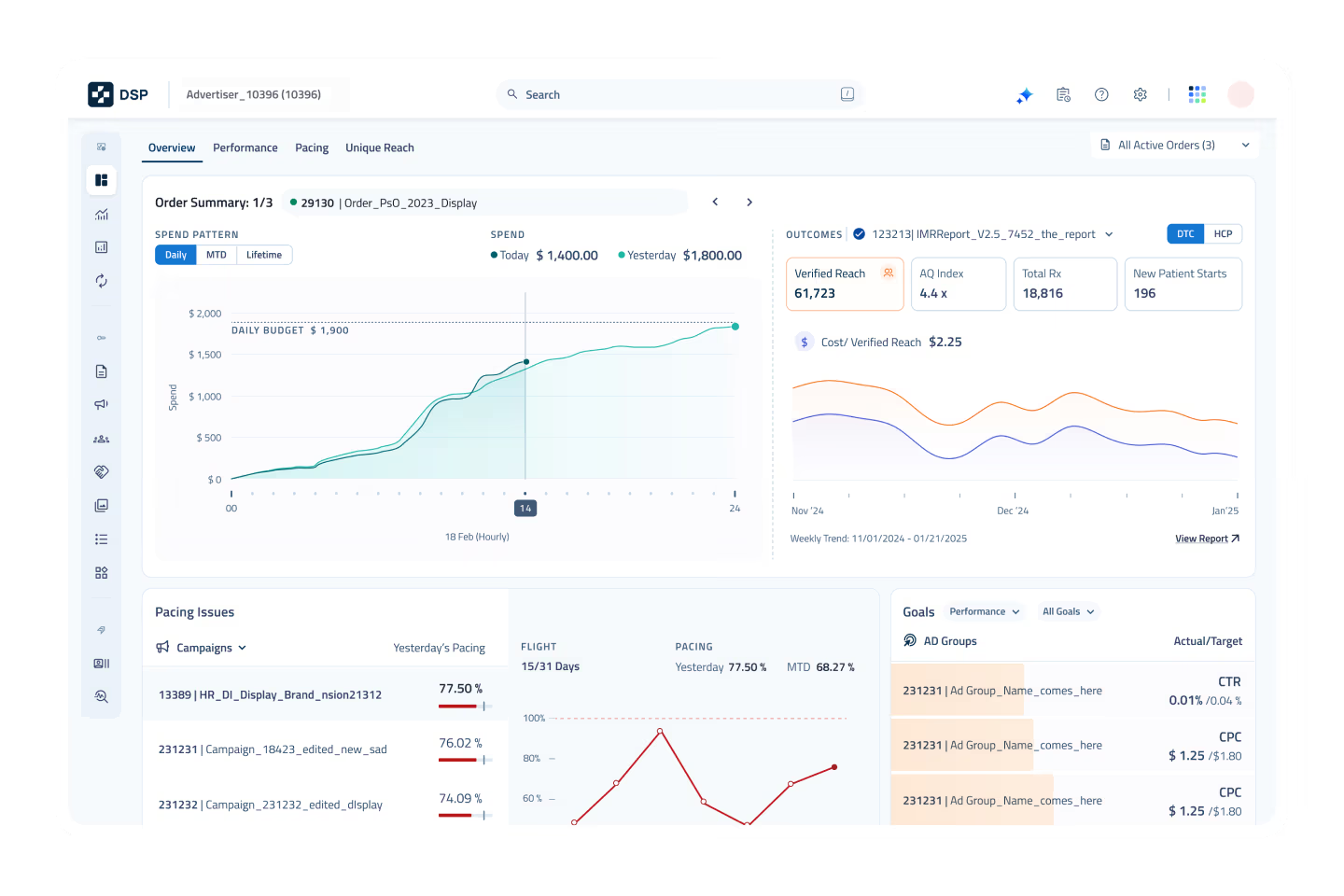
Pharma has invested enormously in data, like claims, identity, EHR, and outcomes measurement. Most brand teams today have access to more information than their predecessors could have used. What they do not have is a short path from that data to an approved buy.
A brand director picks up on something in the market. The question becomes a request. The request joins an analytics queue. It comes back as a slide, goes to the agency, comes back as a plan, goes to review, and eventually becomes a media buy. That all takes six weeks, optimistically. Every handoff in that chain was designed by people who were right about the world they designed it for, when competitive intelligence arrived as a monthly report.
Markets do not move that way now. Formulary positions shift, a competitor changes its promotional posture, and a label expands. The signal arrives continuously and the response is scheduled quarterly, and that gap is where commercial opportunity is lost.
What DeepIntent built
DeepIntent Cora™ is our answer to that gap.
The premise is straightforward. The person accountable for the outcome should be able to ask the question directly, in their own words, and get an answer they can defend to any department. They should be able to turn that answer into an audience and a plan. And when something is about to touch a live campaign, a human being should have to say yes.
The interval between a question and an approved buy is not a fixed cost of doing business in this category. It’s a choice—and now it’s a choice with an alternative.
The next ten years
When DeepIntent started, healthcare advertising was being run on infrastructure built for retail. The first decade of this company went into proving that healthcare media could be measured against outcomes a brand team actually cares about, and into building the data foundation that made it possible.
That work is the precondition for DeepIntent Cora. An agent is only as good as what it can reason over, and reasoning over healthcare data requires the right expertise and infrastructure.
Great medicine has never been enough on its own. What is different now is that the gap between a good therapy and the patients who need it has become a tech question rather than a fact of life.