Pharma marketing is unique. There are two primary audiences (healthcare providers and patients) and only two countries where you can do direct-to-consumer advertising (the U.S. and New Zealand). Pharma is also one of the most highly regulated industries, presenting a variety of restrictions, considerations, and guardrails that healthcare marketers must learn to navigate. This is primarily due to HIPAA, which places limits on data access and targeting tactics to maintain consumer and patient privacy.
To do pharma marketing effectively, one must understand the industry itself, the common lingo used when planning, activating, and measuring campaigns, and the complexities of the patient journey, all while keeping a pulse on evolving trends within the larger marketing landscape. Let's start with the six basics every healthcare marketer should know, an intro to pharma, if you will.
What Makes Pharma Marketing Different From Every Other Industry
Most marketing categories sell a preference. Pharma sells something a patient and a provider decide on together, often under legal and clinical constraints that don't exist anywhere else in advertising. Every claim has to hold up against approved labeling, every audience has to be reached without compromising protected health information, and every campaign has to work within rules set by the FDA rather than by the brand itself. That combination of regulation, dual decision-makers, and clinical stakes is what separates pharma marketing from selling almost anything else.
The Dual Audience Challenge in Pharma Marketing
Nearly every pharma campaign has to speak to two different audiences at once: the patient living with a condition and the provider who ultimately writes the prescription. Each group needs different messaging, different channels, and different proof points, yet the campaign has to move both toward the same outcome on roughly the same timeline. Getting the balance wrong, by over-indexing on patient awareness while under-informing providers, or vice versa, is one of the most common ways pharma campaigns underperform.
The Pharma Marketing Channel Mix
A modern pharma media plan rarely leans on a single channel. It's built from a mix, each suited to a different point in the patient and provider journey.
Programmatic Display and Native
Display and native placements remain a workhorse for both patient education and HCP awareness, letting brands reach defined audiences across the open web with condition-specific or provider-specific creative.
Connected TV (CTV)
CTV brings the reach and production value of television to an addressable, data-driven format, giving pharma brands a way to run full-length safety information alongside targeting that traditional linear TV can't match.
EHR and Point-of-Care Advertising
Messaging inside the electronic health record and other point-of-care settings reaches providers and patients during the actual clinical encounter, when a treatment decision is being made rather than considered in the abstract.
Video, Audio, and Digital Out-of-Home
Video and audio extend a campaign's reach across streaming and podcast environments, while digital out-of-home puts a brand in front of both patients and providers outside the home and the exam room, rounding out a plan that follows people through their day.
Role of Data in Modern Pharma Marketing
Data is what turns a broad pharma campaign into a targeted one. First-party clinical data, prescribing behavior, and condition-level insights let brands identify which providers and patients are actually relevant to a given treatment, rather than reaching a general population and hoping some portion converts. Privacy-safe, HIPAA-compliant data is what makes this possible without compromising patient trust, and it's the foundation that separates disciplined pharmaceutical marketing from campaigns built on guesswork.
Navigating the Compliance and Regulatory Landscape
Every pharma campaign has to clear a compliance review before it runs, and that review touches everything from the claims in the creative to the way an audience was built. Fair balance requirements mean risk information has to appear alongside benefit claims, and data use has to stay within HIPAA and FTC guidelines at every step. Marketers who build compliance into the planning process from the start, rather than treating it as a final check, tend to move campaigns to market faster and with fewer revisions.
The Fundamentals Every Pharma Marketer Needs to Get Right
Beyond channel strategy and data, there are five basics that every pharma marketer, new or experienced, needs to have down cold.
1. Know the Lifecycle of a Drug
From a consumer standpoint, most people outside of the healthcare industry aren't aware of the amount of time, money, and effort that goes into developing each new drug, immunization, and treatment. As marketers, it's critical to understand the lifecycle of a drug, which can span decades. In 2022, Deloitte found that the average cost of developing a new drug among the top 20 global biopharma companies amounted to $2.3 billion. With clinical trials, this process can take up to 15 years. Drug patent protection also holds for 20 years before any generics come into the picture. Knowing this, we can truly appreciate all of the complexities involved before we're even tasked with coming up with a marketing strategy.
2. Know the Lingo
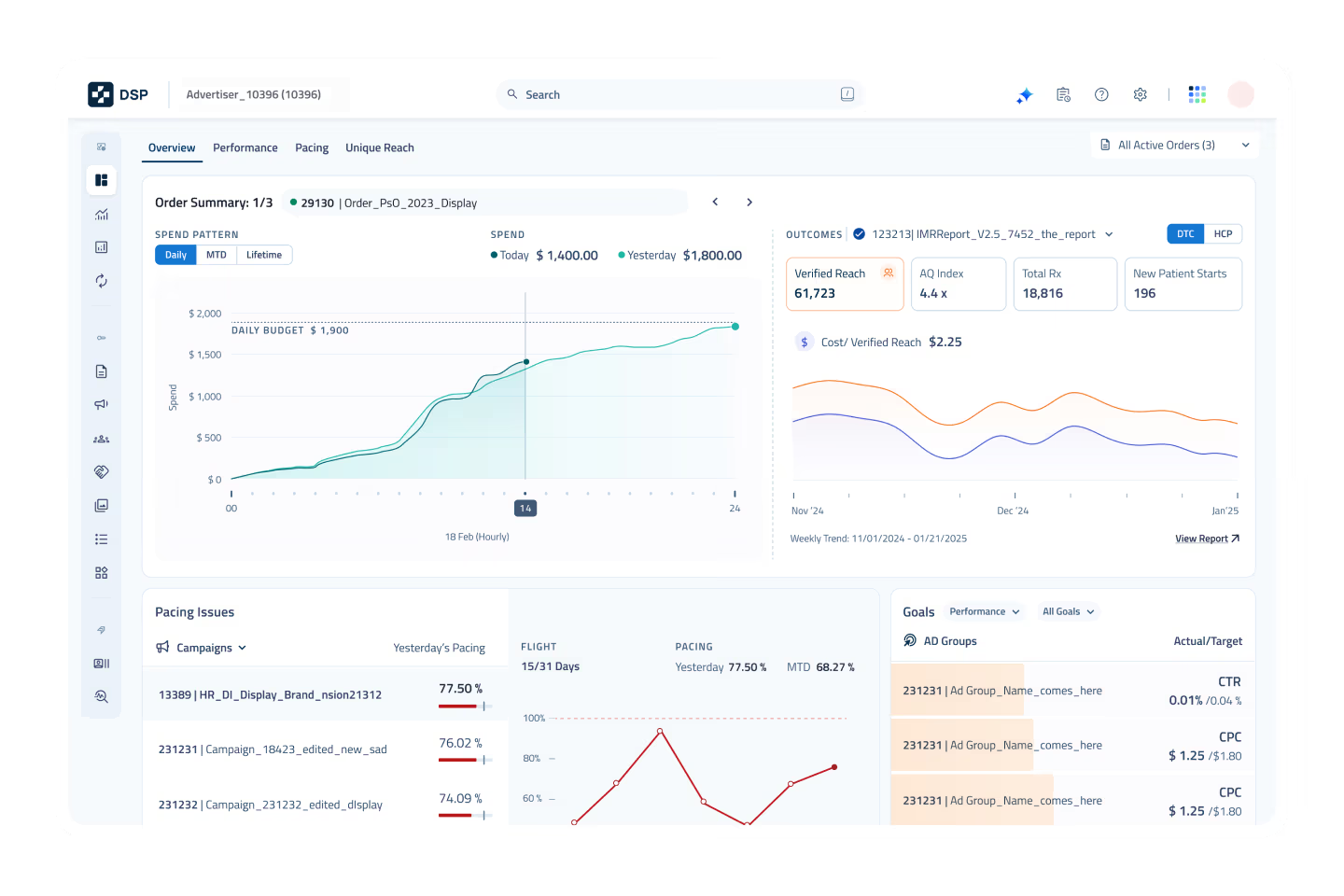
Whether you're just starting out in the pharma marketing space or you're more seasoned, you're bound to encounter jargon and a variety of acronyms in your daily work. For example, when it comes to planning a campaign that will reach healthcare professionals (HCPs), you may come across "NPI," or the National Provider Identifier, which is used to target physicians and understand their prescribing behaviors. And when it comes to measurement, pharma marketers are looking for conversion metrics such as TRx (total prescriptions) and NPS (new patient starts).
3. Know the Patient Journey
I often think about how pharmaceuticals are typically the only products purchased that you don't choose for yourself. The patient journey is much different and way more complex than any other path to purchase, especially as it concerns those privacy laws we talked about earlier.
Put it this way: the path to going on a prescription is nothing like buying a car. It's a lifelong journey, and no single media stream influences your decision. Today, we can use privacy-safe data to help us figure out where a patient cohort is along that path, and where we can reach them with the right message at the right time, while simultaneously keeping HCPs informed. Pharma companies are spending dollars to educate patients, and as we all know, marketing is not one-size-fits-all. Data is the key to customizing the journey for both patients and providers.
4. Know How to Reach HCPs With Your Pharma Marketing
As marketers, we tend to place a lot of our focus on the end user, which in most cases would be the patient. However, in the pharma marketing world, we view healthcare providers as an equally (if not more) important audience to reach because they are the ones who ultimately decide which patients get prescribed what.
Developing an HCP-specific strategy is essential to the success of a new drug or treatment, and most efforts are focused on education. When it comes to connecting with healthcare providers, real-world clinical data can shed light on how doctors are treating certain conditions and prescribing similar drugs, and their NPIs can help you target them accordingly.
5. Know What's on the Horizon
According to eMarketer, healthcare and pharma digital ad spend is estimated to reach more than $19 billion this year. Digital ads are no longer just targeting patients, but also healthcare providers, and this overall shift is happening at a rapid pace.
During the pandemic, pharmaceutical brands needed an alternative way to educate physicians when in-office visits from sales reps were temporarily prohibited. As a result, healthcare marketers turned to digital advertising solutions to reach both HCPs and consumers. Digital ads, as well as programmatic CTV ads, also make it possible to help inspire more positive patient outcomes by keeping all parties informed about potential treatment options and bridging the gap between patients and their providers.
How AI Is Transforming Pharma Marketing
AI is starting to reshape how pharma brands plan and run campaigns, from identifying which HCPs and patient segments are worth prioritizing to optimizing creative and spend once a campaign is live. Predictive models can flag which providers are most likely to prescribe a given treatment before a single impression runs, and in-flight optimization can shift budget toward the segments actually driving script lift. Brands that treat AI as an input to strategy, rather than a replacement for it, are the ones getting real value out of it in pharmaceutical marketing today.
DeepIntent's Role in Effective Pharma Marketing
Pharma marketing works best when audience data, channel activation, and measurement all live in one connected system instead of a patchwork of point solutions. DeepIntent brings HCP and patient targeting, cross-channel activation across CTV, display, audio, EHR, and more, and outcomes-based reporting together on a single platform built for the compliance requirements pharma brands operate under. Schedule a demo with our team to learn more about how a connected approach can work for your brand.