Healthcare marketing is evolving, and policy is a big part of that story. From conversations about drug advertising to new ideas like tariffs on imported medicines, there’s a lot happening that could reshape how the industry communicates with patients and providers.
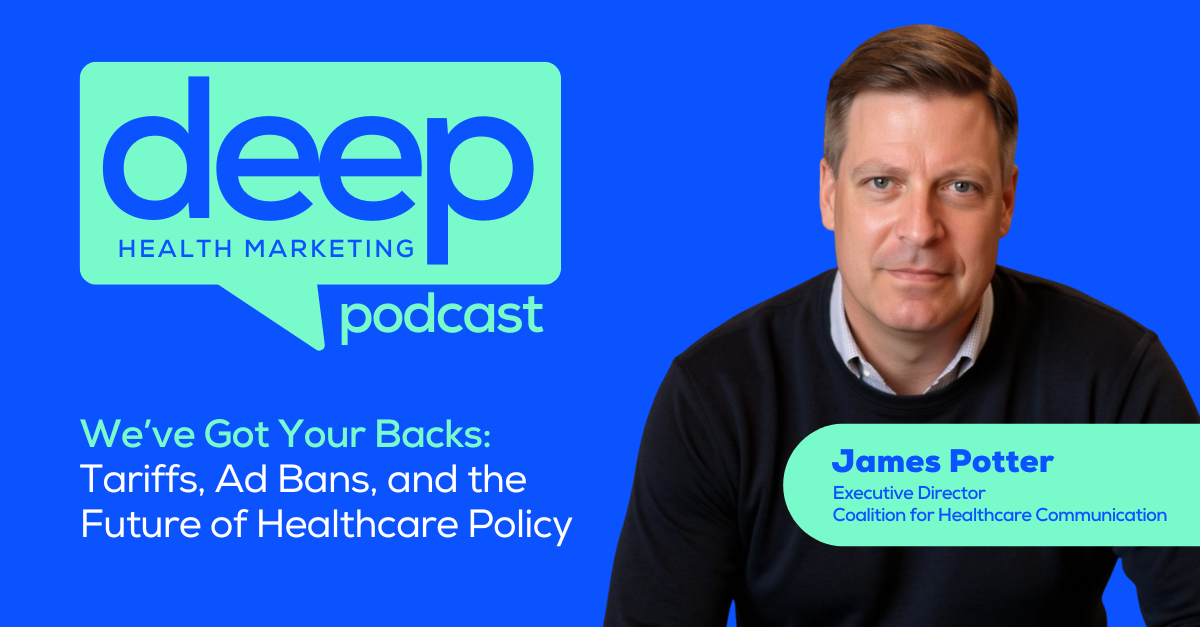
In this episode, Jim Potter, Executive Director of the Coalition for Healthcare Communication, joins health advertising expert John Mangano to break down the latest proposals and what they might mean in practice, from ad rules and tax policy to efforts to bring more drug manufacturing back to the U.S. You’ll hear why some ideas generate headlines but face big legal and practical hurdles, and how industry groups are preparing for what comes next.
Most importantly, we highlight how smart communication can support better health outcomes and why advertising plays a bigger role than many realize. It’s a thoughtful look at the balance between policy, industry, and patient needs, with abundant insights for anyone curious about where healthcare is headed.
Also available on Apple Podcasts, Spotify, Amazon Music, and wherever you listen to your favorite shows.
Transcript:
John Mangano (JM): Welcome to Deep, the health marketing podcast. I'm John Mangano. On this show, we explore the ways marketing helps improve patient health, usually focused on how we achieve that through the evolution of marketing — the channels we use, the strategies we employ, or the tech changes constantly impacting us. But we can't ignore the influence legislative activity has on our highly regulated industry. As marketing and technology evolve, so do the laws and bills that shape how we're allowed to market.
Today we're looking toward Washington, going deep on the ever-changing legislative landscape. Our guest is the perfect person to help us unpack it all. Jim Potter is Executive Director of the Coalition for Healthcare Communication, a leading voice advocating for the free flow of accurate, science-based health information. He's been at the center of this conversation for decades and can help us understand the legislative changes being discussed today. Jim, welcome to the show.
Jim Potter (JP): Thank you very much, John.
JM: Jim, this show is about the people — the patients, the providers, and the people in roles like ours who make things happen every day. I'd guess most listeners have never actually spoken to a lobbyist, so we'd love to hear what exactly you do in that role.
JP: I'm a lobbyist who's managed to walk on two legs out of the swamp. I haven't been formally based in DC for the last 10 years, but I spent a good chunk of my life there. My primary role is managing an association, CHC, which is a subsidiary of the 4A's. Since we're an advocacy organization, I'm also a registered federal lobbyist, meaning I help influence and shape federal, and in some cases state, healthcare policy on behalf of our members. That can mean meeting with key legislators or regulators, or often just helping frame and reframe how the industry is perceived by policymakers.
What do I do for fun? I live in New England, so there are plenty of mountains nearby, and I have a dog named Harry — Harry Potter — who's probably the most famous resident in our neighborhood. He walks around without a leash, which drives all the other dog owners crazy — they ask how I manage it, and honestly, it's 90% him; I just keep him out of the way of cars. We have four kids in New England. I play golf, and I've coached track and field, throwing events specifically, for about the last 10 years — a bit of a carryover from something I did in high school and college. They don't pay me anything, which is probably why they keep asking me back, but I genuinely enjoy it.
JM: So on top of being a lobbyist, you're also an expert in shot put and javelin?
JP: Mainly shot put — we help out with javelin too. It started as a side thing, working with kids in middle school, and now I've been doing it for almost 10 years. It's fun watching kids you first worked with as sixth graders eventually graduate and move on. I think there's a real familiarity and trust that builds when they're young — "you helped me figure this out," or "you helped calm me down before a tough meet." That's genuinely rewarding. I started when my own daughters were in high school; they've all since moved on, but I still get asked back every year, usually by the kids themselves, and I get along well with the other coaches too. It's a nice way to give something back to the community.
JM: Probably not all that different from dealing with politicians on the Hill.
JP: Are you trying to draw a parallel between coaching kids and working with legislators, John?
JM: Well, let's dive in — you've been in this world for a while. What would you say are the three biggest legislative trends shaping, or potentially influencing, pharma today?
JP: Great question. There are actually four immediate issues affecting the healthcare communication and marketing industry, as it relates to pharma specifically. First is the potential ban on prescription drug advertising. Second is the possible elimination of tax deductibility for advertising in the year it's spent. Third, for pharma specifically, is national security tariffs. And fourth is a set of proposals around what's called the "Most Favored Nation" policy, aimed at lowering the price of brand-name drugs. Those four issues have been especially active this spring and into the summer, under the new administration.
JM: Let's go through each. First, the potential advertising ban.
JP: This really goes back to the 2024 election, when Robert F. Kennedy Jr. was running for president and said, at a rally, that he'd sign an executive order on day one banning pharmaceutical advertising on television. Later in the campaign, once he'd dropped out and Trump was the clear frontrunner, he said something like, "Get Trump back in the White House, and me in DC, and we'll ban pharmaceutical advertising." FCC Chairman Brendan Carr and Elon Musk both amplified that message on social media, which generated a lot of buzz right before the election.
Right after the election, I got a call from an old friend — when you've worked in DC a long time, you accumulate a lot of those. The day before Thanksgiving, he told me, "Jim, I'm working the transition, though I won't be joining the administration. You need to know two things: first, we're lining up campaign promises, and this issue is high on the list. Second, if you think this is just about TV, think again."
You've probably heard people say, "if we just fix this one thing, it'll solve everything on linear TV." That's not accurate. Some state-level bills on this topic are actually far more comprehensive, banning virtually any promotional communication targeting consumers. That's similar to a bill Senator Bernie Sanders introduced last month, which would ban any promotional communication aimed at consumers — explicitly including television, radio, print, digital platforms, and social media. A full ban, essentially.
A couple more state bills have surfaced since, but that's the core thrust behind this push. So I immediately got to work, pulling together court precedent, the laws passed over the last 50 years, and the regulatory framework around pharmaceutical advertising. What came back was a clear message: this would be extremely difficult to implement, for a few key reasons.
First, the Supreme Court has, since the 1970s, treated advertising as a form of commercial speech, and ruled that banning it outright violates the First Amendment. There's a legal framework called the Central Hudson test, which says you can restrict commercial speech only when one of three conditions applies: it's misleading — which is the essential basis for all FDA law and regulation; banning it advances a substantial government interest — the closest historical example being restrictions on tobacco advertising, though much of that has actually remained voluntary on the industry's part; or, and this is what's really shaped 40 years of legislation and FDA regulation, the government's interest can be achieved through a less restrictive route — think required labeling, or the "fair balance" requirement between risks and benefits.
The other major factor limiting what government agencies can currently do is last summer's Supreme Court decision, Loper Bright, which overturned the Chevron doctrine — the legal precedent that, for roughly 30 to 40 years, let federal agencies interpret ambiguous statutory language largely on their own. They can no longer do that; if an agency strays from a statute's direct language now, they're far more likely to face a successful lawsuit.
The only major piece of legislation actually passed in the last 40 years is the FDA Amendments Act of 2007, which introduced the requirement for a "major statement" of risks presented in a "clear, conspicuous, and neutral manner," or CCN. Those specific rules were only finalized in the last year and a half.
There are also a handful of perennial bills that resurface every few years: a one-to-three-year moratorium on advertising newly approved drugs, removing the tax deduction for advertising, and requiring price disclosures in pharma ads. None of these has ever gotten a real hearing, real momentum, or many co-sponsors. The closest anything came was in 2019, during the first Trump administration, when HHS tried to pass a rule requiring price transparency in drug ads — it was blocked in court almost immediately, largely because most, if not all, of that regulatory authority actually sits with the FDA, and the rule missed that mark entirely.
Since the CCN rule was finalized last November, some senators have said, "We like this — can you apply it everywhere?" And the FDA's response has been, "We really only have authority over television and radio." When asked to extend it to all digital platforms, the answer again was, "No, we can't do that." What the FDA has done instead is issue six "untitled letters" over the past year — a step below a formal warning letter, essentially a slap on the wrist. A few social-media campaigns that talked up a drug's benefits without proper balance have received these letters, and you really don't want to get one.
Back in mid-December, we put together information on the relevant Supreme Court precedent and existing FDA law, and got the message out that banning pharmaceutical advertising outright wouldn't be easy to accomplish. Since then, over the past six or seven months, I've done 35 national and trade media interviews, spoken at seven national conferences, and done dozens of stakeholder briefings — literally dozens. We brought together a broad coalition of broadcasters, pharmaceutical manufacturers, and healthcare marketing interests, and essentially organized a legal challenge ready to go, including a temporary restraining order, should anything actually materialize — whether that's a rule, regulation, executive order, or piece of legislation, including any state law running up against a state constitution's free-speech clause. We'd challenge any of that on the Supreme Court grounds I described.
The most important thing for everyone to know is: we have your back, and we're ready. I'm confident we've framed the issue well, for two reasons. First, Secretary Kennedy, in testimony this past May, actually admitted that prescription drug advertising is commercial speech protected by the First Amendment — a statement that also appeared in the administration's first MAHA report, which is probably where he picked it up. Second, FDA Commissioner Makary said in an interview a couple of months ago that they have no current plans to ban direct-to-consumer advertising, though there are things they could do to ensure information is presented more completely.
As of today: no executive order, no formal rulemaking, and this provision wasn't included in the "One Big Beautiful Bill," although RFK Jr. is reportedly still looking for other ways to limit DTC ads. If something does emerge, know that it will be met immediately with a legal challenge. In the meantime, our recommendation is: apply the CCN rules consistently across all your digital and omnichannel campaigns. We suspect there could be a Senate hearing this fall or next spring focused specifically on these untitled letters and the companies that received them — you don't want your boss's boss testifying and being asked, "Why do you follow these rules on television, but not on social media? Why the inconsistency?"
Sorry for going on so long there, but I wanted to get the full picture out.
JM: That's helpful. On the second point — removing tax deductibility for advertising spend — I've been in this industry a while, and honestly didn't realize advertising was tax deductible at all. But there does seem to be a real distaste among some legislators toward DTC marketing specifically. What's driving that?
JP: Part of it is the MAHA movement, and part of it is simply how much pharma advertises in certain media, particularly evening news. I met with one news company after a 90-minute interview, peppered with questions, and they told me roughly 40% of their evening ad revenue comes from pharmaceutical advertising. They said if a ban went through, it would genuinely crush them — and after grilling me with questions, they actually asked for my presentation, which I'm fairly confident got back-channeled to the White House and administration. That broadcasting company, who'll remain unnamed, is now basically my new best friend.
I think that's part of it. The other part is simply how profitable pharma is — there's an underlying sentiment of, "Let's go after the people making a lot of money." You've also seen a kind of proxy war playing out in DC — pharmacy benefit managers, or PBMs, have been a major congressional target, appearing in and out of various bills, and they also got carved out of the "One Big Beautiful Bill" at the last minute. Pharma and PBMs have effectively been fighting a year-and-a-half-long proxy battle, each spending millions on advertising trying to frame the other as the villain.
There's a leftward-leaning group funded by PBMs called the Campaign for Sustainable Rx Pricing — I affectionately call them "the Crispies," since they lean a bit like the "Crunchies," but they'd really like to burn pharma. You've got to have a little fun with this stuff.
Importantly, none of this is really about revenue mechanics. We met with tax-writing staff on the Senate side, both majority and minority, back in May, and walked through this issue. Their response was essentially: this is too complex to isolate, and if we eliminate deductibility for one specific business sector, every other industry's deduction is suddenly on the table too — small businesses would be at our door immediately, worried they're next, and for many small businesses, this deduction is genuinely make-or-break.
This deduction has been on the books since 1913, when personal and corporate income taxes were first introduced — it's a very longstanding provision. It keeps coming up because of the potential budget savings attached: the CBO estimated that amortizing half of ad spend over five to ten years could save somewhere between $83 and $177 billion over a decade. That's a big, attractive number, which is why it keeps resurfacing. But ultimately, I think it's too deeply woven into how every business operates to isolate just pharma. It's a business expense, not some kind of special tax break.
JM: Right, it's not unique to pharma — advertising is a tax-deductible expense for any business. Every car ad, every Meta ad Zuckerberg runs, none of that gets taxed differently. It's not some strange advantage pharma specifically gets.
JP: Exactly. There have been some state-level proposals floated to tax digital advertising specifically, but this deduction itself has been clearly established for 120 years.
Something else we do: we work with a group called the Advertising Coalition, and roughly every two years, they produce a study on advertising's economic impact, nationally, by state, and by congressional district. Every time we do a Hill visit, we walk into a congressional office and say, "Here's how many jobs the advertising industry supports in your specific district," alongside the state and national numbers. What really stands out is that roughly 20% of all US jobs are tied in some way to advertising — it's a massive economic driver.
JM: So if we look at what's really driving these concerns: some see pharma ads as a nuisance, though frankly, those people are the lucky ones, since it usually means they don't have the condition being advertised — they should probably be grateful, even if they'd rather see fewer ads. But we all know pharma advertising helps fund the evening news; if not pharma, someone else would need to, or there'd be less news funding overall. And pharma is a profitable industry, which raises its own questions, especially since drug prices are genuinely expensive for all of us. Let's move to your third point — national security tariffs on pharmaceuticals. What exactly does that mean?
JP: This is something you typically hear about in steel and aluminum. There's a long legal history establishing that if an industry relies heavily on foreign production, in this case pharmaceuticals and computer chips specifically, similar to steel, aluminum, or automakers, and really anything defense-related, there's substantial precedent the government can draw on. Now they're applying that same logic to pharmaceuticals.
Typically, this kind of rulemaking through the Commerce Department allows up to 270 days for a public comment period; this one ran just 21 days, ending back in May. So we expect some kind of rulemaking to follow. It's a very broad definition, covering essentially anything related to manufacturing a prescription drug, including raw ingredients and resources. Secretary Lutnick indicated they expect to have something out by the end of July.
That could just be a report, or it could be an actual rulemaking framework, but we think something is coming. The industry is clearly taking it seriously — seven major pharmaceutical manufacturers have already pledged $214 billion combined to reshore manufacturing and resources here in the US, over the next three to five years. That's a significant number, and I think it's partly meant to get ahead of the process. I'd expect negotiations, and likely some kind of formal waiver process — companies pledge reshoring commitments, Commerce signs off, and in exchange, companies get a temporary waiver from national security tariffs.
President Trump mentioned last week a potential 200% tariff on all internationally manufactured drugs being imported — a big number, and the President does sometimes throw out large figures to grab headlines. But I think it really comes down to a choice the administration will have to make this year: do they prioritize reshoring manufacturing, or do they prioritize pushing down brand-name drug prices? My sense is pharmaceutical manufacturers believe they can realistically do one or the other, not both — without healthy margins, reshoring simply isn't viable, and companies might instead choose to keep manufacturing abroad and accept the tariffs, passing that cost on to American consumers. My guess is they'll negotiate for some flexibility, or a broader waiver, in exchange for the reshoring commitments.
I've actually given this same broad presentation to two pharmaceutical companies directly, since their own lobbyists and executives can't speak this publicly, and I can. I think our read on this aligns well with theirs, since they're comfortable having me speak to their employees about it — which suggests this is roughly consistent with what they're actually looking for in these tariff negotiations.
JM: That makes sense from a national-security angle too — as a large country, we probably shouldn't be entirely dependent on other nations that could restrict access to what we need to keep our population healthy.
JP: We saw exactly that risk play out during Covid, with real supply chain interruptions. My guess is that big pledged number reflects the fact that a number of these companies were already thinking along these lines, which made it easier to commit, and maybe inflated the number somewhat to look appropriately responsive. But I think reshoring some of this manufacturing was already on a lot of pharma executives' minds well before this.
JM: That makes sense. Of course, most manufacturing happens overseas because it's cheaper. So if we look at the broader set of concerns here: too many ads bothering people, drug prices being too high while pharma remains highly profitable, and now a national security argument for reshoring, which itself risks making things more expensive. Does that eventually lead back to PBMs, as the pressure point for controlling costs? There's a natural supply and demand curve here, and ultimately, as a country, we want essentially unlimited supply to keep everyone as healthy as possible. How do we balance rising costs against the benefits of onshoring?
JP: It really comes down to what this administration wants to prioritize and succeed at this particular year — that doesn't mean they won't pivot again in three or four years. I think the PBM reform proposals, scored at roughly $12 billion in impact, are genuinely real, and likely to have some real effect on domestic pricing. I expect some version of PBM reform to pass, though we'll see exactly what form Congress lands on — ultimately, this requires congressional action.
The other idea that's circulated across the last three administrations is "Most Favored Nation" pricing. Back in May, the Trump administration issued a new executive order that would essentially require the US to pay the same price other peer economies, think Western Europe, possibly Japan, pay for the lowest available brand-name price. There's a real potential consumer benefit here — the CBO estimated last year that this policy could reduce prices by more than 5%, and I've seen other estimates as high as 15%, specifically for brand-name drugs. So depending on the specific drug mix, that could mean something like a 25 to 30% reduction in brand-name pricing if fully implemented.
The problem is there's not much legal foundation supporting it, especially post–Loper Bright. Even running demonstration projects would likely be legally difficult. The Obama administration tried something similar; the first Trump administration tried it too, and lost in court. The Biden administration considered it, decided they weren't comfortable with how it was structured, and instead focused on Medicare price negotiation under the Inflation Reduction Act.
The real questions here: can this administration find a genuinely viable legal authority to pursue Most Favored Nation pricing? And second, can they execute it with enough discipline to avoid the procedural missteps that made them vulnerable to legal challenges last time? I suspect this would ultimately require new legislation, and if there were real appetite and confidence in passing it, it likely would have been part of the "One Big Beautiful Bill." It wasn't. So I'm not sure how seriously this is actually being pursued right now.
The real political calculation for policymakers is: if you put forward a proposal that gets struck down in court, you effectively can't talk about that issue again for another five years — that's exactly what happened after the 2019 price-transparency rulemaking got blocked; nobody discussed it again for half a decade. So there's a real question of whether they'd rather keep this as ongoing political rhetoric, applying informal pressure throughout the administration, rather than risk a formal proposal that gets struck down and taken off the table entirely.
If I had to guess the most likely path: I think they move forward with the national security tariffs to push reshoring, something most people broadly agree is reasonable. On pricing specifically, I'd expect that to remain more voluntary pressure than hard policy — right now, beyond Medicare price negotiation, which is already having some real impact, there just isn't strong legal footing to do much more at this particular moment. That's ultimately what they'll have to figure out.
JM: Pharma and healthcare really is such a complicated industry. There's a lot of information, and misinformation, about the actual impact of pharma advertising. Personally, I've done a lot of research showing that, more often than not, it has a genuinely positive impact. Like any marketing, it doesn't always land perfectly, but on balance, more people end up healthier after seeing pharma ads than they would if those ads never existed. Given how much you talk with brands and others in advertising, what hurdles are you seeing that could specifically help or hurt our shared goal of getting people healthier?
JP: Something I've noticed since joining this industry, and it's ironic, given we're all marketers, is that as an industry, we rarely talk about ourselves, what we actually do, or why we got into this work in the first place. That struck me as odd. One lesson I've learned throughout my advocacy career: if you can get roughly 60% of stakeholders repeating the same message, consistently, you generally win. We did this successfully around breast cancer detection and treatment, and around infant hearing screening, the number one congenital condition. Once everyone's repeating the same core message, good things tend to follow.
So we've developed 14 core facts about the healthcare communication and marketing industry. Going back to an earlier topic: banning DTC advertising entirely would have little to no real effect on the average price of drugs. The CBO estimated last year that a full ban would result in only a 0.1% to 1% reduction in average drug prices — reaffirming that this wouldn't actually deliver the cost savings people assume.
The other thing we don't talk about enough is the genuine good this advertising does. Over the last 40 years, a lot of promotional campaigns, often unbranded, have helped reduce the stigma around embarrassing or difficult conditions, and that information genuinely gets patients into a doctor's office. Ultimately, all of these talking points are really about enhancing shared decision-making between patients and their doctors, leading to better health outcomes. That's really the core goal behind all of this, and I think, as an industry, we'll keep evolving toward more complete information as the CCN rules take fuller effect. But we need to keep repeating these 14 points consistently, and we'll likely keep adding more as new research becomes available — this isn't static.
One shift I've seen in recent studies: physicians' perceptions have changed dramatically. Back around the turn of the century, roughly 50% of physicians said they thought healthcare or drug advertising was actually helpful. That number is now in the mid-90s.
So the old assumptions simply aren't accurate anymore. And think about newer approaches too, like point-of-care marketing, where you're working directly with a hospital or practice to bring the right information together at exactly the right moment, around diagnosis and treatment. Physicians, and other practitioners like PAs, have very limited time — the more relevant information a patient brings into that conversation themselves, the better the typical outcome, and often the more buy-in the patient has in their own treatment plan. Advertising also genuinely helps with treatment compliance and adherence more broadly. These are things we should be talking about constantly. If we're not saying them, no one else will, and if we don't, the loudest voices, the "we're annoyed, ban it all, burn it all" crowd, will simply win the conversation by default. So we need a consistent counter-message that everyone in the industry can repeat.
JM: That's an interesting way to frame it too — unless you're actively working in or around healthcare, whether you're building houses, doing advertising outside pharma, or anything else, you're just not regularly learning about medical conditions; it's simply not part of your world. So when you eventually develop a condition yourself, you won't recognize the signs unless you've seen something like an ad beforehand. Fundamentally, these ads build the awareness needed for people to have that first conversation. Some people might have that conversation when they didn't strictly need to, but that's fine, because for everyone who did need it, it might genuinely save their life.
Final two questions. What advice would you give a health and pharma marketer, given everything happening in this space right now?
JP: Three things. First, understand that President Trump often uses various leverage points, personal and professional, to shape outcomes. Second, keep in mind that RFK Jr.'s professional training and background is as a personal injury attorney, which shapes how he tends to approach issues. Third: if you see any proposal to ban or limit pharmaceutical advertising, don't pause your own advertising activity, keep running your planned ad buys, because pulling back voluntarily effectively hands leverage to whoever's pushing that agenda.
The first and most important thing: stand firm, and know someone genuinely has your back. If any of these proposals actually get implemented, we're prepared to challenge them in court, and I believe we'll win. So don't change your behavior just because of a headline. Know that the First Amendment protects your ability to advertise as a form of commercial speech, and once you understand that, you don't have to feel bullied or co-opted by whatever's making headlines that week.
JM: Great advice. Last question — if a legislator were listening to this conversation right now, what would you hope they'd take away from it?
JP: Realistically, any serious attempt to eliminate the First Amendment right to commercial speech will be vigorously challenged in court, and will lose. Honestly, part of me almost wants someone to actually try something, and make a clear legal misstep, so we can push back decisively and take the whole issue off the table for a while.
You simply can't legislate away being "annoyed." I see this pattern constantly: "I find this annoying, ban it." Well, wait, plenty of people find the NFL annoying, should we ban that too? Or someone finds a particular institution's messaging annoying on a given day, should that be banned as well? We're a nation of laws, and this right is genuinely secure. You can certainly try to challenge it, but I think that's exactly why we haven't seen much real movement, because the underlying legal argument here is solid, and legal counsel across the industry broadly agrees. Attempting a ban would likely backfire, producing the opposite of the intended effect.
So the real calculus for policymakers becomes: do we just talk about this as rhetoric? Being publicly critical of certain institutions, whether that's pharma advertising or, relatedly, parts of academia and medical journals under the broader MAHA banner, remains politically popular to gesture toward. So it'll likely remain part of the political conversation, but meaningfully, I don't think it'll have much real day-to-day impact on the actual work of our member agencies, companies, and med tech firms.
JM: Well, Jim, thank you so much for joining us today. This has been incredibly insightful.
JP: Thank you, John, for having me — I really appreciate it.
Links
- Jim Potter on LinkedIn
- Coalition for Healthcare Communication
- 4A's (American Association of Advertising Agencies)