Most pharma marketing budgets are still built around the individual prescriber. Media plans are keyed to NPIs, field teams call on offices, and reach gets reported physician by physician. Meanwhile, the decision that determines whether a drug can actually be prescribed has moved upstream, into formulary committees and system-level contracts staffed by people who never see an HCP banner ad.
That gap between who gets targeted and who controls access is what pharmaceutical account-based marketing (ABM) exists to close. This article covers what pharma ABM is, why the structure of the market now demands it, how it differs from ABM in other industries, and how to build a program that holds up under MLR review.
What Is Pharmaceutical Account-Based Marketing?
Pharmaceutical account-based marketing is a strategy that treats an institution (like a health system, IDN, oncology network, or large group practice) as the unit of targeting, rather than the individual physician.
Instead of running one campaign against a pool of specialists, an ABM program identifies a defined set of high-value accounts, maps every stakeholder inside them who touches the access decision, and coordinates messaging across those roles for the length of the buying cycle. Prescribers remain central, but they sit inside an account strategy rather than serving as the whole strategy.
Reasons for Using Account-Based Marketing in the Pharma Industry
ABM works in most B2B categories. In pharma, several structural conditions make it close to mandatory, and each one has to do with how access decisions are actually made.
Physician Targeting Alone No Longer Reaches the Full Decision
Roughly 82% of U.S. physicians now work for a hospital or corporate entity, according to Physicians Advocacy Institute and Avalere research. Employment brings institutional constraints with it: system formularies, order sets, preferred-product protocols, and prior authorization rules.
A physician can be fully convinced by your clinical data and still be unable to prescribe. Clinical conviction and formulary access are two different problems, and HCP-level media only solves the first one.
A Single Formulary Win Unlocks Access Across an Entire System
The upside of institutional consolidation is leverage. CommonSpirit Health alone spans 142 hospitals and more than 700 care sites across 21 states. HCA Healthcare operates roughly 190 hospitals plus thousands of affiliated sites of care.
One formulary approval inside a system like that opens the door at every affiliated hospital, clinic, and outpatient center at once. Reaching the same volume of prescribers one NPI at a time takes quarters of media spend and still leaves the access barrier above them in place.
Multiple Stakeholders Control Access That HCP Campaigns Cannot Reach
Formulary decisions run through P&T committees, system pharmacy directors, value analysis teams, and clinical leadership. Most of these people are not prescribers, so they fall outside the NPI-based targeting that HCP campaigns are built on.
Their influence is disproportionate to their numbers. A pharmacy director evaluating budget impact or a P&T reviewer questioning comparative evidence can hold up a product indefinitely, no matter how much prescriber demand exists underneath.
Declining Rep Access Has Created a Gap That Digital ABM Fills
Field access has been shrinking for close to two decades. ZS's AccessMonitor tracking has followed physician restrictions on rep visits from under a quarter of prescribers in 2008 to more than half, with once rep-friendly specialties moving the furthest: about 73% of oncologists are now classified as access-restricted.
Reps also rarely reach the non-prescribing stakeholders described above. Account-based digital engagement fills both gaps, delivering coordinated messaging to prescribers and administrators across channels that do not depend on getting through a front desk.
Formulary Cycles Are Long and Demand Sustained, Coordinated Engagement
P&T committees typically meet quarterly at minimum, review new approvals within a 90- to 180-day window depending on therapeutic class, and revisit standing formularies annually. The window in which your evidence matters is measured in months, not campaign flights.
Standard campaign execution is not built for that rhythm. Keeping four or five stakeholder types engaged with role-appropriate content over two or three quarters requires a program structure with account-level planning behind it.
Focused Spend on High-Value Accounts Produces Stronger ROI
ITSMA benchmark research has consistently found that mature ABM programs report higher returns than any other marketing investment, with about 76% of practitioners saying so.
In pharma the efficiency argument is sharper than in most categories. Media budgets are large, audiences are narrow, and every impression served to a clinically irrelevant viewer is waste that compounds across the flight. Concentrating spend on accounts with real therapeutic alignment and real formulary influence cuts that waste directly.
How Pharmaceutical ABM Differs From Other Industries
Three things make pharma ABM a separate discipline rather than a vertical application of a standard playbook.
Clinical evidence is the currency. Enterprise software ABM leans on efficiency and cost arguments; pharma ABM is won or lost on trial data, comparative effectiveness, safety profile, and real-world outcomes. Timing is set by formulary review calendars rather than fiscal budget cycles, so planning works backward from committee dates. And MLR review shapes every asset, which means personalization carries a production cost most ABM frameworks never account for.
General ABM models still apply structurally. They need adaptation at each of these three points before they survive contact with a pharma commercial team.
Building an Effective Pharmaceutical ABM Framework
A working pharma ABM program has four layers: account identification, account tiering, stakeholder mapping, and message architecture. They are sequential. Tiering is meaningless without a defensible account list, and message architecture falls apart if stakeholder mapping is thin.
Identify the Right Accounts to Target
Score accounts on therapeutic alignment, patient population size within your indication, formulary influence across affiliated facilities, and the current access barrier you face. An account with heavy patient volume and no formulary restriction may need less investment than a mid-sized system actively blocking your product.
Weight affiliation reach heavily. A single approval at a large IDN can drive adoption across dozens of downstream hospitals and clinics, a return no individual practice can match.
Tier Accounts by Opportunity and Engagement Level
Tier 1 accounts get one-to-one treatment: custom content, named-stakeholder engagement, field and medical alignment. Tier 2 accounts get one-to-few programs built around personas shared across similar institutions. Tier 3 accounts are covered at scale through programmatic one-to-many activation.
Accounts move between tiers as conditions change: a P&T review entering its evidence-gathering phase, a new service line, a competitor's contract coming up for renewal. Resourcing should follow, with the majority of custom content effort concentrated in Tier 1.
Map Stakeholders Within Each Target Account
Combine verified NPI-level identity with institutional affiliation data to build a picture of who sits inside each account. Done well, this reveals functional role, seniority, prescribing behavior, and where each person sits in the buying committee.
That map is what turns a list of individuals into an account plan. Without it, you are running parallel one-to-one campaigns that happen to share an employer.
Build Messages That Work for Multiple Roles
The same product needs different arguments for different seats at the table. Prescribers respond to clinical evidence and patient selection guidance. Pharmacy directors want budget impact and total cost of care. Clinical leadership cares about workflow, adherence, and quality metrics.
Anchor all of it to one account-level narrative, the case for why this product belongs in this system, and treat role-specific content as different proofs of that single claim. Consistency comes from the narrative, not from repeating the same asset.
The Data Foundation Pharmaceutical ABM Needs
Pharma ABM runs on four inputs: verified NPI identity, institutional hierarchy data mapping affiliations and ownership across facilities, prescribing behavior at both the individual and account level, and intent signals that indicate active evaluation.
Static account lists fail because the underlying reality does not hold still. Affiliations change with every acquisition, physicians move, committee membership rotates. A workable model refreshes continuously, re-scores accounts as new signals arrive, and pushes those updates straight into activation rather than leaving them in a quarterly report.
Compliance and MLR Considerations in Pharmaceutical ABM
Personalization multiplies review volume. Four stakeholder roles across three account tiers can mean a dozen content variants where a broad campaign had two, and each one carries its own MLR cycle.
HCP-level targeting also brings data obligations. Audience construction has to stay on the right side of HIPAA, which in practice means working with de-identified or professionally sourced data and documenting how audiences were built. Teams that design modular, pre-approved content blocks and settle data questions before launch spend far less time stuck in review later.
Mistakes Pharma Marketing Teams Should Avoid With ABM
- Renaming a target list "ABM." A filtered NPI list without stakeholder mapping or account-level coordination is still HCP targeting.
- Building the account list once. Affiliation data decays fast, and a list that is not refreshed will be wrong within two quarters.
- Sending the same clinical message to every role. Pharmacy directors and prescribers are evaluating different things.
- Bringing MLR in late. Personalization planned without review capacity in mind stalls at launch.
- Measuring impressions instead of accounts. Reach and frequency say nothing about whether an account moved.
- Spreading investment evenly across tiers. Tier 1 economics only work if Tier 1 gets disproportionate resourcing.
- Ignoring non-prescribing stakeholders. They are the people most likely to stop a formulary decision.
Summing It Up
Pharma budgets are still allocated as if prescribing decisions were made one physician at a time, and the market has not looked like that for years. Account-based marketing realigns spend with where access is actually granted: inside institutions, across multiple stakeholders, over cycles that run for months.
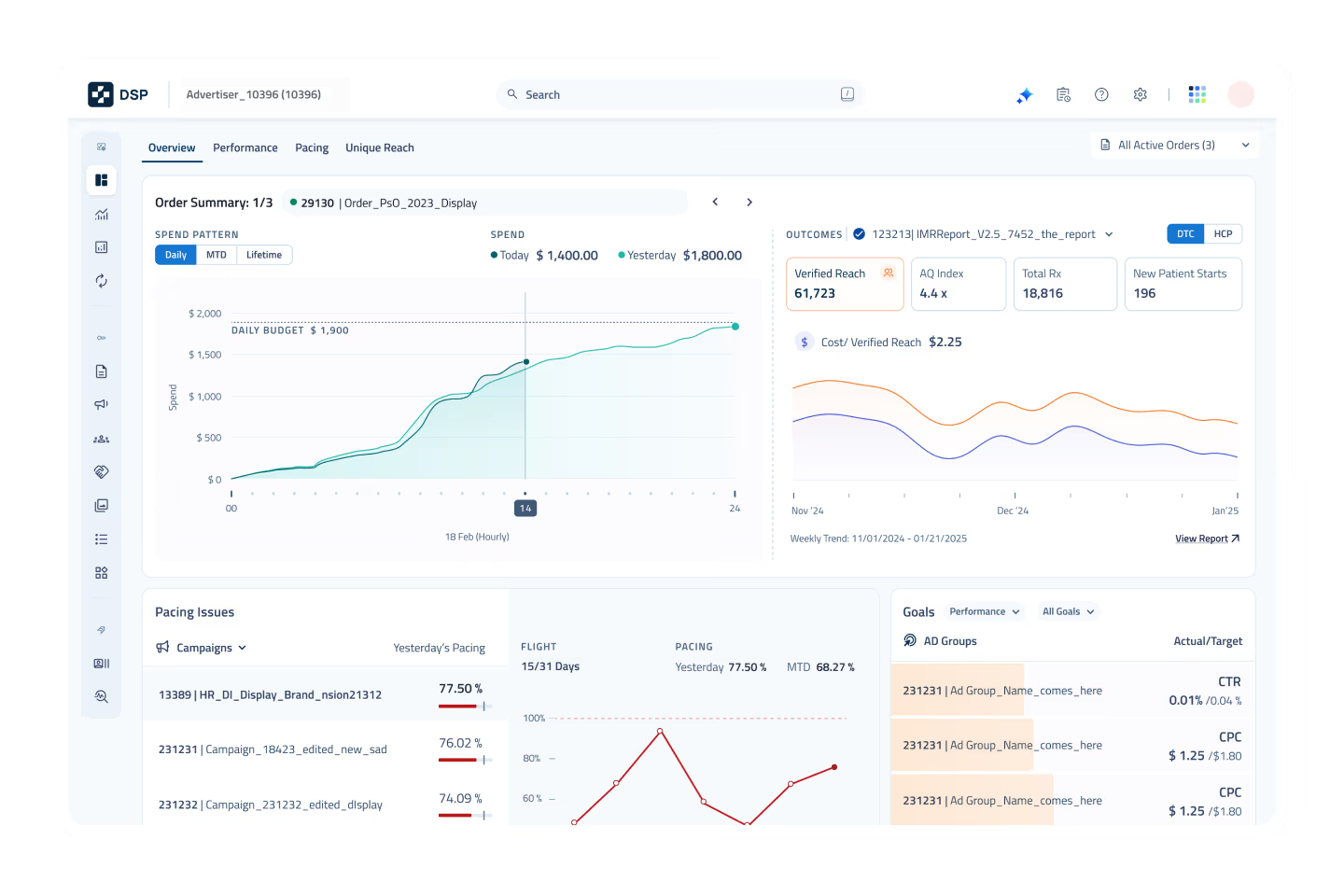
Execution is where most programs struggle, and most of that difficulty is a data and activation problem. A healthcare-specific platform like DeepIntent connects verified NPI identity to institutional affiliation data, makes account-level audiences addressable across channels, and measures outcomes against scripts rather than clicks. That gives ABM teams the ability to reach every stakeholder in a target account, hold engagement steady through a full formulary cycle, and show what the investment returned.