ChatGPT is growing as an advertising channel.
OpenAI first announced plans to test ads in ChatGPT in January 2026, then began its U.S. pilot on February 9. Since then, the company has expanded the program, introduced self-service buying tools, and begun opening additional markets and advertiser categories. Healthcare is among the categories OpenAI is approaching more cautiously, with additional restrictions and case-by-case approvals.
For healthcare marketers, that makes ChatGPT ads worth watching. Conversational AI introduces a new kind of intent signal, one based on an ongoing dialogue rather than a search query or conventional audience segment. But healthcare advertising also depends on capabilities that general-purpose advertising platforms were not originally designed to provide, including clinical audience verification, healthcare-specific compliance controls, and measurement tied to real-world outcomes.
Understanding both sides of that equation is important. Here is where ChatGPT ads for healthcare stand today, how the model differs from search and programmatic advertising, where important gaps remain, and how healthcare marketers can prepare for what comes next.
How ChatGPT Ads Work
ChatGPT ads can appear below responses and are visually separated from the answer and clearly labeled as sponsored. Ads may appear for eligible users on ChatGPT's Free and Go plans, while Plus, Pro, Business, Enterprise, and Edu accounts remain ad-free. OpenAI also offers an Ads-Free version of the Free plan with lower usage limits.
The targeting model is different from traditional search advertising. Instead of simply bidding against keywords, advertisers provide information about their offering, while OpenAI considers signals including the context and intent of the current conversation, the ad's landing page and creative, and advertiser-provided context hints and targeting selections. When a user has enabled ad personalization, select signals from their broader ChatGPT experience can also contribute to relevance.
OpenAI introduced a beta self-service Ads Manager in May 2026 alongside cost-per-click bidding and expanded measurement tools. The company says advertisers do not receive users' conversations or personal details.
That creates an advertising experience built around conversational intent: what someone appears to be trying to understand, evaluate, or accomplish during an interaction with ChatGPT.
Why Healthcare Is a Uniquely Complex Ad Category
For most advertisers, reaching someone who has demonstrated relevant intent can be valuable. Healthcare adds another layer.
Pharmaceutical and healthcare marketers often need to know whether someone belongs to a clinically relevant audience. That can mean identifying an HCP by NPI and specialty, understanding prescribing behavior, or building patient audiences using privacy-safe health data.
The creative itself is also subject to extensive oversight. Prescription drug promotion, for example, must not be false or misleading, must disclose material facts, and must appropriately balance information about benefits and risks.
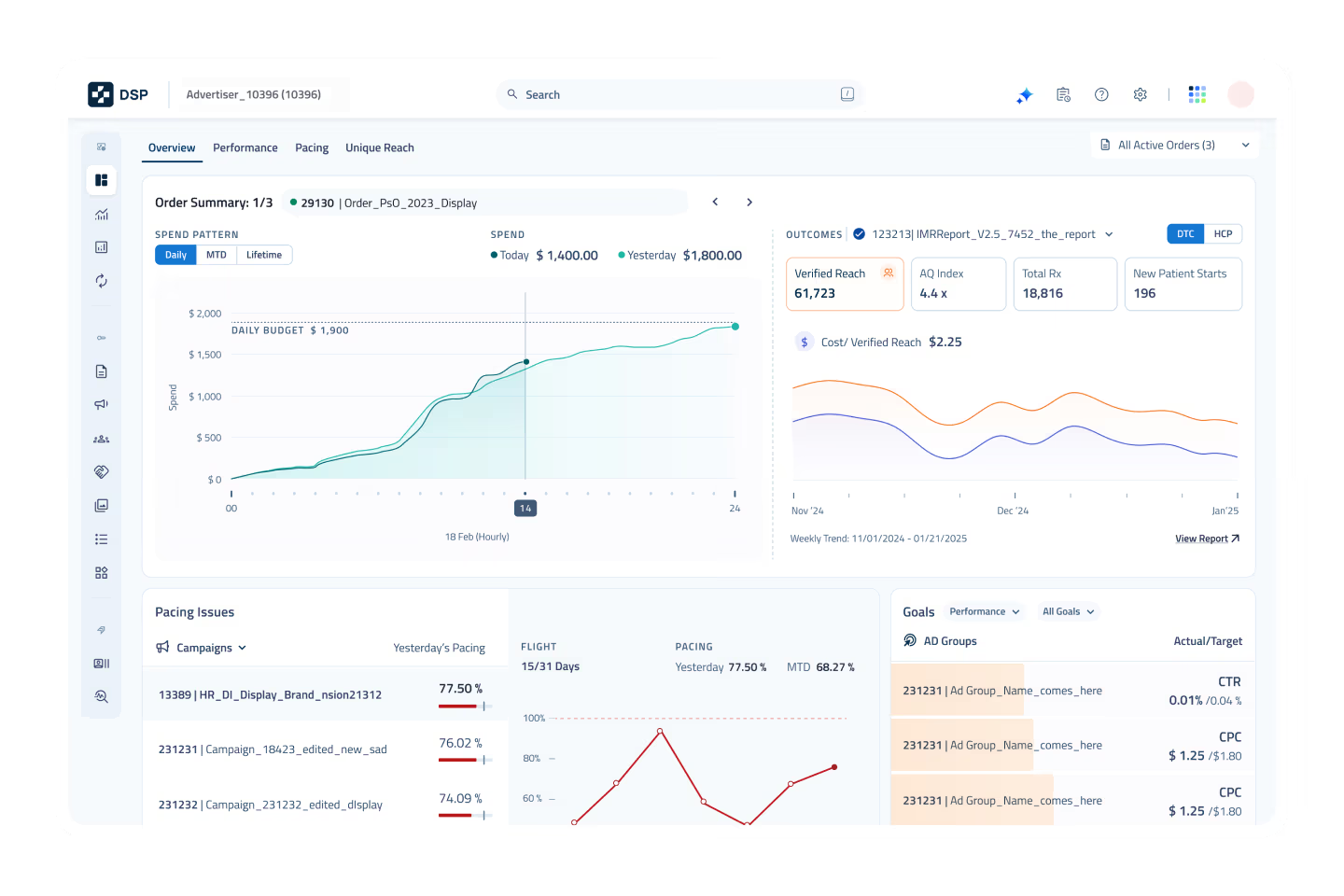
And campaign success frequently extends far beyond clicks. Healthcare marketers may evaluate audience quality, verified reach, prescription lift, new patient starts, and other real-world outcomes.
Those requirements create a higher bar for any emerging advertising channel.
Where Healthcare Stands in OpenAI's Ad Rollout
OpenAI's advertising policies have evolved considerably since the initial rollout. Its current policies, updated in September 2026, say healthcare and medicine advertisers are being introduced gradually, with approvals reviewed manually on a case-by-case basis. That makes the details important.
What's Currently Restricted for Healthcare Advertisers
OpenAI continues to restrict ads for regulated medical products and services and ads making claims related to the prevention, diagnosis, or treatment of physical or mental health conditions.
The current policy does not broadly open the door to pharmaceutical advertising. Prescription drugs are not among the U.S. healthcare categories OpenAI currently identifies as potentially eligible for case-by-case approval. OpenAI also prohibits unsafe or unapproved medical products, unsupported treatment claims, experimental or investigational therapies, invasive or high-risk medical procedures, and health-related products that exploit user vulnerabilities.
In other words, healthcare may now be part of the advertising ecosystem, but access remains significantly more controlled than it is for many consumer categories.
What's Allowed and Where the Policy Is Evolving
There are important exceptions.
General health and wellness products without medical claims, including fitness equipment, wearable devices, and menstrual products, may be permitted. In the U.S., OpenAI may also approve certain advertisers on a case-by-case basis for categories including consumer medical devices, dental services, disease awareness campaigns, health insurance, hospitals and urgent care, medical testing and diagnostic services, and vision products and services.
The direction of travel has also changed. An April 2026 policy update removed the categorical prohibition on ads appearing in medical, legal, and financial advice contexts. Sensitive conversations remain excluded, but the change gave OpenAI more flexibility to determine when an ad may be appropriate.
For healthcare marketers, the takeaway is less about predicting exactly when pharmaceutical advertising will become available and more about recognizing that the policy framework is actively developing.
What Stays Off Limits Regardless of Policy Changes
Some guardrails go deeper than advertiser eligibility.
OpenAI says ads do not appear in mental and personal health conversations, emotionally reliant contexts, or sensitive user journeys. Advertisers do not receive users' ChatGPT conversations, chat histories, memories, or personal details. And advertising operates separately from ChatGPT's answers, meaning advertisers cannot pay to influence what ChatGPT says.
Those boundaries matter particularly in healthcare, where a conversation can move quickly from general information into deeply personal territory.
As conversational AI platforms become better connected to trusted external data sources, the capabilities surrounding healthcare marketing may become more sophisticated. But expanding those capabilities will still require privacy, compliance, and governance infrastructure designed for health data.
How Conversational AI Advertising Is Different Than Search or Programmatic
ChatGPT ads introduce a fundamentally different signal from the ones marketers already use.
Search advertising primarily responds to queries. Someone searches for a term, and advertisers compete for the opportunity to appear against that expression of intent.
Programmatic healthcare advertising can work differently. Instead of relying solely on what someone types or reads, campaigns can use privacy-safe clinical and behavioral data to build audiences based on characteristics such as specialty, diagnosis, prescribing behavior, or patient populations.
Conversational AI adds another model: understanding intent from the context of an ongoing dialogue.
Search AdsProgrammatic Healthcare AdsChatGPT AdsTargeting ModelKeyword matchClinical audience dataConversation contextAudience VerificationNoneVerified HCP/patientNoneIntent SignalQuery termsBehavioral + clinicalFull conversationMeasurementClicks, conversionsAQ, script lift, verified reachAggregated impressions, clicks
The distinction is especially important in healthcare.
A conversation can provide a rich signal about what someone is interested in. But interest is not the same thing as clinical identity. Someone discussing a particular condition could be a diagnosed patient, caregiver, physician, student, researcher, or simply someone looking for information.
Conversational targeting can understand what is being discussed. Clinical data can help establish who an audience represents from a healthcare perspective. Healthcare marketers evaluating AI advertising will need to understand the difference.
Where the Gaps Still Exist for Healthcare Advertisers
The remaining challenges are not necessarily shortcomings of conversational AI. They reflect the specialized infrastructure healthcare advertising has developed over years to meet its particular requirements.
For conversational AI to become a significant healthcare advertising channel, several of those capabilities will need to develop further.
No Clinical Audience Verification
Healthcare campaigns frequently depend on verified audiences.
An HCP campaign might need to reach cardiologists actively treating patients with a particular condition. A DTC campaign might need to reach a privacy-safe audience modeled from clinically relevant patient populations.
ChatGPT's ad product does not currently offer the healthcare-specific audience tools available through purpose-built platforms, such as NPI-level targeting, condition-code segmentation, claims-based audience creation, or verification of whether someone discussing a condition is actually part of the relevant patient population.
Over time, privacy-safe connections to governed healthcare data could help narrow that gap. Doing so responsibly would require clear controls separating sensitive health information from advertising systems and maintaining appropriate consent, privacy, and governance.
Measurement That Doesn't Yet Connect to Clinical Outcomes
Healthcare advertisers also need to know what happened after an impression.
ChatGPT provides advertisers with aggregated performance information such as views and clicks without sharing conversations or personal details.
Pharmaceutical marketers often need another layer of accountability: Was the intended audience reached? Did prescribing behavior change? Did more patients begin treatment?
Closing that gap would require privacy-compliant infrastructure capable of connecting media exposure to verified healthcare outcomes without exposing individual health information. Until capabilities like those become available, conversational AI advertising and healthcare programmatic advertising will offer different levels of campaign accountability.
Compliance in a Conversational Format
Conversational advertising also raises new questions about how established healthcare advertising rules translate to a new interface.
FDA requirements do not disappear because an advertisement appears in an emerging medium. Prescription drug promotion must remain truthful and balanced, and product-claim advertising is subject to requirements around risk information and material facts.
Healthcare organizations also rely on medical, legal, and regulatory review processes that are typically designed around defined creative assets and placements. A contextual advertising environment introduces new considerations around adjacency, disclosures, and the separation between a user's health-related conversation and sponsored content.
Clearer platform standards, predefined healthcare ad formats, rigorous advertiser review, and strong data boundaries could make those questions easier to manage as the category develops.
How Clinical Data Is Already Working Inside Conversational AI
The clinical data challenge extends beyond advertising.
General-purpose AI can make it dramatically easier to ask questions and analyze information, but healthcare marketers still need trustworthy data behind the answers. Purpose-built connections between conversational AI and governed health data are beginning to address that problem today.
What the Model Context Protocol Makes Possible for Healthcare
Model Context Protocol, or MCP, is an open standard that allows AI assistants to connect with external tools and data sources. Instead of relying only on information contained within the AI model itself, an MCP connection can give an AI environment controlled access to specialized systems and datasets.
DeepIntent Helix AI™ applies that model to healthcare marketing.
Helix AI connects governed, HIPAA-compliant healthcare intelligence with tools including ChatGPT and Claude, allowing marketers to query healthcare data through natural language. DeepIntent's current platform supports HCP and DTC intelligence, audience building, campaign strategy, and activation from a conversational interface.
The underlying DeepIntent ecosystem spans millions of verified HCPs and hundreds of millions of patient lives, giving conversational AI access to healthcare-specific intelligence that a general-purpose model does not contain on its own.
From a Question in ChatGPT to a Verified Audience in Your DSP
Consider a healthcare marketer developing a campaign in a particular therapeutic area.
Instead of opening several dashboards or submitting an analytics request, the marketer can ask a natural-language question about specialist behavior, prescribing patterns, patient populations, or competitive trends.
Through Helix AI, the response can be grounded in healthcare data rather than the public information available to a general-purpose model. The marketer can then use that same conversational workflow to build an HCP or DTC audience and deploy it directly to DeepIntent Cortex DSP.
The conversation becomes more than a way to retrieve information. It connects market intelligence, audience strategy, and activation.
That distinction is useful when considering the future of AI advertising. The immediate opportunity is not limited to putting an ad inside an AI conversation. Healthcare marketers can already bring the data that powers their advertising decisions into the conversation itself.
What Healthcare Advertisers Should Do Now
The exact trajectory of ChatGPT ads for healthcare will depend on how OpenAI's policies, capabilities, and advertiser access continue to develop.
Healthcare marketers do not need to wait for that future to prepare for it.
Monitor How AI Ad Platforms Evolve
Conversational AI advertising is moving quickly. OpenAI has changed its healthcare policies several times since launching its ads program, including updates to where ads can appear and which healthcare categories may be considered.
Teams should establish a process for monitoring changes to eligibility, targeting, measurement, privacy, and healthcare-specific advertising requirements.
That way, if broader pharmaceutical access arrives, the first question will not be, "How does this work?" Teams can focus instead on whether the channel fits their specific brand and campaign objectives.
Strengthen the Channels That Already Deliver Verified Outcomes
Conversational AI may create an important new source of consumer intent, but healthcare marketers already have channels capable of delivering clinical precision.
Programmatic display, CTV, online video, audio, EHR, and point-of-care advertising can be supported by healthcare-specific audience data and measurement infrastructure. Purpose-built platforms can connect media exposure to prescribing and other real-world outcomes while giving marketers tools to optimize against healthcare KPIs.
Those capabilities remain important regardless of which new inventory sources emerge.
Bring Governed Health Data Into Your AI Workflow
The more immediate AI opportunity may be upstream of the ad itself.
Healthcare marketers can already use natural language to explore prescribing behavior, analyze market dynamics, identify relevant HCP or patient populations, and build audiences when governed health data is connected to their AI environment.
That allows teams to benefit from the speed and accessibility of conversational AI while preserving the clinical intelligence healthcare marketing requires.
How DeepIntent Helps Healthcare Advertisers Navigate This Shift
The advertising interface may change. The need for trusted healthcare intelligence does not.
DeepIntent provides a healthcare-specific foundation spanning data, identity, audience creation, media activation, optimization, and outcomes measurement. Its platform supports verified HCP and consumer audiences informed by real-world health data and connects campaign engagement back to healthcare outcomes.
Helix AI extends that foundation into conversational AI. Through MCP, healthcare marketers can access governed healthcare intelligence inside tools such as ChatGPT and Claude, ask questions in natural language, build HCP and DTC audiences, and move those audiences directly into activation workflows.
As ChatGPT ads for healthcare and other conversational advertising products evolve, those capabilities offer a useful model for what healthcare marketers should expect from AI: the accessibility of natural-language interaction combined with the clinical precision, governance, and accountability the industry requires.
Ready to bring healthcare intelligence into your AI workflow? Learn more about DeepIntent Cora™.