.png)
1. You've spent years in healthcare marketing and ad tech. What got you thinking about where this industry needs to go next?
The same campaigns get re-trafficked year over year. That's what I couldn't stop noticing.
Everyone in the chain knew the distance between having good data and shipping a campaign that reflected it was enormous. We've all sat in the meeting where someone says we should personalize better, everyone agrees, and then the plan goes out looking a lot like last year's. Most of that gap was processing and coordination work in the middle.
I adopted AI early, and the pattern showed up fast: it could synthesize more than a great analyst or even a great team. Not better judgment, more throughput on the parts of the job that were never judgment to begin with. Finding the insight that should change a campaign. Designing an HCP or DTC audience strategy from a brand's actual landscape. Building the change instead of writing it up in a deck.
That middle got much smaller. I now regularly see someone move from a strategy question to a media plan in hand inside a single working session. Small groups lean in and try things, because the tax on trying is no longer prohibitive.
2. Healthcare marketing has always been fragmented across brand teams, agencies, planners, and analysts, each with their own slice of data. Does AI fix that?
Not by itself, and I know that because I watched myself be wrong about it.
Earlier this year we put an early version of the platform in front of a room of customers, early enough that we handed out our own laptops rather than let it walk out the door. They worked on brands they knew cold: pulling claims data, building segmentation strategies, building a media plan. The room was floored. They were getting more in minutes than they typically get back from partner teams in weeks.
Then everybody sobered up, because the next questions weren't about the output at all. How would I show this to somebody? How do I get them to trust it? If I build something in here, how do I hand it to a colleague in a way where they can see what went into it? Nobody doubted the analysis. They doubted their ability to move it three feet to the left, onto a colleague's desk, with its credibility intact.
The fragmentation in this industry was rational to begin with. The work in the middle was genuinely hard, so teams formed around slices of it. Someone owned claims. Someone owned media performance. Someone owned the deck that reconciled the two. I'd assumed compressing that middle would dissolve the silos on its own, and it doesn't. Hand five specialists five fast AI tools and you get five silos that disagree faster, each arriving with a confident summary generated from its own slice. That's the old problem with better latency.
Marketers can already summarize with AI. What they still can't do is collaborate on the same answer. That takes a shared workspace: one canvas, multiple people, the same plan, and the same data underneath. Somebody builds an audience and shares it, and the next person asks the system to reshape it against different criteria, and both of them can see how it got that way.
The same problem exists across channels. Social reports one way, programmatic another, linear TV a third, each in its own system with its own definitions, so every meeting gets spent reconciling exports. Those channels weren't built to be compared, and pretending the metrics line up cleanly would be its own kind of dishonesty. But getting them into one place with the differences visible beats what most teams have now, which is three tabs and an argument.
3. What does healthcare marketing need from AI that general-purpose tools may not fully deliver?
Three things, and the first isn't a capability at all, which is why it gets missed.
It has to prove where the answer came from. That question from the room, how do I get someone to trust this, turned out to be the whole ballgame, and it sits well ahead of model quality. A pharma marketer defends an output to a brand team, to legal, through MLR, sometimes to a center of excellence that will ask about sample size and expect a real answer. An analysis nobody can audit is worse than no analysis, because it can't be used at all. So: source attribution and methodology on every recommendation, a freshness stamp showing the time window of the underlying claims, and an audit trail that travels with the artifact. On the output itself, not in the documentation.
It has to speak the language natively. This includes taxonomies and relationship graphs, so the system knows how conditions map to procedures, procedures to specialties, and specialties to real prescribers. It needs to understand line of therapy, because "who should we reach" has a different answer in first line than in third. When a planner types NSCLC, the system should just know. If you have to explain your own field to the tool before you can ask it anything, you haven't saved any time.
The data has to be there, joined, and deep enough in time to matter. Real-world health data, media and creative performance, an HCP and patient identity graph, assembled in advance, HIPAA-compliant, immediately queryable. Depth is the underrated part: a snapshot tells you who prescribed last quarter, but years of longitudinal claims show script-writing behavior and catch a prescriber who's lapsing. Those are the signals that change a plan.
4. There's a lot of conversation about where AI is headed. What's actually achievable today?
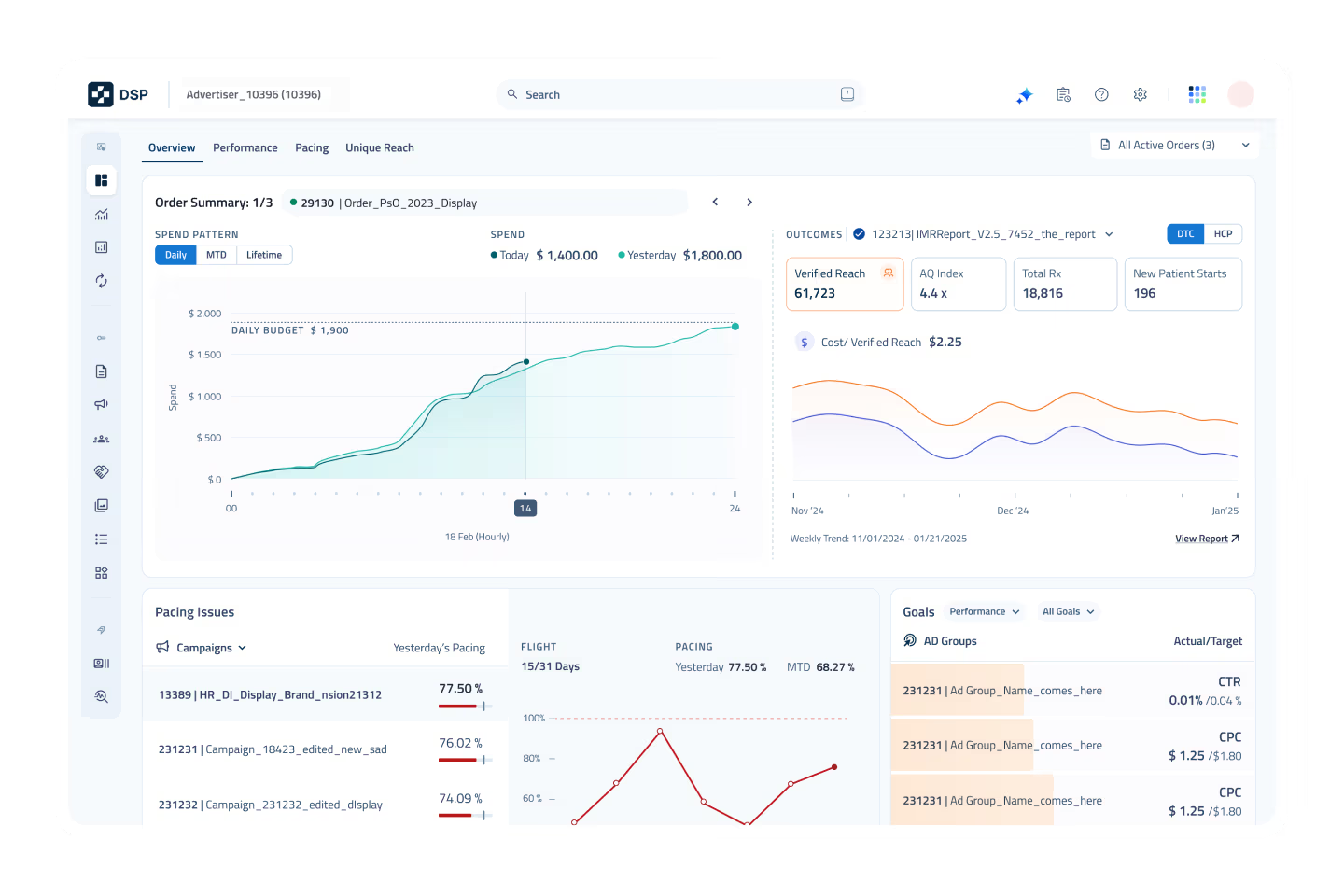
Audience strategy, end to end, is the clearest one. You give the system context on the brand, its competitive landscape, and what you've learned in market. It comes back with a segmented strategy, not one blob but tiers with priority attached. You map that to spend: highest-impact audiences go to campaigns with more aggressive CPMs, and you ladder down from there for reach goals. The plan pushes to a DSP, and you close the loop weekly or daily on how it's converting.
The loop only closes if it reaches the platforms where the spend lives, which is the work we're doing now: authenticated connections out to the major ad and CRM platforms, so performance comes back into one place automatically and a change goes back out the same way. That whole arc used to be several teams and several weeks. I've watched a user go from a brand and a condition, to the associated prescribers and patients, to built audiences, to competitive prescribing behavior, to a media plan they could visualize and adjust, without leaving the conversation.
Modeling the plan before you commit a dollar is part of that now too. Change the budget, the impressions, the audience definition, the CPM, and see what happens to delivery before you spend anything. Then keep doing it mid-flight, because a plan you build once and abandon is just a document.
Format matters more than it sounds like it should. A useful output tells you three things in order: what's true, what to do about it, and what you get if you do. HCPs writing a competitor are concentrated in five DMAs; shift this share of spend to CTV against those DMAs; here's the added reach against priority HCPs at the same CPM. Three paragraphs of prose instead means someone spends the first half of the meeting translating before anyone can decide anything.
The good version of this also asks you better questions. Users tell us the re-prompts are the most useful part, the system surfacing the thing they should have asked.
5. Looking out a few years, what does a healthcare marketing team look like when agentic AI is simply how the work gets done?
Less siloed, and centered on the brand, the strategy, and the outcome rather than on who owns which dataset.
I want to be careful here, because "AI makes teams smaller" is usually a euphemism and I don't mean it as one. The change I expect isn't thinner teams but fewer handoffs. An enormous amount of senior time goes into reconciliation: aligning on whose number is right, re-explaining how a recommendation was derived, waiting for analytics to come back. When the brand, the agency, and the analyst work on the same artifact with the same data underneath, that mostly evaporates. Same people, more strategy, and far less coordination overhead.
The bigger picture is why DeepIntent cares at all. Roughly 90% of drug candidates fail before reaching market, and in a meaningful share of those cases the wall they hit is commercial viability, not efficacy. Good science gets orphaned because the commercialization math doesn't close, often because these are precise treatments for precisely defined populations that are hard to find and reach with confidence. Cut the cost and time to commercialize meaningfully and that math closes for therapies where it doesn't today. More programs means more teams, even if each team is leaner than it was. I'd rather work toward a world with more therapies on the market and less overhead behind each of them than defend the current arrangement, where the coordination cost is a line item that patients ultimately pay.