Healthcare marketers are navigating a genuinely difficult environment right now. Budgets are tightening, privacy regulations keep expanding, HCP access has eroded in many specialties, and the cost of reaching the right audience keeps climbing. The stakes are high: campaigns that miss the mark waste spend that teams can't afford to lose. The good news is that each of these challenges has a practical path forward. Here's what's driving the pressure and what to do about it.
1. Reaching the Right Audiences Without Sacrificing Compliance
Nearly half of healthcare marketers have pulled back on audience targeting altogether because of HIPAA concerns. That caution is understandable, but it's costly. Brands that do target compliantly see conversion lifts of 20 to 50 percent compared to broad, untargeted campaigns. When campaigns reach the wrong audiences at scale, the wasted spend compounds fast and the downstream impact on brand credibility is hard to recover.
How Clinical Audience Data Solves Both Problems at Once
The answer isn't to abandon targeting. It's to move away from demographic proxies and build audience segments from medical claims, pharmacy data, and condition codes instead. Clinical audience data improves both precision and compliance posture at the same time because it doesn't rely on sensitive individual-level tracking. Marketers can activate highly relevant segments while staying firmly within HIPAA guidelines.
2. Navigating a Privacy Landscape That Keeps Changing
HIPAA is table stakes. The real challenge is the expanding patchwork of more than 22 state privacy laws, the deprecation of third-party cookies, Meta's 2025 restrictions on healthcare advertisers, and a more aggressive enforcement posture from the FTC. Brands that treat compliance as a reactive process will always be playing catch-up. By the time a legal team reviews a new regulation, campaigns built on fragile data practices are already exposed.
Integrate Compliance at the Data and Platform Level
Privacy-first is a strategic posture, not a legal checkbox. It means building compliance into campaign architecture before activation. HIPAA-compliant infrastructure, cookieless identity resolution, and privacy-safe audience activation are not add-ons. They are the foundation that makes both precision targeting and regulatory compliance achievable on an ongoing basis.
3. Proving ROI in Terms That Leadership Cares About
Marketing budgets in healthcare are under real pressure, and ROI justification has become non-negotiable. The problem is that most campaigns still report on clicks, impressions, and reach. Those metrics don't survive a budget review conversation with finance. The disconnect between marketing activity and clinical outcomes is the root cause of the credibility gap that so many marketers face with leadership.
Measuring What Actually Moves Prescriptions
Closing that gap means anchoring measurement to clinical outcomes from the start. Audience quality scores, script lift targets, and verified patient and HCP reach need to be defined before launch, not evaluated after the campaign ends. When those metrics are set upfront, they determine which platforms, channels, and data sources make the plan. That's a fundamentally different approach than optimizing for proxy metrics and hoping leadership connects the dots.
4. Breaking Through to HCPs Whose Attention Is Harder to Earn
Rep access has declined sharply across many specialties, and the vacuum left behind has been filled with digital content competing for limited HCP attention. Eighty-eight percent of physicians prefer video-based content, and HCPs increasingly expect the same quality of digital experience from pharma brands that they get in their personal lives. Generic outreach doesn't just get ignored. It actively erodes brand perception.
Earning HCP Attention Instead of Buying It
The frame shift here is from interruption to relevance. Content that earns HCP attention combines channel preference data with clinical context so that messaging feels useful rather than promotional. This is as much a targeting and sequencing challenge as it is a creative one. Getting the right message in front of the right physician at the right moment in their day requires both data precision and thoughtful delivery.
5. Delivering Personalized Experiences at Scale
HCPs and patients now expect messaging tailored to their specialty, condition, journey stage, and channel preference. The challenge for pharma marketers is delivering that level of personalization at scale without building a manual production process that can't keep up with a live campaign. Most personalization strategies break down precisely at the gap between what teams want to deliver and what their current tools actually allow.
How Verified Clinical Data Makes Personalization Manageable
Clinical audience data combined with AI-powered segmentation makes it possible to personalize compliantly and at scale. Condition-specific segments, prescribing behavior data, and journey stage signals let marketers deliver messages that feel relevant without crossing privacy lines. The personalization becomes a function of data architecture as opposed to just creative effort.
6. Managing Fragmented Channels Without Losing Message Consistency
When CTV, display, point-of-care, and social operate independently, the costs are real and compound quickly. HCPs receive inconsistent messaging across channels. Patient journeys break between touchpoints. And performance data stays siloed in each channel, making it impossible to see what's actually working across the full media plan. Channel fragmentation is an infrastructure problem as much as a strategy problem.
What Connected Channel Execution Actually Looks Like
Activating channels from a shared audience foundation with consistent identity resolution and coordinated message sequencing changes what is possible. Cross-channel frequency management, consistent creative logic, and performance data that reflects the full media plan rather than individual channels in isolation all require that unified infrastructure underneath. Without it, optimization decisions are made on incomplete information.
7. Measuring Performance Across the Full Media Plan
A patient researches a condition online, has a conversation with their doctor weeks later, and fills a prescription after that. Connecting those events compliantly and in real time is where most pharma measurement breaks down. End-of-campaign reporting is too late to change outcomes. Channel-level metrics give an incomplete and often misleading picture of what drove results.
Moving From Channel-Level Reporting to Clinical Outcomes
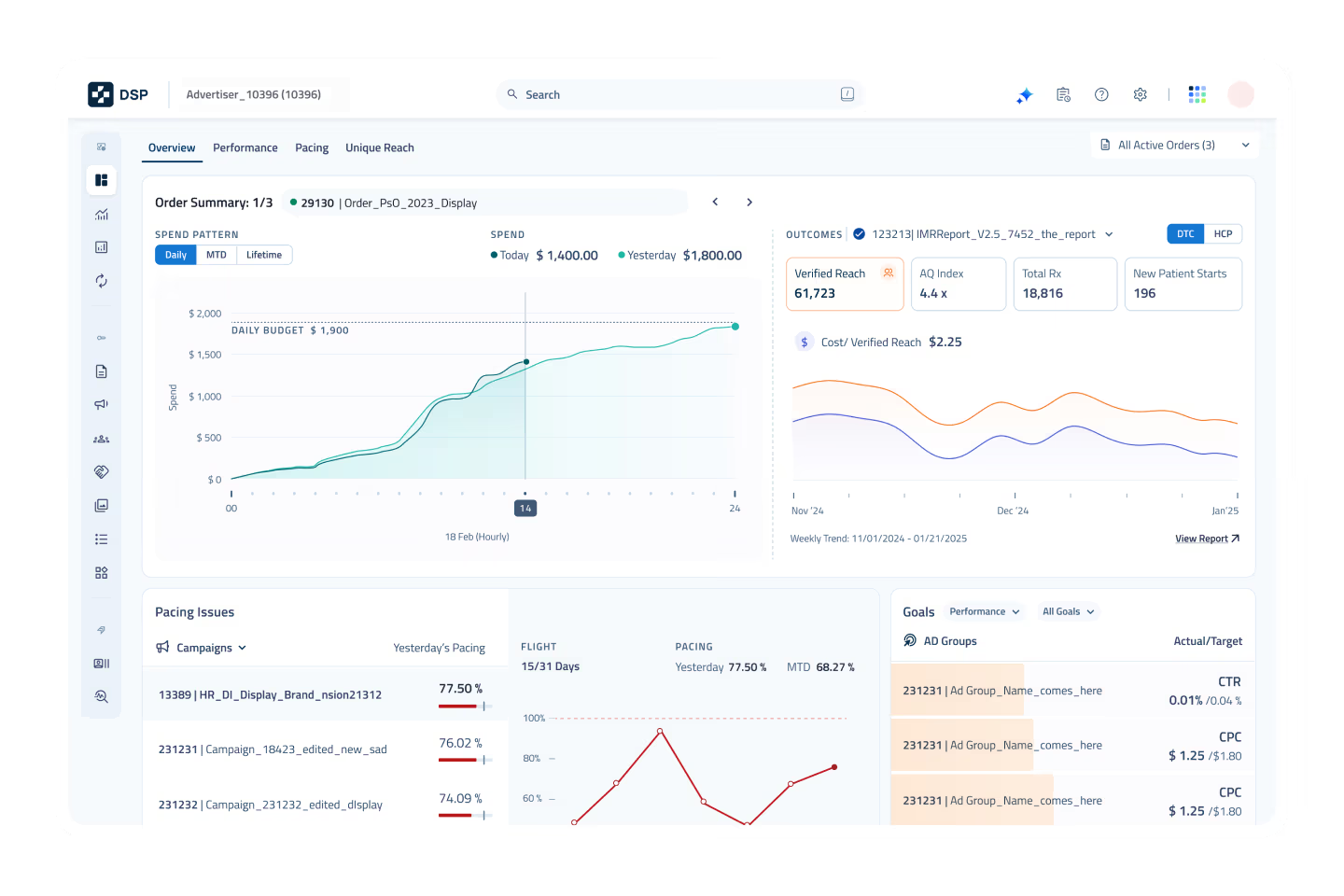
Cross-channel measurement grounded in clinical data means daily-refreshed insights, script lift tracking across the full media plan, and a single performance view that connects impressions to real-world outcomes. This level of visibility changes the optimization decisions available during a live campaign. Instead of waiting until the end to assess results, teams can act on what's working while the campaign is still running.
Need a Solution to Overcome All These Healthcare Marketing Challenges?
The challenges above don't exist in isolation. Privacy, targeting, measurement, personalization, and channel execution are all connected, and solving for one while ignoring the others creates new gaps. Marketers who address them together, through a shared data foundation and integrated infrastructure, are the ones who will sustain performance as the environment keeps shifting.