.png)
The EHR advertising category has filled up fast, and vendors that do very different things now describe themselves in nearly identical language: authenticated prescriber reach, point-of-care engagement, workflow-native messaging. Read three sales decks side by side and the claims blur together.
Most buyer frameworks do not help, because they compare vendors on the metrics vendors chose to lead with. Headline reach figures are the worst offender. Two vendors can quote numbers four times apart while both are technically accurate, because they are counting different things.
This article covers the models available for buying EHR media, the criteria that separate them, the questions to ask before signing, and why programmatic access changed the calculus for a lot of teams this year.
Why Choosing the Right EHR Marketing Solution Matters
The cost of getting this wrong is rarely a failed campaign. It is a campaign that looks fine in the vendor's reporting and cannot be defended anywhere else.
Pick a vendor whose network skews toward two or three EHR platforms and your target prescriber list gets served wherever coverage happens to exist, not where your audience actually works. Pick one that reports at campaign aggregate rather than NPI level and you cannot tie delivery to prescribing behavior. Pick one whose data sits in its own portal and your EHR results never reconcile with the rest of the plan, which usually means the channel gets argued about rather than scaled.
Get it right and the arithmetic changes. You reach prescribers at the moment of clinical decision, verify delivery against confirmed provider identity, attribute script lift at the individual HCP level, and fold that performance into the same measurement framework as every other channel.
Different Types of Advertising Options in EHR Systems
There are three ways to buy EHR media, and they differ in more than price. Each carries a distinct set of trade-offs around reach, control, and how the resulting data behaves.
Direct Buys From Individual EHR Platforms
The traditional route is contracting directly with a single EHR vendor. The advantages are real. Placements are native to that system's interface, the vendor controls the full experience, and many will offer competitive ad exclusivity by indication, so no rival brand appears against your therapeutic area for the term of the agreement.
Where it breaks down is coverage. There are roughly 400 EHR platforms in the US market, and a target prescriber list almost never concentrates inside one of them. Reaching a meaningful share of your audience means negotiating, trafficking, and reporting across several vendors at once, each with its own specs and formats, and the exclusivity that made a single contract attractive gets hard to replicate at scale.
Point-of-Care Networks That Aggregate Across Platforms
Aggregators solve the coordination problem. A point-of-care network contracts with multiple EHR and e-prescribe platforms, then sells across them as a single buy, which gives you one insertion order, one creative spec set, and one list match against your target NPIs.
Reporting transparency varies a lot between vendors here, so it is worth pressing on. So are reach claims. Only about 20 to 25% of EHR platforms accept advertising at all, and the bulk of that sits with two or three systems holding large market share. When a vendor quotes reach well above that band, the number usually includes commercial offerings beyond advertising, such as copay and savings program messaging or adherence texts. That may still be valuable, but it is not the same product, and you should ask for the advertising-only figure before comparing vendors.
Programmatic EHR Through a Healthcare DSP
The newest model removes the standalone vendor relationship entirely. In May 2026, OptimizeRx opened a programmatic connection point between its authenticated EHR network and demand-side platforms, letting media buyers activate point-of-care inventory inside the programmatic workflows they already use.
DeepIntent was announced later that month as the first healthcare DSP to integrate that network, with availability on the platform expected in Q3 2026. The practical effect is that EHR stops being a separate line item negotiated on its own terms and becomes another supply source in the same buying environment as CTV, display, and endemic, sharing one identity layer and one measurement framework.
What to Evaluate When Choosing an EHR Marketing Solution
The criteria below matter more than the reach number on the first slide, and most of them never come up unless a buyer raises them.
NPI Match Rate and What the Numbers Actually Mean
NPI match rate is the share of your target prescriber list reachable within a vendor's advertising inventory. It is the single most-quoted figure in this category and the least standardized.
Given how few EHR platforms accept advertising, a match rate above 20 to 25% should prompt a direct follow-up: is this figure advertising placements only, or does it include savings programs, messaging, and other commercial channels? Vendors are not necessarily being evasive. Definitions in this category are simply not standardized, and an unqualified number tells you nothing you can compare.
Where in the Clinical Workflow the Ads Actually Appear
Being inside the EHR says almost nothing on its own. What matters is where in the encounter your message appears, so ask any vendor to name the specific workflow stages their inventory covers.
The prescribing screen, the patient chart, and the intake form each carry different intent. A message at prescription selection reaches a clinician mid-decision. A chart placement reaches one reviewing history. These differ in cost, in the creative formats they support, and in what a reasonable performance expectation looks like, so a blended workflow figure tells you very little.
How Deep the Targeting Actually Goes
Specialty-level filtering is the floor, and plenty of vendors stop there. Targeting a cardiology list is straightforward; identifying which cardiologists treat the patient population your brand is indicated for is a different capability.
Platforms drawing on condition codes, prescribing history, and real patient panel data find the right prescribers with far more precision than those working from specialty and geography alone. Ask which clinical signals inform audience construction and how often those signals refresh, because a segment built once at campaign setup decays over a long flight.
NPI-Level Reporting and Verified Impression Delivery
Deterministic matching confirms an impression reached a specific verified provider identity. Probabilistic matching infers a likely match from device, location, and behavioral signals. The distinction gets blurred in sales conversations and it matters enormously.
Verified deterministic delivery is the standard worth requiring, because it is what makes script lift attribution possible at the individual HCP level rather than only in campaign aggregate. Without it, you can report that a campaign ran and that prescribing moved, but you cannot connect the two with any confidence.
Integration With the Rest of Your Media Plan
EHR that cannot share identity with your CTV, display, and endemic buys produces a reporting silo. Frequency across channels becomes unmanageable, incrementality becomes unanswerable, and the channel gets evaluated on its own reported numbers rather than its contribution.
Before committing to a standalone vendor, ask specifically how EHR impression data connects to cross-channel measurement. A file export on request is not integration. Shared identity resolution and a common measurement layer are.
Compliance Standards and POCMA Certification
HIPAA compliance is a baseline expectation, not a differentiator. Any EHR vendor that treats it as a selling point is telling you something about the rest of the field.
POCMA certification is a more useful filter. The Point of Care Marketing Association certifies individual product lines through annual third-party audits conducted by the Alliance for Audited Media, against published verification and validation standards. Veradigm became the first EHR media platform to earn it in February 2025. Certification does not measure performance, but it does indicate that delivery and measurement claims have been independently examined.
MLR Compatibility and Creative Format Requirements
This is the step most teams discover late. EHR platforms impose different format restrictions, character limits, and rules on interactivity, and those constraints do not map cleanly onto assets built for display or endemic placements.
A brand that completes MLR review and then learns the approved creative will not run in half its network is looking at a second review cycle and a delayed launch. Ask for format requirements and competitive scheduling windows before creative development starts, not after, and build the MLR timeline around the strictest spec in the network.
Questions to Ask Any EHR Marketing Vendor Before You Commit
Bring these to the call. The answers separate vendors faster than any deck will.
- How do you calculate NPI match rate, and does that figure reflect advertising placements only? Definitions vary enough that unqualified numbers are not comparable.
- Which specific EHR platforms make up your network, and what share of inventory comes from each? Concentration tells you whether your target list is genuinely covered.
- How do you verify that an impression was delivered to the correct NPI? This is where deterministic and probabilistic get separated.
- Does your reporting integrate with cross-channel data, or does it live separately? A standalone portal means the channel will be measured in isolation.
- Is there competitive ad exclusivity by indication or therapeutic area, and how is it enforced? Exclusivity is worth little without a stated enforcement mechanism.
- What are your creative format requirements, and where does MLR review fit in the timeline? Asking now prevents a second review cycle later.
- What clinical data signals inform your audience targeting? The answer reveals whether targeting is behavioral or demographic.
- How does EHR performance data connect to the rest of my media plan for measurement? If it does not, you are buying a channel you cannot defend against the others.
Why Marketers are Choosing Programmatic EHR Advertising Over Other Options
Money has been moving toward point of care for several years. Spending reported by POCMA members grew 171% between 2019 and 2023, reaching roughly $803 million, and crossed $1 billion in 2024, up 16% year over year. Over that same 2019 to 2023 window, HCP-targeted media spending overall declined 22%, which makes the point-of-care growth curve unusual rather than a rising tide.
The performance case supports the shift. POCMA research puts TRx lift from adding point of care to a digital or TV campaign at 6 to 8%. Physicians rank the EHR among their top channels for accessing brand information, with 68% naming it in one 2023 survey.
What changed in 2026 is access. Roughly 90% of US digital display spending now transacts programmatically, and pharma has moved in the same direction. Until this year, EHR sat outside that workflow, bought through bespoke agreements with its own specs, timelines, and reporting. Programmatic access folds the channel into the same buying environment, identity layer, and measurement framework as everything else on the plan. The inventory itself has not changed much. What changed is that it finally behaves like the rest of the media plan, and that is what is pulling budget toward it.
Why Healthcare and Pharma Marketing Teams Choose DeepIntent
DeepIntent is a healthcare DSP built specifically for this problem. Its data foundation spans more than 3.7 million healthcare providers and 240 million patient lives, which supports audience construction on clinical behavior rather than specialty proxies, and verified NPI-level delivery reporting rather than campaign-level estimates.
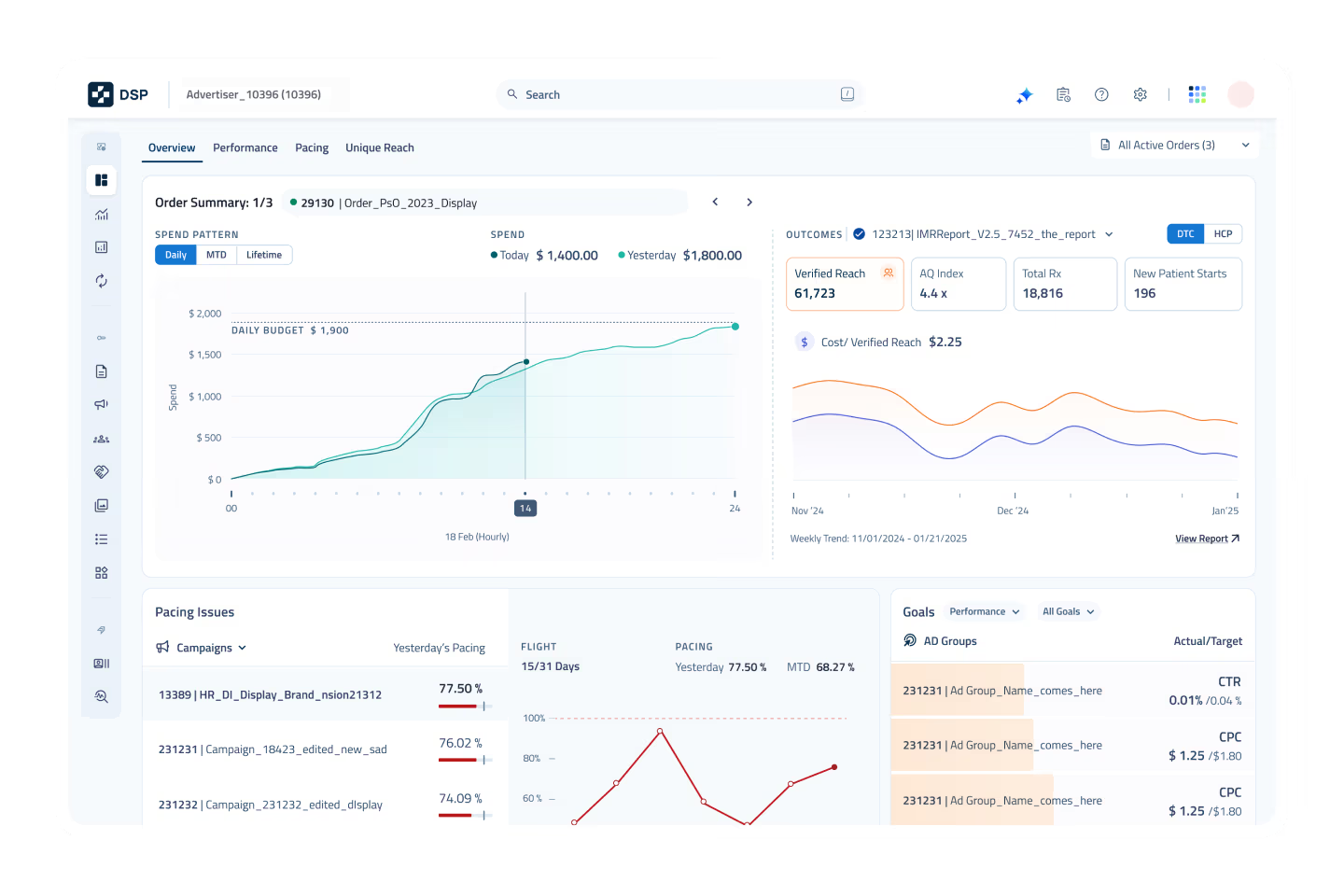
The measurement position is what most teams cite. DeepIntent Outcomes is a patented method for optimizing live campaigns toward script lift using real-world clinical data, which means media weight shifts during the flight instead of after a post-campaign study. Audience Quality scores how much delivered volume actually reached the intended clinical audience, giving planners a mid-flight read on precision.
That approach has concentrated adoption at the top of the market. DeepIntent reports working with more than 600 brands and 50 agencies, including 19 of the top 20 global life sciences companies, at 98% client retention. And as the first healthcare DSP to integrate OptimizeRx's authenticated EHR network, it lets teams buy EHR inventory alongside CTV, display, audio, and endemic in a single platform, with one identity layer underneath.
If you want to see how EHR fits into your current plan and what verified delivery looks like against your target list, book a call and we will walk you through the platform.