AI-driven programmatic advertising uses machine learning to decide which ad impressions to bid on, at what price, and with which creative, in real time, rather than relying entirely on fixed rules established when a campaign launches.
That technology is already deeply embedded in digital advertising. But healthcare changes the equation.
Healthcare marketers operate with stricter rules around data, privacy, targeting, creative, and measurement than advertisers in most other industries. A model that can predict who is likely to click is useful. A model that understands which HCPs are actively treating a particular patient population, or which media exposures are contributing to prescription lift, can solve a much more meaningful problem.
Understanding programmatic advertising AI in healthcare therefore requires looking beyond automation itself. The more important questions are what data the AI can use, what it is optimizing toward, and how its decisions connect media investment to clinical outcomes.
How Programmatic Advertising Works, and Where AI Fits In
Programmatic advertising automates the process of buying and selling digital media. AI adds intelligence to that automation by helping platforms evaluate opportunities and make decisions faster than a person could manually.
To understand how AI is used in programmatic advertising, it helps to start with what happens each time an ad becomes available.
DSPs, SSPs, Exchanges, and the Bid Request
Imagine someone opens a website or app.
As the page loads, an available ad impression creates a bid request. That request can contain information about the impression, such as the device, content environment, ad format, and other permitted signals.
On the sell side, a supply-side platform, or SSP, helps publishers make their inventory available. An ad exchange facilitates the auction. On the buy side, a demand-side platform, or DSP, evaluates the opportunity on behalf of advertisers.
Eligible buyers submit bids, and the winning advertiser's creative is served.
This entire process can happen in milliseconds.
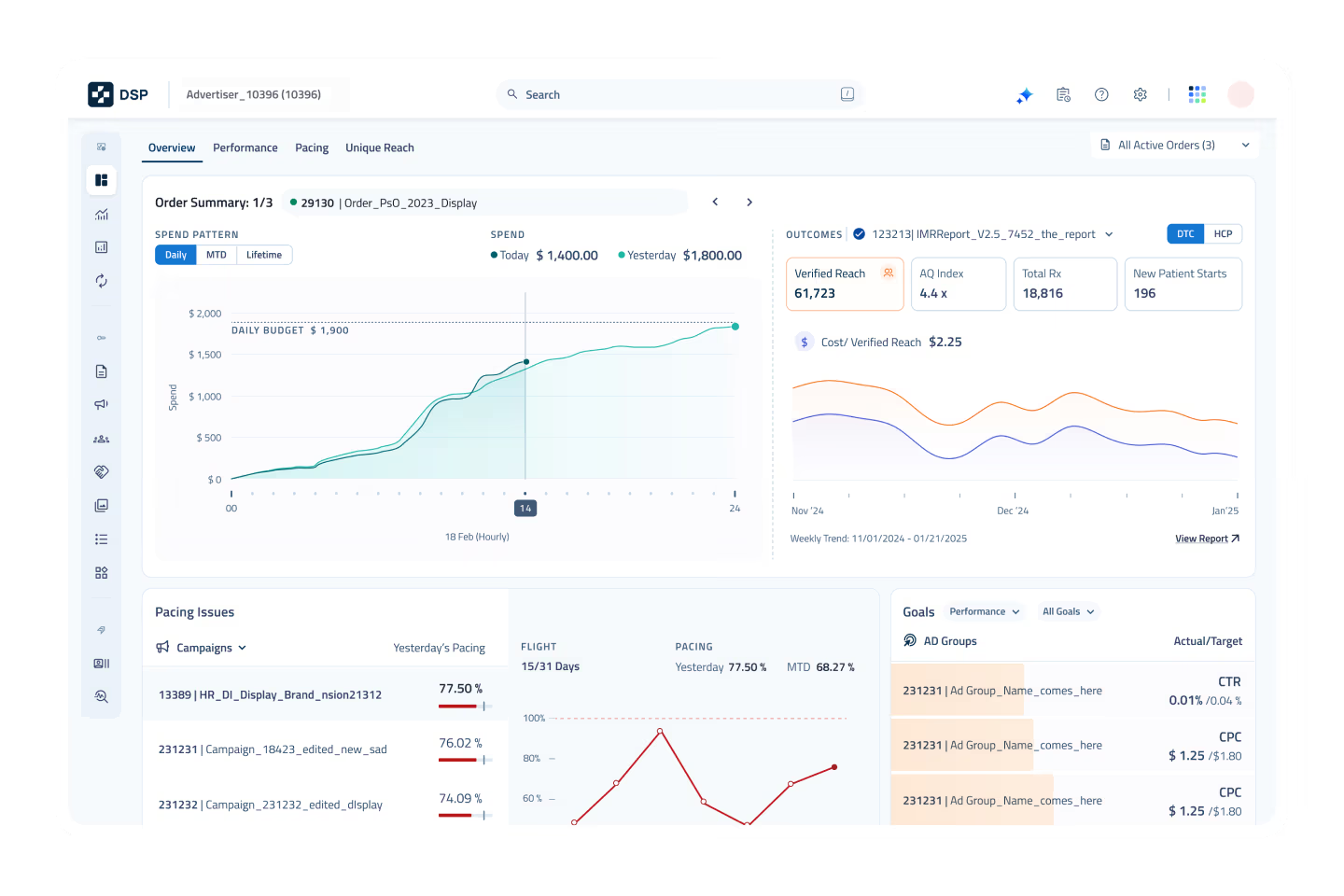
In healthcare, another layer of intelligence may sit behind that transaction. A purpose-built healthcare DSP can evaluate the impression against healthcare-specific audience, media, and outcomes data before determining whether and how much to bid.
The Decision Points AI Touches
AI can influence nearly every stage of that transaction.
Machine learning models can determine an appropriate bid price, manage budget pacing, model audiences, select among eligible creative, evaluate supply paths, and identify suspicious traffic.
AI is therefore less a single feature added to programmatic advertising than an intelligence layer running throughout the media-buying process.
That makes the underlying data critical. An algorithm can optimize only against the signals and objectives it is given. If those signals indicate clicks, it can get better at finding clicks. If they indicate clinically relevant audiences and prescription outcomes, the same basic technology can pursue a very different result.
How AI Is Used at Each Stage of a Programmatic Campaign
AI's role begins well before the first impression and continues after media is in market.
Adoption is already widespread. Digiday research found that 61% of surveyed brand and agency respondents used AI for programmatic advertising. Separately, IAB's 2025 State of Data report found that 30% of surveyed agencies, brands, and publishers had fully integrated AI across the media campaign lifecycle.
The applications span the campaign lifecycle.
Planning and Forecasting
Before a campaign launches, AI can analyze historical performance, audience characteristics, inventory availability, and other signals to forecast how a media plan might perform.
Predictive audience scoring can identify segments with greater potential, while channel-mix models can help determine how investment might be distributed.
In healthcare, human expertise remains essential. A model may identify a statistical opportunity, but marketers still need to determine whether that opportunity makes sense for the therapeutic area, brand strategy, and regulatory environment.
AI can make the planning process faster and more evidence-based. It does not eliminate the need for healthcare expertise.
Audience Building
Machine learning can also expand audiences from a smaller set of known signals.
A model might begin with a verified seed population, identify characteristics associated with that population, and score a broader universe based on the likelihood that individuals share relevant attributes.
Healthcare raises an important constraint: not every available signal should be used.
Teams need clear governance around which data is appropriate for audience creation and how sensitive health information is handled. The quality and provenance of the seed data matter as much as the sophistication of the model built on top of it.
Activation and Bidding
Once the campaign is live, AI can evaluate individual bid opportunities and determine how much an impression is worth.
The model might account for audience relevance, inventory quality, historical performance, cost, frequency, and other variables. It can also pace spend across the campaign so the budget is deployed according to the advertiser's goals rather than simply spent as quickly as possible.
The trader still defines the environment in which that intelligence operates. Budget limits, bid parameters, inventory requirements, frequency rules, and other campaign controls give the AI boundaries for its decisions.
In-Flight Optimization
Traditional campaign management often involved reviewing results periodically and making manual changes.
AI makes that process continuous.
As performance data arrives, algorithms can shift investment toward audiences, publishers, inventory, or tactics producing stronger results and away from those that are not.
Healthcare still requires human oversight. A machine can recommend a media optimization in real time. Changes involving clinical claims, targeting strategy, or regulated creative may require additional review before they can be implemented.
Measurement and Attribution
AI can also help determine what happened because of the campaign.
Attribution models evaluate multiple exposures and touchpoints to identify patterns associated with desired outcomes. In conventional advertising, those outcomes might include a site visit, lead, or purchase.
Healthcare can go further. When media exposure is connected to appropriate clinical data in a privacy-compliant environment, measurement can examine outcomes such as audience quality, prescription activity, patient starts, or provider visitation.
AI can surface relationships within that data. Human analysts and marketers still determine what the evidence supports and how those findings should influence strategy.
The Targeting Data Problem With Programmatic Advertising and AI
The standard AI advertising playbook has a fundamental limitation in healthcare: most consumer signals do not tell marketers what they actually need to know.
Browsing behavior can suggest interest. Purchase data can reveal consumption. A click can show engagement.
None necessarily establishes that someone is a diagnosed patient, that an HCP treats a particular condition, or that a person is clinically relevant to a therapy.
Healthcare marketers also operate under federal and state privacy requirements that restrict how sensitive data can be collected, shared, and used. The loss of traditional identifiers such as third-party cookies adds another complication for targeting and measurement.
This creates a data problem before it creates an AI problem.
A more sophisticated algorithm cannot manufacture clinical truth from signals that do not contain it. For AI in programmatic advertising to make better healthcare decisions, it needs an appropriate healthcare data foundation.
What Changes When AI Runs on Verified Clinical Data
Give AI better data, and the objective of programmatic optimization can change.
Instead of asking only which impressions are likely to generate engagement, a healthcare-specific system can evaluate whether those impressions are likely to reach clinically relevant audiences and contribute to meaningful health outcomes.
Audience Quality as the Optimization Target
Audience quality (AQ) measures how effectively media reaches the clinically relevant audience a healthcare campaign was designed to engage.
That relevance can be evaluated using information such as diagnosis data, prescribing behavior, or verified provider identity rather than relying solely on clicks or inferred consumer interest.
This changes the optimization problem.
An impression with a high likelihood of producing a click is not necessarily the most valuable impression for a pharmaceutical campaign. If another impression has a greater probability of reaching a verified patient or relevant prescriber, an AI system optimized toward AQ can prioritize that opportunity instead.
DeepIntent, for example, defines patient AQ as the percentage of ads delivered to individuals with a relevant diagnosis, as determined using appropriate clinical criteria.
Bidding on Daily-Refreshed Claims and EHR Signals
Recency also matters.
A static audience segment built months ago may not reflect what is happening in a therapeutic market today. Claims and EHR-derived signals that are refreshed frequently can give models a more current view of prescribing and patient activity.
That can make each bid decision more informed by current clinical behavior rather than historical assumptions.
Doing this requires healthcare-specific identity infrastructure capable of connecting signals while maintaining privacy protections.
Deterministic matching relies on known, verified identifiers to establish a connection. Probabilistic matching uses statistical signals to estimate whether records or devices belong to the same person or household.
Both approaches can play roles in advertising, but healthcare marketers need to understand which is being used, what data supports it, and what degree of confidence is appropriate for the campaign.
Optimizing Toward Script Lift, Not Clicks
Script lift measures incremental prescription activity attributable to media exposure compared with what would have been expected without that exposure.
This creates another fundamentally different optimization target.
A conventional algorithm might learn that a particular site produces a high click-through rate and allocate more budget there. But clicks are not prescriptions.
When appropriately governed clinical data connects media exposure with prescription activity, optimization can instead identify the impressions, audiences, and inventory associated with stronger script performance.
DeepIntent Outcomes, for example, provides daily AQ and script lift metrics that can be used to measure and optimize HCP and patient campaigns.
The AI is still optimizing media. The difference is the objective function.
How AI Transforms Programmatic Buying Across Healthcare Channels
AI does not operate identically across every media channel. The signals available, buying mechanics, and healthcare-specific considerations change depending on where an ad appears.
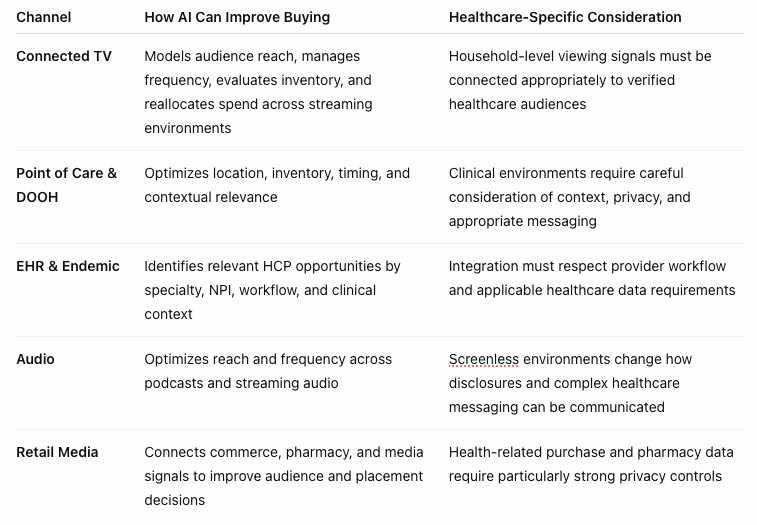
CTV illustrates the opportunity clearly. AI can help manage reach and frequency across fragmented streaming inventory while clinical data helps establish whether that reach includes relevant HCP or patient audiences. Healthcare-specific measurement can then evaluate downstream outcomes rather than stopping at completed views.
Similar principles apply across other channels. DeepIntent's healthcare DSP, for example, supports activation across CTV, audio, display, native, DOOH, EHR, and online video while applying healthcare-specific audience and measurement capabilities across the media plan.
Generative AI Creative and the MLR Review Bottleneck
Generative AI can produce creative variations at a speed traditional production processes cannot match.
Copy, imagery, layouts, and other assets can be generated and adapted for different audiences or contexts. Dynamic creative optimization can then test eligible variations and determine which performs best.
Healthcare introduces a practical constraint: faster creation does not automatically mean faster approval.
Pharmaceutical creative may need to pass through medical, legal, and regulatory review. Claims need appropriate substantiation. Required disclosures and fair balance cannot disappear because an asset was generated dynamically.
One potential solution is modular creative.
Instead of allowing a generative model to create unrestricted healthcare claims, marketers can establish a library of pre-approved messages, claims, imagery, and other components. AI can then select or recombine eligible modules according to predefined rules.
That allows some of the speed and personalization of generative AI while maintaining human control over what is permitted to reach the market.
Keeping Healthcare Ads Off Fraudulent and Non-Compliant Inventory
AI is also changing what advertisers choose not to buy.
Machine learning systems can analyze traffic patterns and other signals to identify invalid traffic, bots, suspicious behavior, and made-for-advertising sites. Supply path optimization can reduce unnecessary intermediaries between advertisers and publishers, improving transparency and directing more media investment toward quality inventory.
For healthcare marketers, inventory quality carries additional importance.
An inappropriate placement can create more than inefficient spend. Healthcare advertisers need to consider brand safety, privacy, regulatory requirements, and the sensitivity of the content surrounding an ad.
AI can help evaluate enormous volumes of inventory and identify potential risks faster than manual review alone. But marketers still need clearly defined inventory standards and human oversight for situations where context matters.
Agentic AI and Conversational Campaign Planning
The next phase of programmatic advertising AI integration is moving beyond individual bid decisions.
Agentic AI systems can assist with broader workflows such as market analysis, media planning, audience creation, campaign setup, and optimization. Instead of navigating a series of dashboards and filters, a marketer can increasingly describe an objective in natural language and have an AI system help complete the work.
Open standards such as Model Context Protocol, or MCP, expand this possibility by allowing AI tools to connect with external data sources and applications.
In healthcare, that could mean asking an AI system to analyze prescribing trends, identify a relevant HCP population, create an audience, evaluate available media, and recommend a campaign strategy within a single conversational workflow.
The critical word is recommend.
Healthcare's privacy, regulatory, and clinical requirements make unrestricted autonomy inappropriate for many decisions. Human-in-the-loop models provide a more practical framework: AI analyzes, recommends, and executes approved actions, while qualified people retain authority over consequential decisions.
That direction is already visible across advertising. IAB has described AI as moving across audience segmentation, media buying, optimization, and performance measurement, while emerging agentic systems are beginning to expand automation further into the campaign lifecycle.
Why Using a Specialized AI-Powered Programmatic Advertising Platform Is Important
The value of an AI-powered programmatic platform is not that it has AI somewhere in the product.
The more useful question is what the intelligence allows a healthcare marketer to accomplish.
A specialized platform can use clinical intelligence to help marketers size and understand relevant HCP and patient populations before a campaign launches. Those audiences can then be activated across channels without losing the healthcare-specific data foundation that informed the strategy.
Once media is live, AI can continuously evaluate performance and optimize toward healthcare KPIs such as audience quality and script lift rather than relying only on conventional media metrics.
Measurement completes the loop by connecting exposure back to real-world health outcomes.
The result is a continuous workflow: understand the market, find the relevant audience, activate media, learn from clinical outcomes, and use those outcomes to improve what happens next.
That is where specialized healthcare infrastructure changes what AI can do.
The Trends Shaping AI-Driven Programmatic Ads in Healthcare
The next evolution of AI in programmatic advertising is likely to be defined less by a single breakthrough than by several technologies converging.
AI will move further upstream. Optimization has historically happened after campaign parameters were established. Increasingly, AI will help shape the plan itself, analyzing markets, forecasting audience opportunity, and recommending channel and budget strategies before activation.
Healthcare outcomes will become more central to optimization. As measurement becomes faster and clinical signals become more accessible within media workflows, algorithms can increasingly optimize toward outcomes such as AQ, prescriptions, and patient starts rather than treating those metrics only as post-campaign reporting.
Conversational interfaces will simplify complex media workflows. Marketers will be able to ask questions, interrogate data, build audiences, and manage campaigns through natural language, reducing the amount of specialized platform navigation required to translate an idea into action.
Agents will coordinate more of the campaign lifecycle. AI agents may eventually move information and actions between planning, audience, activation, optimization, and measurement systems. Human approval and clear auditability will remain particularly important in healthcare.
Creative and media intelligence will become more connected. Pre-approved modular creative could allow AI to choose not only where and how much to bid, but which approved message is appropriate for a particular context.
Data differentiation will become more important than model differentiation. As powerful AI models become broadly available, competitive advantage will increasingly depend on the quality, recency, governance, and specificity of the data connected to them.
That last trend may matter most for healthcare. Better AI will continue to improve the mechanics of programmatic advertising. Better healthcare data determines whether those mechanics optimize toward something clinically meaningful.
How DeepIntent Connects AI-Driven Programmatic to Clinical Outcomes
DeepIntent Cortex™ brings AI, real-time media signals, and healthcare data together in a DSP purpose-built for healthcare.
Rather than treating health intelligence as a separate reporting layer, Cortex embeds it throughout campaign planning, activation, measurement, and optimization. Verified HCP and patient audiences can be activated across premium media, while healthcare-specific KPIs give traders visibility into how campaigns are performing beyond conventional media metrics.
DeepIntent's optimization technology is fueled by billions of daily health and media signals and can optimize investment toward audience quality and script performance. SmartBid analyzes historical clearing costs to improve auction efficiency, while Outcomes Optimization uses healthcare-specific signals to focus media investment on impressions that drive AQ and script lift.
That closes the loop between media buying and clinical outcomes.
Instead of asking AI simply to find cheaper impressions or more clicks, healthcare marketers can use it to make decisions informed by the audiences they need to reach and the outcomes their campaigns are designed to influence.
That is the larger opportunity behind AI in programmatic advertising: faster automation paired with healthcare intelligence that makes the automation more meaningful.
See how DeepIntent uses AI and Health Intelligence™ to transform programmatic healthcare advertising. Schedule a demo.