For many healthcare marketing teams, AI has become part of the daily routine. It helps draft blog posts, generate email subject lines, answer common patient questions, and reduce repetitive work.
Those applications create real value. They also leave some of healthcare marketing's hardest questions unanswered: Which providers are treating the patients a therapy is designed to help? Where are treatment gaps visible? Is a campaign reaching clinically relevant audiences and contributing to prescription activity?
Answering those questions requires AI connected to healthcare-specific data and measurement.
The next stage of AI in healthcare marketing is campaign intelligence: using governed clinical data to inform strategy, build verified audiences, and improve decisions throughout a campaign. Understanding that shift helps marketers see where AI can deliver more than faster execution.
Where Most Healthcare Marketing Teams Are Using AI Today
The most familiar applications of AI in healthcare marketing address work teams already do every day. Content production, patient communication, and personalization are natural starting points because their benefits are relatively easy to see.
Content Creation and Campaign Ideation
Generative AI helps marketers draft blog posts, social copy, ad variations, and educational materials. It can suggest angles for a campaign, turn a webinar into several content assets, or produce a patient-friendly first draft from technical source material.
The time savings can be meaningful. LinkedIn's 2025 B2B Marketing Benchmark research found that surveyed B2B marketers reported saving approximately four hours per week on content creation with AI. That finding concerns B2B marketing broadly, rather than healthcare specifically, but illustrates the productivity opportunity.
Healthcare adds an important review requirement. AI-generated content can omit qualifications, misstate evidence, or introduce an unsupported clinical claim. Pharmaceutical promotional materials still need appropriate medical, legal, and regulatory review. FDA standards for truthful, balanced prescription drug promotion apply regardless of how the draft was produced.
AI can reduce the work needed to reach a first draft. The accuracy and suitability of the finished asset still depend on qualified reviewers.
Patient Engagement and Communication
Conversational tools can help healthcare organizations answer routine questions, support appointment scheduling, and guide people toward relevant services. Automated follow-up sequences can provide reminders and practical information after someone requests an appointment or resource.
Available around the clock, these tools can reduce friction for people seeking information outside office hours. Healthcare marketing education programs already cover applications such as chatbots, personalized communication, and AI-supported patient engagement.
Their role needs clear boundaries. Administrative questions and approved FAQs are different from symptom assessment or clinical triage, which require appropriate clinical safeguards and escalation.
These applications improve communication and access. On their own, they provide little insight into which audiences a media campaign should prioritize or how advertising affects treatment activity.
Basic Personalization and Segmentation
AI can use CRM and first-party data to personalize emails, recommend content, and group audiences according to previous interactions.
Someone who downloaded a resource about a therapeutic area might receive related educational content. A returning website visitor might see information tailored to the pages they previously viewed.
That is a useful improvement over sending everyone the same message. But interaction history offers a limited view of clinical relevance.
An email open does not establish that someone has a diagnosis. A website visit does not reveal which therapies an HCP prescribes. CRM records may contain additional verified information, but engagement signals alone cannot establish those facts.
AI Can Do Much More for Healthcare Marketers
Using AI in healthcare marketing can extend into the decisions that shape a campaign.
A strategist can compare proposed messaging with competitors' published positioning and identify claims that need stronger substantiation. A planning team can synthesize approved clinical evidence into a campaign brief, with references retained for expert review. An analyst can use AI to explore performance patterns and develop hypotheses about why one tactic outperformed another.
Public prescribing datasets can also help teams form initial audience hypotheses, provided they account for the datasets' reporting periods and limitations. Those hypotheses can then be tested against more current, appropriate healthcare data before activation.
The value grows when these activities connect. Findings from a competitive analysis can inform the brief. Audience analysis can refine the media plan. Performance results can guide the next round of messaging.
This practical approach appeared in DeepIntent's five AI takeaways from industry leaders at AdLab 2025: match the tool to the problem, validate the data, and keep human expertise involved.
What Campaign Intelligence Looks Like When AI Meets Verified Clinical Data
Campaign intelligence connects healthcare evidence to marketing decisions. It gives teams a way to evaluate the market, define relevant audiences, and assess performance using signals that reflect clinical activity.
When AI can access governed healthcare datasets, marketers can ask more specific questions and receive answers grounded in those datasets.
Querying Prescriber Behavior and Patient Populations in Real Time
A marketer might ask which specialties account for prescribing activity in a therapeutic area, how that activity varies by geography, or where competitor prescribing overlaps with the brand's target list.
Patient-level source data, analyzed within an appropriately governed environment, can also help identify populations with recorded diagnoses but no observed treatment during a defined period.
Those findings need interpretation. An absence of recorded treatment may reflect incomplete data, reporting delays, or care outside the dataset. It does not automatically establish that every person in the population is untreated or eligible for a particular therapy.
The practical advance is the ability to explore these questions interactively. Real-time querying means faster access to available evidence; it does not mean every underlying clinical event is recorded instantly.
Shrinking the Gap Between Insight, Audience, and Activation
Consider a marketer planning an HCP campaign in a competitive therapeutic area.
The marketer asks which specialists have recently prescribed relevant treatments. AI queries the connected data and returns a result with defined criteria and a reporting period. The marketer refines the population by specialty, geography, prescribing activity, or an existing target list.
That same workflow can produce an audience for activation, subject to the platform's supported destinations and governance requirements.
Helix AI, for example, supports conversational HCP and DTC audience building and deployment to DeepIntent Cortex DSP, alongside distribution to supported social channels.
Tasks that previously required separate data requests, exports, and platform handoffs can happen within one session. Marketers still review the criteria and campaign settings, but the route from a question to an actionable audience becomes much shorter.
Optimization That Moves Toward Prescriptions, Not Just Clicks
Clinical data also changes how campaigns can be evaluated and optimized.
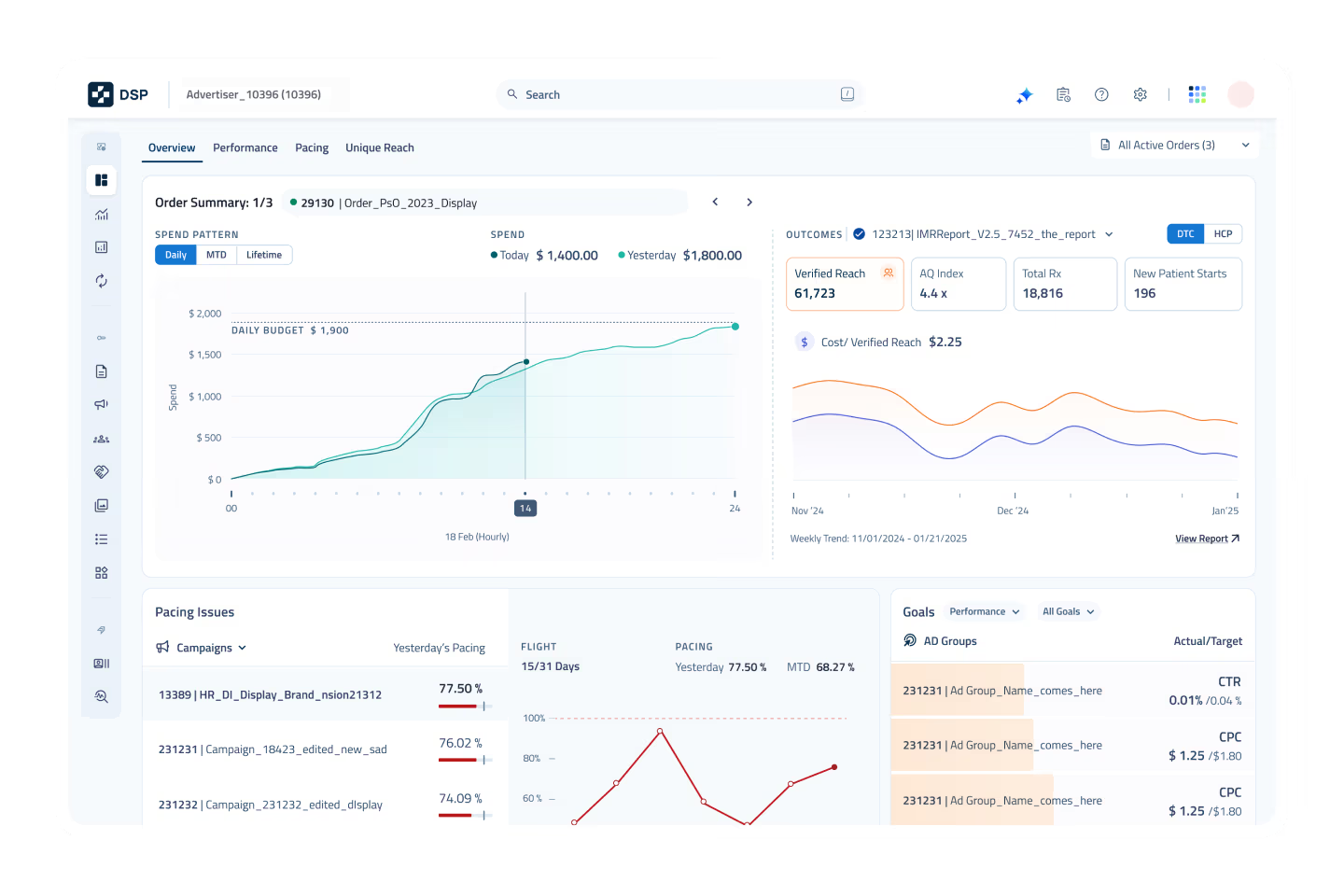
Audience quality, or AQ, measures how effectively media reaches a clinically relevant audience under the campaign's defined criteria. Script lift estimates incremental prescription activity associated with advertising exposure through the measurement methodology used.
These metrics give marketers a more direct connection to healthcare objectives than click-through rate alone.
When a platform connects impression data with refreshed clinical measurement, its optimization systems can use those signals to guide bidding and allocation. DeepIntent Outcomes provides daily AQ and script lift metrics and supports machine learning optimization toward healthcare performance.
Daily measurement updates still reflect the availability and timing of the underlying data. Their value is that teams can use clinical performance during a campaign, rather than waiting until it ends to assess whether their media decisions were effective.
Why Data Infrastructure Matters More Than the AI Model You Choose
A capable AI model can organize information, recognize patterns, and make complex systems easier to use. The evidence available to it determines which healthcare questions it can answer reliably.
Browsing data may help reveal interest. Governed claims and prescribing data can support analysis of recorded clinical activity. Verified provider identity can establish whether an audience includes the specialties and prescribers a campaign intends to reach.
Healthcare-grade infrastructure brings those capabilities together. It includes appropriate HIPAA-compliant environments, privacy-preserving clinical-to-media identity resolution, controlled collaboration through clean rooms, and compliance architecture built into data access and activation. HHS guidance also establishes specific requirements for de-identifying protected health information; removing a name alone is insufficient. Source: HHS
Interoperability makes that foundation usable through AI tools. Model Context Protocol, or MCP, is an open standard that connects AI applications with external tools and data sources. It allows an assistant to retrieve information or invoke a supported function through a standardized connection.
MCP does not make a system compliant by itself. The implementation must enforce access permissions, data boundaries, and appropriate controls. With that foundation, conversational interfaces can make specialized healthcare intelligence easier to use.
Where General-Purpose AI Falls Short in Healthcare
General-purpose AI remains useful for healthcare marketers. Its limits become apparent when a task requires evidence or accountability outside the information and systems connected to it.
First, generating more content does not automatically expand medical, legal, and regulatory review capacity. Teams can produce variations faster while still facing the same approval requirements.
Second, CRM engagement and behavioral signals provide incomplete evidence of clinical relevance. Without appropriate additional data, they cannot establish active prescribing, diagnosis history, or treatment gaps.
Third, paid media systems optimize toward the objectives they can observe. If those objectives are clicks or website conversions, performance improvements may say little about verified reach, AQ, or prescription activity.
Fourth, search trends and public information can reveal interest in a condition without providing a current, comprehensive picture of treatment activity. They can suggest where further investigation is useful, but cannot independently establish clinical opportunity.
These gaps reflect healthcare's particular data requirements. AI becomes more useful for campaign decisions when it is connected to infrastructure built around those requirements.
What the Future Holds for AI in Healthcare Marketing & Advertising
Looking at AI in healthcare marketing in 2026, the clearest direction is toward more connected campaign workflows. Agentic systems can increasingly coordinate analysis, audience creation, planning, and approved actions. DeepIntent's AdLab recap on agentic AI highlights the foundations needed for that progress, including consent, identity resolution, and human oversight.
Campaign management may become more autonomous within defined limits. Targeting and budget decisions can respond to updated healthcare signals, while creative optimization can select among approved assets using evidence of healthcare performance. Changes to clinical claims or patient-facing messages will still require appropriate review.
Deeper connections between AI and governed health data can also bring HCP and patient marketing into more coordinated workflows. Teams can examine both sides of a treatment journey and assess how their media strategies work together. The measure of AI in healthcare marketing effectiveness will increasingly include the quality of those decisions and their contribution to campaign outcomes.
How DeepIntent's Helix AI Connects Clinical Data to Campaign Performance
DeepIntent's infrastructure connects healthcare intelligence with media buying and measurement.
Cortex is the healthcare DSP, embedding Health Intelligence™ into campaign workflows and supporting optimization toward AQ and script performance. Outcomes is the patented measurement technology connecting media exposure with real-world clinical data and daily performance updates.
Helix is the healthcare marketing cloud underlying this ecosystem. Its launch announcement describes healthcare and media insights spanning more than 3.7 million HCPs and 240 million patient lives, with tools for data integration, custom analytics, and proprietary solutions.
Helix AI makes that foundation accessible through conversation. Marketers can query prescriber behavior, explore competitive dynamics, build audiences, and move them into activation. MCP provides the connection to external AI environments. DeepIntent's preview announcement named ChatGPT, Claude, and Gemini; its current Helix AI page highlights access through the DeepIntent platform, ChatGPT, and Claude.
This can turn tasks that required days of coordination into interactive work completed in minutes. Agencies can also build differentiated analytics and solutions on Helix using their own data alongside the platform's healthcare intelligence.
The benefit is a closer connection between the evidence behind a campaign, the audiences it reaches, and the outcomes used to improve it.
Explore Helix AI to see how governed healthcare intelligence can inform your next campaign and help optimize toward verified reach and prescription outcomes.