Eighty-two percent of pharma executives believe their digital outreach is effective. Only 28% of HCPs agree. Roughly 97% of digital outreach to physicians goes unanswered. That gap between how pharma marketing teams see their own performance and how the audience actually experiences it is the starting point for any honest conversation about strategy.
The good news is that the gap is closable by rebuilding pharmaceutical marketing strategies around how HCPs and patients actually make decisions today: on clinical evidence, at the point of care, and increasingly, without a sales rep in the room. What follows is a practical look at where most strategies break down and what's replacing them.
Why Most Pharmaceutical Marketing Strategies Fall Short
Three problems compound one another in most pharma marketing plans. Digital volume keeps increasing while HCP attention keeps shrinking, so each additional email, banner, or push notification captures less attention than the last. DTC spend has grown steadily over the past several years, but launch ROI has moved in the opposite direction, declining sharply even as budgets climb. And HCP and patient campaigns are still planned and run as separate efforts, funded by separate budgets and measured against separate KPIs, despite the fact that they're both aimed at the same prescribing moment for the same condition.
That 82%-to-28% gap between executive confidence and HCP sentiment is evidence that the underlying strategy (more volume, more channels, and more frequency) has stopped working, and that the industry has been slow to admit it.
Build Audience Intelligence Before Buying a Single Impression
Audience strategy is the single decision that shapes everything downstream in a pharma campaign: which platforms are worth buying, what creative gets built, and what a "good" result even looks like. In broad consumer categories, a loosely defined audience just costs you some efficiency. In narrow therapeutic areas, it compounds waste across every one of the millions of impressions a campaign buys, because there simply aren't that many prescribers or patients to reach in the first place.
The strategies that hold up are the ones that replace demographic proxies with clinical data as the foundation of the audience.
HCP Audiences Built on Clinical Behavior
A specialty label tells you what a physician is credentialed to do. It doesn't tell you how often they're actively diagnosing a condition, whether they're currently prescribing a competitor's product, or what their patient panel actually looks like. Prescribing behavior, procedure codes, and patient panel data do tell you that, and they're what separates a targetable HCP audience from a static list.
This distinction matters most in oncology, rare disease, and neurology, where the addressable prescriber base is small and highly specialized to begin with. Targeting the wrong oncologist, or the right oncologist who stopped treating a given tumor type two years ago, isn't a rounding error — it represents a meaningful share of a limited budget spent on someone who was never going to write the script.
Patient Audiences Built on Condition Signals
Condition-adjacent interest targeting (e.g., someone who searched a symptom, or someone engaged with a wellness article) misses the audience that actually matters: patients who are diagnosed, treated, or currently managing the condition a brand is built for. Pharmacy claims and medical claims data get much closer to that reality than interest or intent signals ever can.
Compliant patient audience construction starts with that clinical grounding, and the payoff shows up directly in cost per verified patient. A campaign built on claims-informed audiences spends less to reach someone who is actually in the patient journey, rather than someone who merely looked like they might be.
Rethink HCP Engagement Around Value Instead of Volume
Pharma brands averaged a negative 10% Net Promoter Score with HCPs in 2025, according to ZS. Eighty percent of HCPs report receiving generic, undifferentiated communications from pharma marketers, and fewer than 20% feel personally engaged by what they receive. Those numbers describe an industry that has been optimizing for reach at the expense of relevance.
The fix is building outreach around each HCP's actual clinical reality.
Move From Broad Segmentation to Provider-Level Personalization
Real personalization means messaging that reflects a specific HCP's patient population and prescribing context, not just their specialty and geography. Real-world data and next-best-action logic change what content that HCP receives and when, adjusting cadence and message based on where they sit in their own treatment decisions.
Channel Mix for HCP Engagement in the Post-Rep Era
HCPs today engage across a wider and more fragmented set of touchpoints than the sales-rep-centric model assumed: endemic programmatic advertising on the sites they already use professionally, EHR advertising at the actual point of prescribing, peer-reviewed platforms, behaviorally triggered email, and clinical webinars. Effective channel selection follows where a given HCP segment genuinely spends its attention, rather than defaulting to whichever channel a brand has always used.
How Sales and Digital Need to Work Together Now
A rep should know if the HCP they're about to visit attended a clinical webinar the night before. A marketing email shouldn't go out the day before a rep is scheduled to walk in the door. But these are default for brands where sales and digital run on disconnected data.
Shared data infrastructure between sales and digital teams closes that gap, and the strategic payoff is direct: HCPs experience one coordinated brand interaction instead of two uncoordinated ones, and reps walk into meetings already knowing what a physician has been exposed to.
Improve Your DTC Approach for the Precision Era
Linear TV dominated DTC media budgets for decades, largely because reach at scale used to require it. In 2026, social media spend outpaced linear TV in pharma for the first time, and CTV has matured to the point where it delivers clinical audience precision at streaming scale rather than broadcast-era demographic reach. Budget is moving toward the channels that can prove they're reaching the right patient, as opposed to just a larger number of viewers.
From Broad Reach to Verified Patient Audiences
CTV now lets brands reach viewers based on condition-level signals instead of network or daypart demographics. For brands in narrow therapeutic areas, that shift changes the entire ROI case: instead of paying for reach against a demographic that might include the patient population, brands can pay for reach against households more likely to actually include it, and measure efficiency against that tighter standard.
The Rise of Direct-to-Patient Platforms
BMS, Pfizer, and Roche are each building direct-to-patient models that go well beyond traditional advertising, extending into access support, pricing transparency, and ongoing patient support programs. DTC is being rebuilt as long-term patient relationship infrastructure rather than a one-off awareness push, and that shift changes what a DTC strategy needs to account for beyond the initial campaign flight.
Align HCP and DTC Into One Coordinated Campaign
Seventy-one percent of pharma marketers define ideal omnichannel strategy as integrating HCP and DTC efforts across the full care journey, according to DHC Group's 2025 research. Fewer than 20% actually execute it that way. Brands that do unify both sides see 30% faster time to therapeutic share targets than brands running them separately.
Starting From the Same Audience Foundation
When HCP and DTC campaigns are grounded in the same clinical data, the physicians being targeted are the ones actually treating the patients the DTC campaign is reaching. That alignment is a data infrastructure decision that has to be made before the media plan is written, because it determines whether the two campaigns can even be pointed at the same clinical reality.
Sequencing Messages Across Both Audiences by Journey Stage
A patient who sees a disease-awareness ad and then visits a physician who has already been reached with clinical messaging on that same condition is experiencing what coordinated omnichannel is supposed to feel like. In practice, that means sequencing DTC awareness content and HCP clinical education so they land in the right order across channels, rather than running on independent timelines that happen to overlap.
Build Compliance Into the Campaign, Not Onto It
FDA enforcement in 2025 targeted digital and social pharma promotion directly, signaling that regulators are paying as much attention to digital channels as they historically have to print and broadcast. Layered on top of that are HIPAA data requirements and an expanding patchwork of state privacy laws that vary by jurisdiction. Campaigns that treat compliance as a final review step, rather than a design constraint from day one, routinely see late-stage MLR review derail timelines that looked fine on paper. Building compliance into audience selection, data sourcing, and creative development from the start avoids the costly rework that comes from bolting it on at the end.
Measure Against Clinical Outcomes, Not Campaign Vanity Metrics
The brands that survive budget cycles are the ones that can connect media spend to script lift, new patient starts, and verified HCP reach — not impressions, click-through rates, or video completion rates. That measurement gap is the root cause of a credibility problem many pharma marketing teams have with finance and executive leadership: it's hard to defend a budget renewal with metrics that don't map to business outcomes finance actually cares about.
Define Success Metrics Before the Campaign Launches
Setting script lift targets and audience quality baselines at the planning stage, rather than after the campaign has run, changes which platforms and data partners make the shortlist in the first place. Measurement planning is a strategic decision made at the start of the process and not a reporting exercise tacked on at the end.
Real-Time Optimization Is a Strategy, Not a Feature
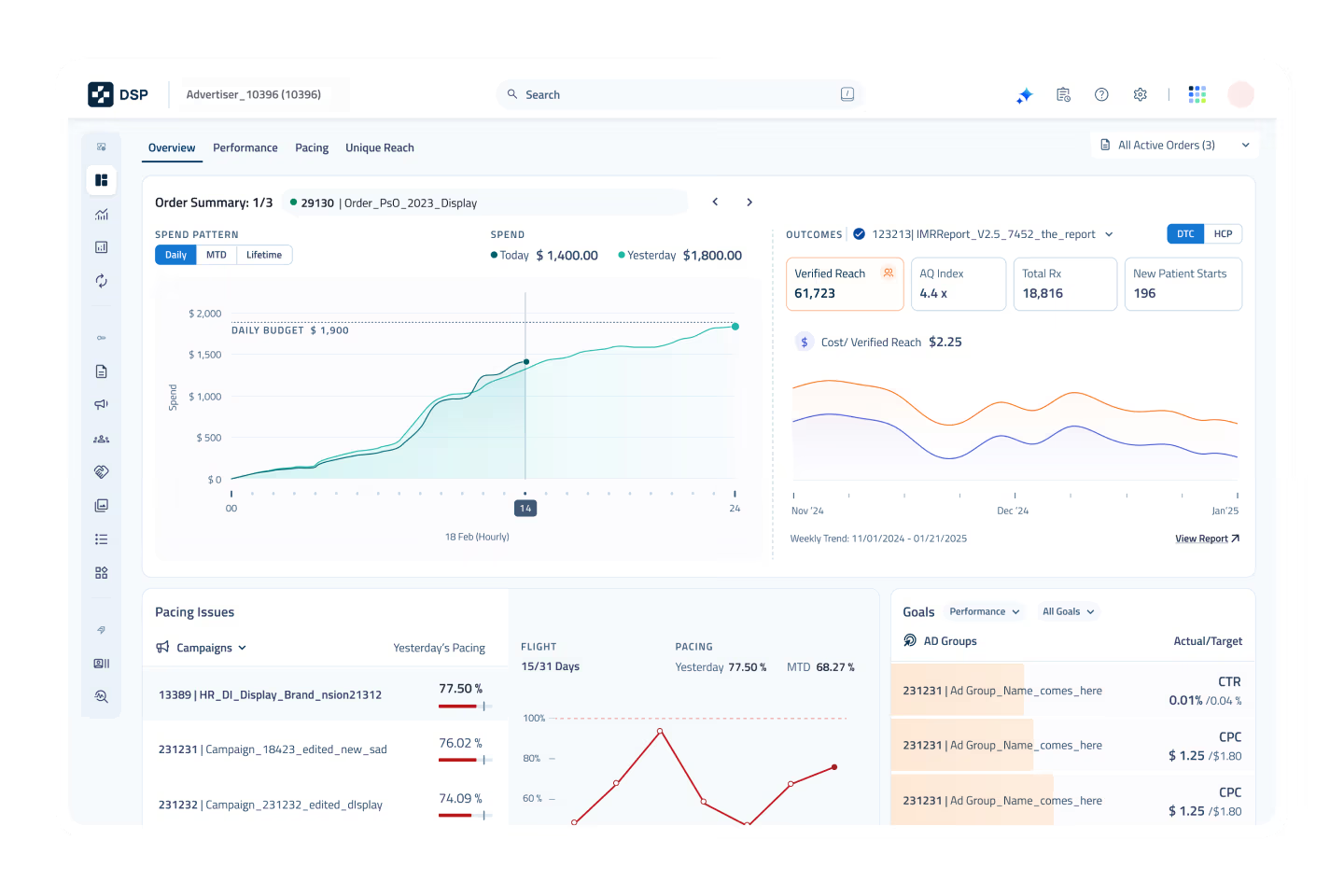
A campaign that produces an impressive post-flight report has already spent its entire budget by the time anyone reads it. Daily-refreshed clinical signals allow for shifting audience definitions, frequency caps, and targeting parameters while the campaign is still running, so performance compounds across the flight instead of only becoming visible after it ends.
How AI Is Changing the Way Pharmaceutical Marketers Plan and Execute
AI is being applied across pharma marketing to audience prediction, next-best-action optimization for HCP engagement, and pre-launch planning for new brands. The market for AI in pharma is projected to grow from $1.97 billion in 2025 to more than $21 billion by 2035, a scale of investment that reflects how central these tools are becoming to campaign strategy.
What separates healthcare-specific AI from general-purpose AI tools is the data it's trained and applied on. General-purpose models don't have access to claims data, prescribing behavior, or NPI-level clinical signals, and they aren't built with HIPAA compliance as a foundational constraint. Healthcare-specific AI applications are, which is what makes their audience predictions and optimization recommendations usable in a regulated, clinically grounded campaign rather than just directionally interesting.
How DeepIntent Helps Pharmaceutical Brands Execute These Strategies
Every strategy above depends on the same underlying requirement: clinical data that's accurate, current, and connected across HCP and patient audiences. That's the problem DeepIntent is built to solve.
DeepIntent combines IQVIA-powered clinical audiences with NPI-level HCP targeting across more than 1.6 million verified healthcare providers, so campaigns are built on prescribing behavior and patient panel data rather than static specialty labels. Omnichannel activation spans CTV, EHR, DOOH, and audio, giving brands the channel mix HCPs and patients actually use today rather than a legacy media plan. Daily clinical measurement replaces post-flight reporting with real-time signal on script lift and verified reach, and HIPAA-compliant infrastructure is built into the platform rather than added on before launch.
Before any of that media planning starts, though, it helps to get the fundamentals right: coming up with a marketing strategy that reflects how the pharma industry actually works is the foundation everything else in this article builds on.
Ready to see how clinically grounded audiences and daily measurement change campaign performance? Get a demo of DeepIntent.