Generative AI is becoming a familiar part of pharma marketing. Brand teams and agencies use it to draft content, explore creative concepts, and make existing materials easier to adapt.
The benefits are visible in everyday work. A brief comes together sooner. A team can consider more messaging options. An approved source document becomes the starting point for several channel-specific drafts.
But faster production leaves important commercial questions unanswered. Which HCPs are actively treating the patients a therapy is designed to help? Where should a campaign focus its investment? Are the people seeing its ads clinically relevant, and is that exposure contributing to treatment activity?
The opportunity for generative AI in pharma marketing extends into those decisions. This article covers familiar use cases, their practical limits, and what becomes possible when conversational AI connects to governed healthcare data and campaign infrastructure.
Generative AI Use Cases in Pharma Marketing You Might Already Know
Generative AI produces new text, images, and other outputs from instructions and source material. Its applications span the work of brand teams, agencies, insights professionals, and field organizations.
The value depends on the task. An exploratory concept can tolerate ambiguity. A clinical statement needs substantiation and review. Understanding that distinction helps teams put the technology to work appropriately.
Creative Briefs and First-Mile Campaign Concepts
Generative AI can help a brand team turn a strategic objective into an initial creative brief. Given an approved product profile, audience description, and competitive context, it can propose messaging territories, positioning angles, and questions for concept research.
Teams can also explore rough visual directions before committing to a full production process. That makes it easier to compare alternatives and give an agency a clearer starting point.
ZS has documented pharma marketers' experimentation with AI-assisted briefs and early creative concepts, including interest in bringing some initial ideation in-house. These are emerging approaches, rather than evidence that every organization has already compressed concept development into days.
HCP Content Personalization by Specialty and Channel
Different physicians may need different framing for the same product information. A specialist might want detailed evidence for a particular patient population, while a primary care physician may need a concise explanation of where the therapy fits in care.
Generative AI can draft those variations from approved source material and adapt them for an email, website, or field conversation.
The inputs determine the quality of the personalization. Specialty information provides one layer of context. Verified prescribing and patient-population data can provide another. A model cannot establish those facts from a physician's name alone.
The result is a more manageable way to develop relevant content across HCP segments, subject to the brand's review process.
Patient Education and DTC Materials
Generative AI can turn technical clinical language into more accessible first drafts for condition awareness, treatment explainers, and adherence-support materials. It can also adapt a source asset for different reading levels and formats.
For example, a team could create a short social post, a longer website explanation, and a printable discussion guide from the same approved educational content.
Simplification requires care. Removing qualifications can change a statement's meaning, while a reassuring tone can unintentionally understate risk. Patient-facing materials need appropriate clinical review, and promotional content must meet the applicable requirements for truthful and balanced communication.
Modular Content Assembly
Modular content systems organize approved claims, images, disclosures, and other components for reuse. AI can help select and assemble eligible modules into channel-specific assets.
A team might build several email variations using a common efficacy statement, different approved introductions, and the required safety information.
This approach reduces repeated drafting and supports more consistent messaging. Veeva describes modular content as pre-approved components accompanied by business rules governing their use.
Those rules matter. Approval of individual components does not automatically approve every possible combination. The finished asset's context, layout, and balance still need to follow the organization's review requirements.
MLR Pre-Screening and Review Acceleration
AI can help improve a submission before it reaches medical, legal, and regulatory reviewers.
Connected to approved claims libraries and relevant standards, a system can flag potential claim deviations, missing required information, broken references, or inconsistencies between assets. Reviewers can then focus more attention on the judgments that require their expertise.
Veeva's work on AI-supported MLR describes pre-review checks for editorial, brand, and market requirements, alongside claims management and more structured review processes. It also emphasizes continued human oversight.
The practical benefit is less avoidable rework. AI flags possible issues; qualified reviewers determine whether the material is accurate and appropriate.
Image Generation and Visual Concepting
Image generation gives teams another way to explore a campaign's visual direction. A creative team can compare settings, compositions, and illustration styles before commissioning final work.
That can make internal discussion and concept testing more concrete. ZS reports that pharma marketers have experimented with image generation as part of early campaign development.
Concept imagery and production assets have different requirements. Final use calls for review of rights, brand standards, representation, and clinical accuracy. Condition-specific visuals also need scrutiny: a plausible-looking image can still misrepresent symptoms, anatomy, or a treatment experience.
Localization and Regional Market Adaptation
Global teams can use AI to produce initial translations and propose ways to adapt campaign materials for a regional audience.
Local teams then refine terminology, cultural references, and reading level. They also verify that the content reflects the local product label and applicable promotional requirements.
This can reduce the work needed to create a first localized draft across multiple markets. It does not remove the need for local expertise. Even an accurate translation may require different claims, disclosures, or presentation in another regulatory environment.
The strongest workflow keeps source content and local revisions traceable, so teams can identify what changed and why.
Sales Rep Enablement and Call Preparation
Generative AI can summarize relevant HCP information before a field interaction. With authorized access to CRM records and appropriate clinical datasets, it can bring together engagement history, prescribing context, and previous discussion topics.
Salesforce's life sciences tools, for example, describe AI-supported provider summaries and pre-visit planning based on HCP profiles and prior activity.
AI can also suggest talking points or help identify approved follow-up materials. The rep reviews the summary and decides how to use it.
The benefit is more preparation time spent considering the conversation, with less time spent searching across records.
Competitive Intelligence and Market Landscape Analysis
Generative AI can help teams make use of information scattered across conference summaries, competitor materials, qualitative research, and internal reports.
A brand team might compare competitors' published positioning, summarize new evidence presented at a congress, or look for recurring access questions in appropriately governed call-center transcripts.
ZS describes organizations exploring conversational insight tools and using generative AI to analyze patient and provider call-center information.
This moves AI into strategic support. The output still needs sources and dates, with reported facts distinguished from interpretations. A convincing synthesis is useful only when the underlying evidence supports it.
Synthetic Audiences and Message Testing
Synthetic audiences use AI-generated representations of HCP or patient segments to explore how messaging might be received. Teams can present alternative concepts to simulated respondents and look for possible confusion, objections, or missing context.
Their usefulness varies with how they are built. A prompted persona can support brainstorming. A research-based simulation trained and validated for a particular market can support more structured testing. ZS makes this distinction in its work on AI-enabled market research.
Synthetic feedback should not be treated as observed customer behavior. Teams need to validate the method against real research, understand its limits, and account for populations it may represent poorly before using it to guide major investments.
The Next Frontier: AI Applied to Healthcare Data, Activation, and Measurement
Content is only one part of campaign performance. Even a strong, approved message needs a relevant audience, an effective media strategy, and a way to assess its contribution.
Generative AI can make those decisions easier to explore when it connects to specialized healthcare systems. In that workflow, the language model interprets a request and communicates results, while underlying data, identity, and measurement technologies perform the healthcare-specific work.
Audience Intelligence Powered by Real-World Health Data
Governed claims, prescription, and other available clinical datasets allow marketers to investigate recorded healthcare activity.
A planner can ask which specialties treat a relevant patient population, where prescribing activity is concentrated, or how an existing HCP target list overlaps with treatment behavior.
The advantage is faster access to evidence that would otherwise require a separate analytics request. Refreshed data can also support audience updates as the market changes.
Clinical datasets still have coverage limits and reporting delays. A useful answer needs a defined population, time period, and explanation of what the available records can establish.
Bridging HCP and Patient Intelligence in a Single View
HCP and patient campaigns address connected parts of a treatment journey. Planning them separately can leave teams with different assumptions about where education or engagement is most needed.
A shared intelligence environment can help planners compare patient-population trends with the behavior of providers treating those populations. That can inform coordinated disease education, HCP outreach, and media investment.
The purpose is to understand the care ecosystem through appropriately governed analysis. Aggregate patterns can reveal opportunities without exposing an individual's medical history to campaign users.
AI makes those relationships easier to investigate, while marketers determine how the findings should shape each audience's strategy.
From Insight to Activation Without the Handoff Gap
Campaign work often involves moving a finding from an analytics tool into an audience system, then into a buying platform, followed by a separate reporting environment.
Each handoff creates work and a chance for the original criteria to become unclear.
Integrated infrastructure can preserve the connection between the planning question, audience definition, and activation. A marketer can investigate prescribing patterns, refine a segment, review its criteria, and send the supported audience into a campaign workflow.
Helix AI supports conversational audience creation and deployment to DeepIntent Cortex DSP, as well as supported social destinations.
The benefit is continuity: the clinical reasoning behind an audience remains connected to the audience being activated.
Omnichannel Activation That Follows the Audience, Not the Channel Plan
Audience intelligence can inform where a campaign should run before channel budgets are fixed.
Teams can evaluate how relevant HCPs and patient audiences are reachable across CTV, display, EHR, endemic, and point-of-care environments, where supported. Media models can then help assess reach, frequency, cost, and performance.
This gives planners evidence for allocating investment across channels. It also helps them evaluate whether a proposed placement reaches the intended audience.
The systems involved have distinct roles. Conversational AI helps explore and explain the plan; audience and buying infrastructure determine eligibility and execute media within campaign controls.
Privacy-Compliant Infrastructure as a Competitive Advantage
Healthcare AI initiatives depend on appropriate access to the data needed for the task.
That requires permissions, privacy protections, and controls governing analysis and activation. Where protected health information is involved, applicable HIPAA requirements matter. HHS provides specific methods for de-identification; removing direct identifiers alone does not necessarily satisfy those requirements.
Infrastructure designed for regulated health data can make approved workflows easier to scale. Teams spend less time resolving access and governance questions for each new application.
A conversational interface does not replace that foundation. Its value depends on the controls and evidence behind the answers it delivers.
Measuring What Actually Matters: Script Lift Over Impressions
Impressions show delivery. Clicks show an interaction. Pharma marketers also need to assess verified audience reach, therapy adoption, and prescription activity.
Audience quality measures how effectively a campaign reaches clinically relevant people under defined criteria. Script lift estimates incremental prescription activity through the methodology used to compare exposed audiences with an appropriate baseline or control.
These measures help teams evaluate the commercial contribution of media, alongside conventional delivery metrics.
Connecting generative AI to outcomes reporting lets marketers interrogate that evidence in plain language. It does not establish causality on its own. The underlying measurement design determines which conclusions the results support.
Real-Time Optimization Using Clinical Signals
Clinical measurement becomes more useful when teams can apply it during a campaign.
Daily feedback can help identify audiences, inventory, or tactics associated with stronger AQ or prescription performance. Optimization systems can use those signals to inform bidding and allocation within the advertiser's settings.
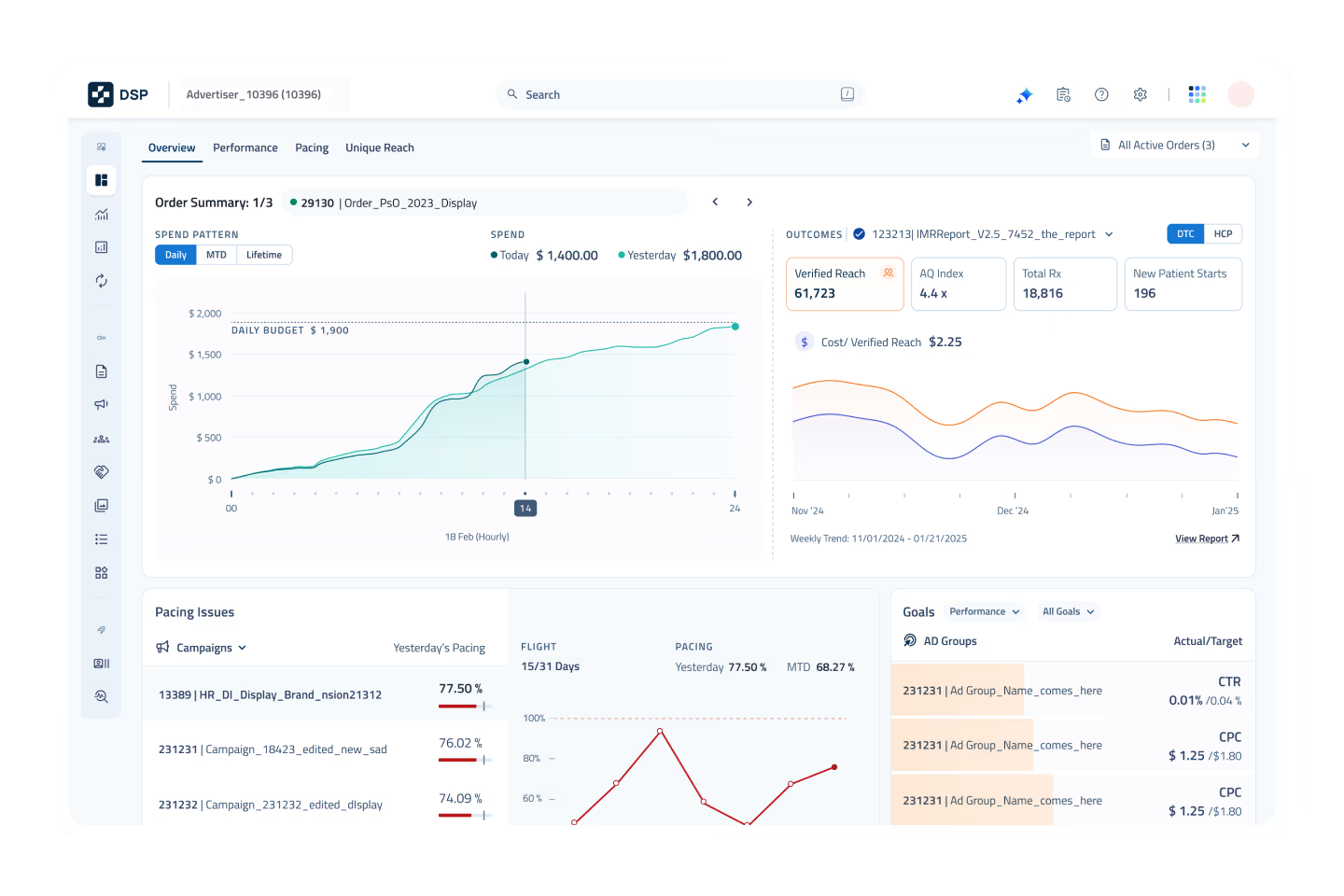
DeepIntent Outcomes provides daily AQ and script lift metrics and supports machine learning optimization toward healthcare performance.
Those updates reflect the timing and completeness of the source data. Daily reporting should not be confused with instantaneous visibility into every prescription.
Generative AI can help a trader investigate results and evaluate recommendations. Specialized optimization technology executes the media decisions supported by those signals.
Where DeepIntent Cora Fits in the Pharma Marketing Stack
DeepIntent connects the healthcare data foundation with campaign activation and measurement.
Cortex is the healthcare DSP, embedding Health Intelligence™ into media workflows. Outcomes connects impression data with real-world clinical measurement to evaluate AQ and script performance. Helix is the healthcare marketing cloud, providing governed data access and tools for analytics, audience development, and custom solutions.
DeepIntent Cora™ makes that infrastructure accessible through conversation. Marketers can query prescriber behavior, investigate competitive dynamics, build HCP and DTC audiences, and move supported audiences into activation.
The connection uses Model Context Protocol, or MCP, an open standard for linking AI applications with external tools and data sources. Governance depends on the implementation and the systems connected through it.
DeepIntent's preview announcement named ChatGPT, Claude, and Gemini. Its current Helix AI product page highlights access through the DeepIntent platform, ChatGPT, and Claude.
For pharma teams, this expands the value of conversational AI beyond content production. The same interface can help investigate the market, define an audience, and review campaign performance using healthcare-specific evidence.
Explore DeepIntent Cora to see how your team can turn healthcare intelligence into actionable audiences and campaigns measured against prescription outcomes.